Filming the Coronation of Emperor Nicholas II in 1896

PHOTO: still from the Lumiere Bros. film documenting the 1896 Coronation.
Emperor Nicholas II, Empress Alexandra Feodorova and their retinue
are seen slowly descending the Red Staircase of the Moscow Kremlin

The Russian State Archive of Film and Photo Documents RGAKFD is the world’s largest and oldest public repository of audiovisual documents. In 2019, the archive celebrated its 100th anniversary.

To date, it holds more than 45,000 titles of film documents, more than one and a half million original photographic documents from 1850 to the present: these include daguerreotypes, ferrotypes, and albums, including those belonging to the Imperial Family, and negatives on glass and film, and modern digital photographic images.

The existing collection of film documents of pre-revolutionary Russia, stored in the RGAKFD, was formed from newsreel-documentary materials requisitioned by the Soviet authorities during the nationalization of the film industry from the warehouses of film factories and film companies.

In total, the archive currently contains about 960 pre-revolutionary newsreels, including the first full-length documentary-film made in Russia – the Coronation of Emperor Nicholas II in 1896.

PHOTO: Lumiere Brothers: Auguste (1862-1954) and Louis (1864-1948)

In May 1896, French cameramen from the Lumiere Brothers (Paris) company arrived in Moscow, to film the coronation ceremony of Emperor Nicholas II. On 5th May 1896, the Moscow newspaper Новости дня [News of the Day] wrote: “among the correspondents who have arrived in the city is Camille Cerf for the coronation of Nicholas II. Sent to Moscow on behalf of Louis Lumière, he is armed with a very interesting device – a cinematograph … He will film the entire solemn procession of the route on a special moving belt, on which the pictures will, however, be so microscopic that only after enlarging them can they can be seen. But, in any case, all parts of the tuple and all of its moments will be reproduced in this way with documentary accuracy.” The coronation celebrations in the Kremlin were captured in great detail.

PHOTO: cinematographers Charles Moisson and Francis Dublier

The “Lumiere Brothers Cinematography” catalogue, released in France for the 100th anniversary of cinema, names four cameramen who filmed “The Coronation of Emperor Nicholas II” – Francis Dubliet, Camille Cerf, Charles Moisson and Alexandre Promio.

PHOTO: Belgian cinematographer Camille Cerf (1862-1936)

A copy of the film of the coronation celebrations was presented by Lumiere to Emperor Nicholas II and, apparently, met with his approval. In any case, it laid the foundation for a special kind of pre-revolutionary Russian newsreel, the so-called “Tsarist Chronicle”, which was filmed in Russia systematically from 1896 to 1917, mainly by Russian cameramen, for distribution to the growing commercial cinema network across the Russian Empire.

The Lumiere Bros. film The Coronation of Emperor Nicholas II was filmed in 35 mm, duration 1 hour 33 min. The video below shows only 1 minute and 40 seconds of it. More than a decade ago, a Ukrainian historian announced plans to restore the entire film. Sadly, he was unable to acquire funding for this important historical project.

The following is a list of the highlights of the video:

1. NDP 1.4m “Coronation of Sovereign Emperor Nicholas II Alexandrovich” May 14, 1896

2. Common. 10.1 m On the streets of Moscow, ceremonial gilded carriages, accompanied by their retinue, pass. In the first carriage sits Empress Alexandra Feodorovna, (removed from the building of the Historical Museum). Cinematographer Francis DOUBLIER . CL No. 1329.

3. Common. 4.8m Emperor Nicholas II and Empress Alexandra Feodorovna, accompanied by the courtiers, walk up the stairs of the Red Porch, down to Ivanovskaya Square to the Assumption Cathedral, (filmed from the side of the Annunciation Cathedral from the height of the roof of the temporary stands).
Operator Charles MOISSON . CL No. 1330.

4. Common. 7.8 m Emperor Nicholas II and Empress Alexandra Feodorovna leave the Archangel Cathedral, join the solemn procession and under a canopy, accompanied by the courtiers, walk towards the porch of the Annunciation Cathedral. Cinematographer Francis DOUBLIER . CL No. 1331.

5. Wed 9.2 m The solemn procession goes towards the Annunciation Cathedral.
Cinematographer Francis DOUBLIER . CL No. 1331.

6. Common. 6.6m Representatives of various nationalities are passing by.
Operator Charles MOISSON . CL No. 1328.

7. Common. 5.1 m A carriage drives up to the porch of the house, dignitaries sit in it.
Operator Charles MOISSON . CL No. 1325.

8. Common. 2.9m The dignitaries sit in the carriage.
Operator Charles MOISSON . CL No. 1326.

***

PHOTO: Ernest Louis, Grand Duke of Hesse (seated center) with members
of the Hessian delegation, who attended Nicholas II’s Coronation in May 1896

The Empress’s brother, Ernest Louis, Grand Duke of Hesse (1868-1937), who was present at the coronation ceremony, provides a vivid description of the event:

“The coronation in Moscow on May 26, 1896 was the most splendid ceremony I have ever seen. It was almost eastern in style and lasted 10 days. In Moscow, the cathedral was full of images of saints on a gold background, and all the priests were wore golden vestments, decorated with embroidery and precious stones. In all the ceremonies, there was a deep mystical meaning and Byzantine traditions. The Anointed Emperor and Empress became God’s Anointed ones. The emperor, like a priest, receives communion at the altar. After that, in front of the throne, he takes off the crown from his head, kneels down and prays aloud with a wonderful prayer for his people. Then they say a prayer for the emperor, and he rises, and at that moment he is the only non-kneeling person in the entire Russian Empire. The procession of people entering and leaving the cathedral passes along the elevation, which is at the level of the heads, standing around, so you can see everyone who takes part in the ceremony. The procession seems to consist only of people in full dress, everything glitters in gold and silver, the emperor and empress in gold and ermine robes stand under a huge canopy, all the grand duchesses are strewn with jewels. Everything happens as in a magical dream, because everything is illuminated by the bright radiance of the sun.”

© Paul Gilbert. 16 March 2021

Putin’s negative assessment of Nicholas II

Putin’s attitude to Nicholas II

During his presidency, Vladimir Putin has spoken negatively about Nicholas II on more than one occasion, describing his role as a ruler “erroneous” and “absurd”. Putin believes that Nicholas II ruled the country incorrectly, made many mistakes, which is why Russia lost the Russo-Japanese War (1904-05) and later lead Russia unprepared into the First World War. Putin further believes that during the war, Nicholas II personally made a number of errors of judgment and policy, which forced his highest ranking military officers to seek his removal from the throne by forcing the Tsar to abdicate. The main conspirators were mainly military leaders and self-serving politicians of the Duma.

Vladimir Putin has also publicly referred to Russia’s last tsar as “Bloody Nicholas” on more than one occasion. His negative attitude towards Nicholas II, however, does not reflect his assessment of other Russian monarchs, including the Emperors Peter I, Nicholas I, Alexander II, and Alexander III.

“Nicholas the Bloody”

A video has been circulating on YouTube for some years now, in which Putin is caught on camera making an insult towards Nicholas II. Entering his Kremlin office (probably on the day of his first inauguration on 7th May 2000), Putin responds to these words spoken by one of his aides: “From this roof [Grand Kremlin Palace], Nicholas II looked out over Moscow.”

“Well, he had nothing to do, so he ran across the roofs,” Russia’s new President remarked contemptuously.

During a meeting with members of construction teams in Sochi in the summer of 2011, Putin referred to the Tsar as “Nicholas the Bloody”. This epithet runs counter to both the position of the Russian Orthodox Church, which canonized Nicholas II on 20th August 2000, and with the ideology of the Russian authorities during the past 20 years.

Then, on 4th March 2014, during a press conference in Novo-Ogaryov on the events in Ukraine and the annexation of Crimea, Vladimir Putin once again, used the Soviet propaganda epithet “Nicholas the Bloody”. He was responding to a question by a journalist of the Interfax news agency, Putin said the following: “A simple Ukrainian citizen, a Ukrainian man suffered both under Nicholas the Bloody and under [Leonid] Kravchuk …”.

Then again, on 15th March 2014, the day marking the anniversary of the bloody February coup of 1917, in which Emperor Nicholas II  was forcibly removed from the throne, and who accepted a martyr’s crown on 17th July 1918, Putin during a press conference boorishly insulted the popularly revered Tsar-Martyr, referring to him as “Nicholas the Bloody”.

PHOTO: The inauguration of Russian President Vladimir Putin is held in the Andreevsky Hall of the Grand Kremlin Palace in Moscow. The thrones of Emperor Nicholas II, Empresses Alexandra Feodorovna and Maria Feodorovna, can be seen in the background.

Why is Putin negative about Nicholas II?

Vladimir Putin probably has a negative attitude towards Nicholas II, because he grew up in Soviet times, where, in principle, Nicholas II was presented as an unambiguously negative character, who refused to progress and generally failed any undertakings. It was during the Soviet years, that Russia’s last tsar was more often than not, referred to as “Bloody Nicholas” – old habits die hard.

During the Stalin era, documents and photographs which depicted the last tsar were seized and destroyed, as they were deemed as “ideologically harmful”. It was Joseph Stalin who ordered the Romanov archives closed and sealed. They were even off limits to historians, unless for propaganda purposes. Up until the fall of the Soviet Union in 1991, these private documents and photographs effectively lay untouched.

Russian historian Pyotr Multatuli notes: “Stalin forbade any mentioning of the hideous crime in Ekaterinburg, because he was well aware that it was working against his regime.

“Stalin, too, was building his empire, but it was an empire that did not have anything in common with the Russian Empire. Stalin’s empire did not pursue the interests of the Russian people. What was the nature of the Russian monarchy? There was God, the Tsar as the father of the people, and the people were his children, whom he loved, but whom he could also punish.”

Perhaps the key to unravelling Putin’s negative attitude towards Nicholas II lies in his words, spoken during a press conference on 22nd December 2010, when Putin served as Prime Minister of Russia under President Dmitry Medvedev:

“And, frankly speaking, he was not an important politician. Otherwise, the empire would have survived. Although this is not only his fault.”

Putin believes, that Nicholas II, as an autocrat, bears the main responsibility for what happened during his 22+ year reign, which resulted in the collapse of both the monarchy and the Russian Empire.

Putin is the only top Russian official who speaks out negatively against Nicholas II. The rest of the top officials, for example Prime Minister Dmitry Medvedev, and Russia’s former Minister of Culture Vladimir Medinsky, have both only spoken positively about the last Tsar.

PHOTO: President Vladimir Putin posing in front of a portrait of Nicholas II, in the Museum of His Majesty’s Lifeguards Cossack Regiment in Courbevoie, France in 2008.

The Russian clergy evaluate Putin’s epithet

Putin’s criticisms of Nicholas II have offended both Orthodox Christians and monarchists over the years, however, Archpriest Valery Rozhnov of the Russian Orthodox Church Outside Russia (ROCOR), issued the following statement dated 7th March 2014:

“Since the words of the president in Russian political culture are often perceived as political truth, the phrase about the “Nicholas the Bloody” can have far-reaching consequences.

“As you know, the epithet was part of Soviet propaganda, which was based on many human lives during the reign of the last Russian emperor. However, after the collapse of the USSR, the rhetoric changed, and Nicholas II began to be presented as a victim of circumstances and a tragic figure. It was only when the Russian Orthodox Church canonized the tsar as a saint, that the authorities began to reassess Nicholas II. President Boris Yeltsin, for example, even participated in the burial of the tsar’s remains in the Peter and Paul Cathedral [17th July 1998].

“Through Putin’s words, Soviet rhetoric once again returned to official discourse. This can have serious consequences both for the Russian Orthodox Church and for Ekaterinburg, where Nicholas II became a figure of meaning. Ekaterinburg as a place of the execution of the royal family and a place of repentance for this crime has become a center of pilgrimage and tourism. There is a monument to the imperial family in the city; a church and a monastery were built in their honour. If Nicholas II is again declared “Bloody” and not saint, then this entire industry may be called into question.

“Whether the phrase dropped by Putin is yet another sign of the return of Soviet propaganda clichés, or is this just his personal opinion, which does not claim any ideological status, the position will become clear in the future. In particular, the rhetoric of Russian officials in relation to Nicholas II and tsarist Russia in general will be of particular interest, especially given the century since the beginning of the First World War.”

PHOTO: In 2016, Putin visited an exhibition dedicated to the 150th anniversary of the artist Valentin Serov, held at the State Tretyakov Gallery in Moscow. He was photographed admiring Serov’s iconic portrait of Emperor Nicholas II (1900).

Putin denounces Lenin for murder of Nicholas II

Since Putin’s rise to power, the head of the Russian Orthodox Church has proclaimed the last tsar, his wife and children, as saints, which was viewed with fear in a country where the Imperial family are still victims of a century of myths and lies, much of which are based on Bolshevik propaganda. In addition to canonization, the Church also decided to build a grand church on the site where the family was murdered in Ekaterinburg on 17th July 1918. In 2003, during a visit to the Urals, President Putin visited the Church on the Blood in Ekaterinburg.

Despite the negative comments made by Putin, he has also made a number of positive gestures regarding Nicholas II, which left many people surprised. During a state visit to France in 2008, Putin visited the Museum of His Majesty’s Lifeguards Cossack Regiment in Courbevoie, where he posed in front of a portrait of the tsar.

On 25th January 2016, while speaking at an inter-regional forum of the All-Russia People’s Front, Vladimir Putin denounced Bolshevik leader Vladimir Lenin, for “brutally executing Russia’s last Tsar along with all his family and servants”. Putin further criticized Lenin, accusing him of placing a “time bomb” under the state, and sharply denouncing brutal repressions by the Bolshevik government, murdering thousands of priests and innocent civilians.

In the weeks leasing up to the 100th anniversary of the death and martyrdom of Nicholas II, rumours in the Russian media speculated that Putin would attend the Patriarchal Liturgy, to be performed by His Holiness Patriarch Kirill on the night of 16/17 July 2018. Sadly, this was not to be, instead, he flew to Helsinki, where he met with US president Donald Trump. More than 100,000 people from across Russia and around the world descended on the Ural capital to honour the memory of the Holy Royal Martyrs.

Putin’s presence on the eve of the centenary, would have indeed been an historic event, one which perhaps would further seal post-Soviet Russia’s condemnation of the Bolsheviks for committing regicide, but also shedding the century of myths and lies, which perpetuated during the Soviet years.

Sadly, the 100th anniversary of the Romanovs’ deaths passed with little notice in Russia. The Russian government ignored the anniversary, as it surprisingly did the year before, when Russia marked the 100th anniversary of the 1917 October Revolution. No prominent state museums or venues hosted events to mark the anniversary. The few exhibitions and other events organized were tellingly modest.

PHOTO: On 17th July 2019, members of the State Duma for the first time observed a minute of silence in memory of the last Russian emperor Nicholas II, and all those killed in the Civil War (1917-1922)

On a more positive note, on 17th July 2019 – Russia’s State Duma for the first time observed a minute of silence in memory of the last Russian emperor Nicholas II and all those killed in the Civil War. (1917-1922)

According to Duma Speaker Vyacheslav Volodin, “reconciliation begins when we all understand that this cannot be repeated and this is unacceptable.”

“Today we are making a proposal to honour the memory of the last Russian tsar, to honour the memory of the innocent victims – all those who died in the crucible of the Civil War,” the speaker addressed his colleagues, who after these words, rose from their seats.

It should come as no surprise that members of the Communist Party of the Russian Federation, did not comply with the moment of silence.

The fact that this is the first time in the history of Russia’s State Duma, that they honoured the memory of Nicholas II is truly unprecedented! The minute of silence was repeated in 2020 and will be repeated each year from hereon.

Also, in 2019, in an unprecedented move, the Russian media reported that President Putin had urged the Russian Orthodox Church to “reach a verdict soon” on the Ekaterinburg Remains.  

PHOTO: portraits of Nicholas II and Vladimir Putin, by the contemporary Georgian artist David Datuna

© Paul Gilbert. 15 March 2021

SOVEREIGN: The Life and Reign of Emperor Nicholas II

There are few monarchs in history about whom opinion has been more divided than the last emperor and tsar of Russia Nicholas II.

Myths about the “weak-willed”, “stupid”, “bloody” tsar, created on the basis of gossip, slanderous fabrications and Bolshevik propaganda in the early twentieth century, remain deeply rooted in the minds of both Westerners and the Russian people even to this day. Modern-day historians and biographers prefer to focus on Nicholas II’s failures, and seldom reflect on the many accomplishments he made during his reign. It was these very myths and lies, which compelled me to launch SOVEREIGN in 2015.

The articles featured in SOVEREIGN are not a rehash of everything which has been written about his life and reign over the past century. There are no conspiracy theories, nor does SOVEREIGN attempt to sweep history under the rug, or whitewash Russia’s last emperor and tsar.

Instead, SOVEREIGN features many first English language works by Russian historians and experts, based on new archival documents discovered since the fall of the Soviet Union in 1991.

Thanks to this new generation of post-Soviet historians, we can now review the life and reign of Russia’s last emperor and tsar through the research of Russian historians – their time has come! In their works, they successfully challenge and put to rest many of the lies and myths presented over the past century by their Western counterparts.

SOVEREIGN was launched in 2015, and has published a total of eleven issues. 

FREE SHIPPING when you buy ALL eleven issues
NOTE: This offer is valid on CANADA and US orders ONLY!
PRICE: $275.00 USD. PAY by CREDIT CARD or PAYPAL
*Payment can also be made by personal check or money order

Earlier this year, I announced that after 26 years, I would be retiring from publishing. I am now pleased to present the following SPECIAL OFFER on a complete set – 11 issues – of this unique publication.

Each issue features first English translations of articles, researched by Russian historians and experts, based on NEW documents from archival sources. The price of each issue is $25 + postage, so the savings on postage are substantial.

NOTE: I have a limited number of copies of issues No. 1, 7 and 9 left in stock, therefore, if you want to add a complete set of this publication to your personal library, this may be your last chance!

© Paul Gilbert. 14 March 2021

Museum of Emperor Nicholas II re-opens in Moscow

PHOTO: Konstantin Malofeev views the exhibits in the Museum of Emperor Nicholas II

On 16th February, I reported on my Facebook page, that the Museum of Emperor Nicholas II, situated in the center of Moscow, was closing. The little known was forced to close due to the COVID-19 pandemic, and almost 9 million rubles (more than $13,000 USD) in arrears of rent.

The museum – which was established in April 2018 – showcases the private collection of Alexander Vasilyevich Renzhin, who has amassed more than 3,000 authentic and memorial exhibits over the past 35 years, all of which belonged to Emperor Nicholas II and his family. It is indeed a unique and rate collection!

The Museum of Emperor Nicholas II was forced to close its doors permanently at the end of February.

PHOTO: multi-collared saucers and cups presented during the Coronation of Nicholas II

PHOTO: sailor’s suit worn by Tsesarevich Alexei Nikolaevich

PHOTO: album with watercolours painted by Grand Duchess Anastasia Nikolaevna

Konstantin Malofeev, the founder of the Tsargrad TV channel, came to the rescue by providing Renzhin’s rare collection with a new venue in which to display his collection. The Museum of Emperor Nicholas II re-opened in the Museum of Russian Art, the former manor house of Nikolai Eremeevich Struisky (1749-1796) – situated in Moscow’s historical district – on 10th February 2021.

The museum showcases more than 3,000 rare exhibits, including a pearl tablecloth from the table of Nicholas II, multi-collared saucers and cups that were presented on the Khodynkha Field during the Coronation of Emperor Nicholas II in May 1896, a sailor’s suit worn by Tsesarevich Alexei Nikolaevich, an album with watercolour drawings, painted by Grand Duchess Anastasia Nikolaevna. Other items include a scarf embroidered by the Empress Alexandra Feodorovna herself, desk writing instruments belonging to Tsesarevich Alexei , and numerous personal belongings of Emperor Nicholas II – to name just a few!

“All items belonging to the Tsar’s family were carefully preserved by people” – said Konstantin Malofeev – “this shows the true popular reverence and love for the Tsar, even when he was under the absolute prohibition of godless power.”

FURTHER READING

Emperor Nicholas II Foundation marks 4th anniversary + PHOTOS

Video tour of the Museum of Emperor Nicholas II in Moscow + VIDEO and PHOTOS

© Paul Gilbert. 10 March 2021

Furniture recreated for the Corner Reception Room in the Alexander Palace

PHOTO: Colour autochrome of the Corner Reception Room, taken in 1917

The restoration of the gilded furniture set (armchairs, chairs and sofas), which will decorate the Corner Reception Room of Empress Alexandra Feodorovna in the Alexander Palace has been completed.

The Corner Reception Room was originally connected to the Concert Hall by a door located along its central wall. In 1895, a fundamental restructuring of the eastern wing of the palace began, whereby the private apartments for Nicholas II and his family would be created. In 1902–1904, when the Maple Drawing Room and the New Study of Nicholas II were created on the site, the Corner Reception Room was connected to the corridor, becoming part of the personal imperial apartments, but at the same time retained its ceremonial function.

PHOTO: recreated chairs, armchairs and sofas for the Corner Reception Room

The furniture of the Corner Reception Room was almost completely lost during the Great Patriotic War (1941-45). For the new recreated interior set, the selected items were made in the classic style, since most of the gilded furniture that adorned this interior at the beginning of the 20th century – until 1941 – was executed in this style.

The set was restored by specialists from the Tsarskoye Selo Amber Workshop. The restored gilded chairs and armchairs with oval backs and seats were made in the 1770s. Before World War II, these items decorated interiors of the Catherine Palace, in the foyer of the Chinese Theater (in the Alexander Park) and in the White Hall of Gatchina Palace. Two sofas from the second half of the 19th century, also included in the furniture set, were transferred to the Tsarskoye Selo State Museum from the State Hermitage in 1959.

PHOTO: original upholstery sample for the furniture in the Corner Reception Room

In the process of restoration, the craftsmen removed all types of dirt, restored the gesso and gilding, recreated the lost carved details with the subsequent summing up of gesso, diverging and gilding, and upholstery works. In the seat cushion of one of the sofas, the craftsmen found fragments of the original  horsehair, used to fill it. Due to the fact that one of the fragments clearly reads the date – 1865, as well as the fact that the sofa was upholstered once, the object can be dated to that year.

The chairs, armchairs and sofas share the same stylistic unity, as well as the upholstery fabric. In the an old 1917 brochure which describes the Alexander Palace, the furniture of the Corner Reception Room is described: “Furniture of the Louis XVI style of the Russian slave. late 18th century, re-gilded and upholstered in silk. the work of the Sapozhnikov factory in Moscow. / In the style of striped fabrics of the era of Louis XVI.” A fragment of the original upholstery fabric for the furniture of the Corner Reception Room, made in 1903, which had been preserved in the collection of the Tsarskoye Selo State Museum, served as a model for recreating the upholstery fabric of the restored items. A pattern of alternating light stripes and stripes of various shades of pink with small ornaments of roses, flower garlands and wavy lines is clearly visible on the silk fabric.

PHOTO: recreated chairs, armchairs and sofas for the Corner Reception Room

NOTE: all photos © Tsarskoye Selo State Museum-Reserve

© Paul Gilbert. 3 March 2021

***

Fifteen interiors situated in the eastern wing of the palace, are now scheduled to open to visitors in 2021. Among the recreated interiors are the New Study of Nicholas II, Moorish Bathroom of Nicholas II, Working Study of Nicholas II, Reception Room of Nicholas II, Pallisander (Rosewood) Living Room, Mauve (Lilac) Boudoir, Maple Drawing Room, Alexandra’s Corner Reception Room, the Imperial Bedroom, among others.

In the future, the Alexander Palace will become a memorial museum of the Romanov family – from Catherine the Great to Nicholas II, showcasing the private, domestic life of the Russian monarchs who used the palace as an official residence. The eastern wing of the palace will be known as the Museum of the Russian Imperial Family. The multi-museum complex, which includes the Western wing is scheduled for completion no earlier than 2024.

***

Dear Reader: If you enjoy my articles on the history and restoration of the Alexander Palace, then please help support my research by making a donation in US or Canadian dollars to my project The Truth About Nicholas II – please note that donations can be made by GoFundMePayPal, credit cardpersonal check or money order. The net proceeds help fund my work, including research, translations, etc. Thank you for your consideration – PG

Elena Tretyakova’s gift to Nicholas II in 1911

PHOTO: Elena Andreevna Tretyakova. Paris, 1875. 

In 1911, the famous Russian collector and philanthropist Elena Andreevna Tretyakova (1846-after 1917) presented as a gift to Emperor Nicholas II: her vast collection of paintings, icons, weapons and historical documents which documented Russia’s military history from ancient times. In addition, she donated a significant amount for the construction of the Госуда́рева Ра́тная пала́та [Sovereign Military Chamber] at Tsarskoye Selo. Due to the outbreak of World War I in August 1914, the construction of the war museum was not completed. At the height of the First World War, and in anticipation of impending hard times, Elena Tretyakova wrote: “Probably, if not during my lifetime, then afterwards others will appreciate my idea and work.”

It would be another century before the Sovereign Military [aka Martial] Chamber would become a museum. The building was transferred to the Tsarskoye Selo State Museum-Preserve in 2010. Between 2011-2014. the building underwent restoration, at a cost of 292,000,000 rubles ($8 million USD). The building is now home to the ‘Russia in the Great War’ Museum, which was inaugurated on 4th August 2014 , marking the 100th anniversary of the beginning of World War One. The museum has been visited by more than 120 thousand people.

The Sovereign Military Chamber at Tsarskoye Selo is the first museum in Russia dedicated entirely to Russia’s participation in the First World War. The history of the museum has its roots in the era of Nicholas II. Today, the museum is a rich repository of military uniforms, weapons, and items used in military life, as well as photographs and documents.

PHOTO: portraits of Elena Tretyakova and Nicholas II in the Sovereign Military Chamber

This year marks the 175th anniversary of the birth of Elena Andreevna Tretyakova (1846-after 1917). 

She was born on 26th February (O.S. 14th) February 1846 in Moscow in the family of the hereditary honorary merchant Andrei Matveyev. In 1868 she married Sergei Mikhailovich Tretyakov (1834-1892), brother of the founder of the Tretyakov Gallery in Moscow, Pavel Mikhailovich Tretyakov (1832-1898).

According to her contemporaries, Elena was “educated, and distinguished by her natural beauty, with beautiful curved shoulders, a pale, slightly puffy face, a heavy plait of hair on the back of her head and tiny hands, which she was very proud”. She dressed very luxuriously, ordered dresses from Paris and rented a large summer dacha in Peterhof for the summer. Her neighbour at Peterhof was the Russian pianist, conductor, and composer. Nikolai Grigoryevich Rubinstein (1835-1881), with whom she was in love (he died in her arms in 1881 in Paris). Every day she received guests at her home, where an exquisite choir of gypsies sang, which was then in great fashion. The Tretyakovs’ marriage was childless. After the death of her husband she lived in St. Petersburg. Elena Andreevna Tretyakova died after 1917, the exact date is unknown.

Elena Tretyakova’s idea came true more than a hundred years later. Today, her portrait hangs in the Sovereign Military Chamber at Tsarskoye Selo.

PHOTO: the restored Sovereign Martial Chamber at Tsarskoye Selo

© Paul Gilbert. 2 March 2021

The birth of the future Emperor Nicholas II in the Alexander Palace

PHOTO: the Blue Boudoir in the Alexander Palace, where Nicholas II was born

At 4 o’clock in the morning of 19th May (O.S. 6th May) 1868, Tsarevna Maria Feodorovna began having contractions. The future Empress Maria Feodorovna was about to give birth to her first child. Immediately, the midwife Mikhailova was summoned and instructed to rush to the nearby Catherine Palace, to inform Maria’s father-in-law Emperor Alexander II, that his grandchild’s entry into the world was imminent. The Emperor rushed to the Alexander Palace from his apartments located in the Zubov Wing of the palace, followed shortly thereafter by his wife, Empress Maria Alexandrovna.

At 12:50 p.m., Maria Feodorovna was taken into the bedroom [the Blue Boudoir, situated in the west wing of the palace – the interior has not survived], which had been specially prepared for the pending birth. Lying down on the sofa, she was surrounded by her father-in-law, Emperor Alexander II, her mother-in-law, Empress Maria Alexandrovna, and her husband, the Heir-Tsesarevich Alexander Alexandrovich [future Emperor Alexander III]. Her father-in-law and her husband kneeled on either side of the sofa, holding Maria Feodorovna’s hands when she gave birth – at 2.30 p.m. to her first child, a son – His Imperial Highness Grand Duke Nicholas Alexandrovich – the future Emperor Nicholas II.

PHOTO: Maria Feodorovna with her first son Nicholas Alexandrovich. 1868

The happy young father wrote in his diary that day: “At long last, the final minute arrived and all suffering ceased at once. God has sent us a son whom we named Nicholas. What a joy it is, it is impossible to imagine, I rushed to hug my darling wife, who at once cheered up and was terribly happy. I cried like a child, it was so pleasant and easy on my soul. I hugged dear Papa and Mama heartily.”

The happy parents decided to name their son in memory of Alexander’s brother Tsesarevich Nicholas Alexandrovich, who died from cerebro-spinal meningitis in 1865. Had he lived, he would have ascended the throne as Emperor Nicholas II.

Emperor Nicholas II was born on 19th May (O.S. 6th May) 1868, the day of St. Job of the Long Suffering.

FURTHER READING

19th December marks the name day of Nicholas II

© Paul Gilbert. 26 February 2021

Home Church of the Imperial Family in the Alexander Palace

PHOTO: the home church of the Imperial Family in the Alexander Palace in the 1930s

On 9th March (O.S. 24th February) 1897, the first liturgy was performed in the home church of the Alexander Palace. “We went to the service in the red corner living room, where the camp church was set up – it is very convenient and pleasant,” Nicholas II wrote in his diary that day.

Initially, a house church had not been built in the New Palace (as the Alexander Palace was called until 1856), Following the tragic death of his beloved daughter Grand Duchess Alexandra Nikolaevna (Adini) on 10th August (29th July) 1844, Emperor Nicholas I, ordered a small chapel (see photo below) to be organized in the western wing of the building, decorated in the Old Russian style.

Russian historian and author Igor Zimin describes the room: “there was a little door in the wall, leading to a tiny dark chapel lighted by hanging lamps, where the Empress [Alexandra Feodorovna, wife of Nicholas I] was wont to pray.”

Since the wife of Nicholas II, Alexandra Feodorovna, due to poor health, could not always attend the service in the church of the nearby Catherine Palace, the emperor decided to create a comfortable and simple house church in one of the ceremonial halls of the Alexander Palace: the Crimson Drawing Room was redesigned for these needs. The Travelling Iconostasis of Emperor Alexander I, made by Vasily Shebuev, was installed.

The Travelling Iconostasis of Emperor Alexander I was created for the emperor’s use during his travels. Very simple by imperial standards, it reflected simplicity, convenience and ease of use, and adaptable for moving from place to place. It could be quickly and easily disassembled, easily stowed in crates with all accessories and just as quickly reassembled. Nicholas II sometimes took this iconostasis with him on his travels.

PHOTO: Red and “Crimson” Drawing Rooms. Artist: Luigi Premazzi (1814-1891)
From the Collection of the State Hermitage Museum

In the photos, the iconostasis of Alexander I can be seen stretched across the center of the chapel. This screen followed the Emperor from Russia to Paris and back as part of the furnishing of Alexander’s travelling camp church. The iconostasis is now in the General Staff Building [part of the State Hermitage Museum] in St. Petersburg.
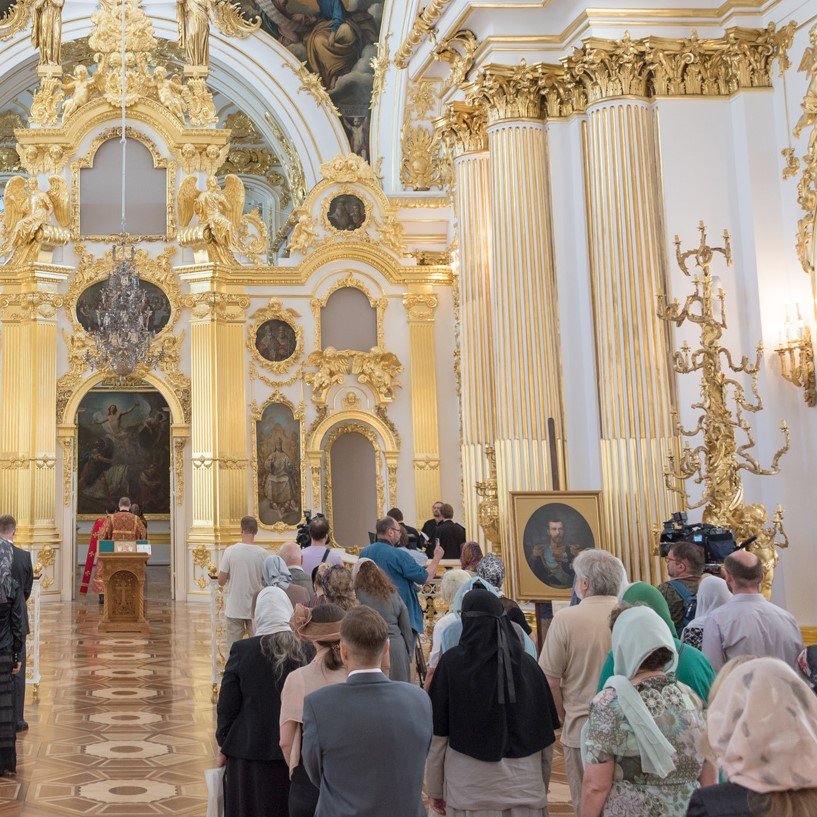
In addition, a small prayer room was installed for Empress Alexandra Feodorovna, where a lectern and a sofa were added for her convenience. The church was consecrated in honour of the Holy Prince Alexander Nevsky.

Divine liturgies were held here for more than 15 years, right up until 1913, when the Feodorovsky Sovereign Cathedral was consecrated in Tsarskoye Selo, which from then on served as the family church of Nicholas II and his family.

PHOTOS: View (above) of the Travelling Iconostasis of Emperor Alexander I. 1930s.
The iconostasis (below) is now in the General Staff Building in St. Petersburg. 1930s

On 12th August (O.S. 30th July) 1917, the last divine liturgy was held in the home church of the Alexander Palace. In his diary, Archpriest Alexander Belyaev recalled this day: “After arriving at the palace at 10 o’clock in the morning, we immediately went, under guard, straight to the church. The valet came from the former empress, bringing a small bunch of carnations and said: “Her Majesty asks that you put these flowers on the icon of the Znamensky Mother of God, which will be brought at two o’clock, into the palace church. These flowers are to remain on the icon during the moleben, and then returned to Her Majesty. She wishes to take them with her on her journey <…> The liturgy began at 11 o’clock. Somehow, I could not help but feel that this was the last Divine Liturgy to be served in the former Tsar’s dwelling . . .”,

The home church existed in the Alexander Palace for exactly 20 years. During the Great Patriotic War (1941-45), its interiors were damaged, but the iconostasis had been evacuated and after the war it was transferred to the Central repository of museum funds of suburban palaces-museums. In 1956, it was transferred to the State Hermitage Museum in Leningrad. Today, it is exhibited in the former interiors of the Ministry of Foreign Affairs of the General Staff Building, which is now a branch of the State Hermitage Museum.

PHOTO: the home church of the Imperial Family in the Alexander Palace is circled in RED

© Paul Gilbert. 26 February 2021

Nicholas II at the 1903 Ball in the Winter Palace

In February, 1903, a grand party was held in the Winter Palace in St. Petersburg, followed two days later by a grandiose fancy dress ball, whereby guests dressed in bejeweled 17th-century style costumes. The ball, timed to coincide with the 290th anniversary of the Romanov dynasty, took place at the end of the Nativity Fast. 

Nicholas II and Alexandra Feodorovna saw the ball as a first step towards the restoration of the rituals and costumes of the Moscow court, continuing the traditions bequeathed by the glorious ancestors of the Romanov dynasty of the distant pre-Petrine times.

Gathering in the Romanov Gallery on 24th (O.S. 11th) February, guests followed in pairs to the Nicholas Hall of the Winter Palace to give their hosts a “Russian bow”. The party’s central event was a concert in the Hermitage Theater with scenes from Modest Musorgsky’s opera Boris Godunov (key parts were performed by Feodor Chaliapin and Nina Figner), Minkus’ ballet La Bayadère and Tchaikovsky’s ballet Swan Lake directed by Marius Petipa (performed by the prima ballerina Anna Pavlova). The performance was followed by a Russian dance in the Pavilion Hall. Dinner was given in the Spanish, Italian and Flemish Rooms of the Hermitage. Thereupon Their Majesties and the guests proceeded to the Pavilion Hall where the party culminated in dancing.

PHOTO: Guests pose for a photograph in the Hermitage Theater

The second part of the ball took place two nights later, on 26th (O.S. 13th) February: all the guests dressed in 17th-century style costumes, made from designs by the artist Sergey Solomko, in collaboration with historical experts. Among the 390 guests, were 65 “dancing officers” – all dressed as 17th century archers or falconers – and personally appointed by the Empress . Members of the Imperial Family gathered in the Malachite Room, others in the adjacent areas. When ten o’clock struck, the guests went to the Concert Hall to dance. The court orchestra, wearing costumes of trumpet-players of Tsar Alexei Mikhailovich performed behind a gilt grating, while 34 round tables were arranged in the Nicholas Hall for dinner. The Concert Hall and Small Dining Room accommodated bars, the Malachite Room, tables with tea and wine.

When dinner was over, the August hosts and their guests returned to the Concert Hall to dance till one in the morning. After three specially prepared dances were performed (Russian dance, round dance and plyasovaya), directed by chief ballet director Aistov and Kshesinsky, waltzes, quadrilles and mazurkas were enjoyed. Young officers of Guards Regiments, Horse-guardsmen, Life-guardsmen and Lancers, acted as male partners in the dances. Participants had received some training: at the dress rehearsal held in the Pavilion Hall on 10 February, 1903, ladies wore sarafans and kokoshniks, while men sported dresses of streletses, falconers, etc. Empress Alexandra Feodorovna and Grand Duchess Elizabeth Feodorovna acted as “judges”.

Despite all the doubts, disputes and gossip, leading up to the luxurious and memorable event, the ball went wonderfully well. Impressed by the ball, Nicholas II wrote in his diary:

“The hall, filled with ancient Russian people, looked very beautiful.”

The palace commandant, Major General Vladimir Nikolaevich Voeikov noted:

“The impression was fabulous – from the mass of old national costumes, richly decorated with rare furs, magnificent diamonds, pearls and semi-precious stones, mostly in old frames. On this day, family jewels appeared in such an abundance that exceeded all expectations.”

After the balls of 11th and 13th February, 1903, the Empress commissioned the best photographers of St. Petersburg: L. Levitsky, D.M. Asikritov, D.S. Zdobnov, Yves. Voino-Oransky, F.G. Boasson, E.L. Mrozovskaya and many others, to take individual and collective photographs of the participants in their costumes. In 1904, a limited edition album containing the photographs was released, consisting of ten large-format files (folders). 21 heliogravures and 174 phototypes. The album was sold primarily among the participants of the ball, and the proceeds from the sale went to charity.

The 1903 Bal, remains the most celebrated festivity arranged in St. Petersburg during the reign of Emperor Nicholas II (1894-1917). More than a century later, it remains an event of an enduring historical significance.

Official Portraits of Nicholas II taken in the Concert Hall of the Winter Palace

PHOTO: For the background, photographers utilized a stand imitating the walls of a 17th century chamber of the Terem Palace in the Moscow Kremlin was installed in the Concert Hall of the Winter Palace – as seen in the photo above. The throne chair, is a prop, from the storeroom of the Hermitage Theater.

PHOTO: Emperor Nicholas II wearing the costume of Tsar Alexei Mikhailovich (1629-1676); the Empress Alexandra Feodorovna in the costume of his first wife Tsarina Maria Ilyinichna Miloslavskaya (1624-1669). Photo by L.S. Levitsky, 1903

***

Nicholas II’s 17th Century Costume

Emperor Nicholas II was dressed in an exact copy of the 17th century clothes, worn by his beloved ancestor, Tsar Alexei Mikhailovich (1629-1676).

The costume sketch for Nicholas II was developed by the Director of the Hermitage, Ivan Alexandrovich Vsevolozhsky (1835-1909) and the artist of the St. Petersburg Imperial Theaters, Yevgeny Petrovich Ponomarev (1852-1906). Two types of velvet and gold brocade were ordered from the Supplier of the Imperial Court – the Sapozhnikovs firm. The fancy dress for Emperor Nicholas II, called “The Small Tsar’s Attire”, was sewn by the theatrical costume designer of the Imperial Theaters Ivan Osipovich Kaffi (1860-19 ??). He was assisted by two dressmakers, whose names have not survived. The tsar’s hat was created in the hat workshop of the brothers “Bruno”, suppliers of the Imperial Court since 1872..

The 17th century-style costume worn by Emperor Nicholas II at the ball held in the 1903 Ball in the Winter Palace, has been preserved to this day in the State Armoury Museum of the Moscow Kremlin. It is on display in Room 6 of the museum, which houses a rich collection of secular and ceremonial costume. The tsar’s 1903 costume can be seen in Showcase 45 (see photo above)

His costume and shashka (hat) were made from the finest materials and design: “velvet, brocade, silk, satin, leather, sable, gilded thread braid, gold, precious stones, pearls, weaving, braiding, casting, chasing, engravings, carving and enamel.”

Opal worn by Emperor Nicholas II (left). Manufactured: Russia, 1903, cufflinks and buttons – Constantinople 2nd half of the 17th century. Materials: Damask, brocade, gold. Work: Sewing, weaving.

Kaftan worn by Emperor Nicholas II (right). Manufactured: Russia, 1903, cufflinks and buttons – Constantinople 2nd half of the 17th century. Materials: Golden velvet, silk, satin. Work: Sewing, casting, chasing.

Rod (staff) of Tsar Alexei Mikhailovich. Istanbul, mid-17th century Gold, precious stones, pearls, iron; casting, chasing, carving, enamel. Collection of the the State Armoury Museum.

Zapona-pendant of Tsar Alexei Mikhailovich. Istanbul, second half of the 17th century. Gold, precious stones; chasing, carving, enamel. Collection of the the State Armoury Museum.

***

The Costume Ball in the Winter Palace. Luxury 2-Volume Edition

In 2003 the Russian publishing company Русский Антиквариат issued a limited luxury edition printing of The Costume Ball in the Winter Palace in a handsome 2-volume set with slipcase. The publication was a joint project of the State Hermitage Museum, the Moscow Kremlin State Museum, with the participation of researchers, genealogists and descendants of relatives of the nobility who attended the historic event.

The publishing firm offered two variations of the 2-volume set. The first featured one volume in Russian, the second volume in English, however, the firm also issued 100 copies featuring both volumes in English. In 2009, I managed to acquire a number of copies of the 2-volume English edition, and sold them through my bookshop.

Volume I featuredall the documentary and research material, including preserved costumes, unique photos and archival documents, most of which are published for the first time. 128 pages, 50 black and white illustrations, 20 tables with colour images, and introductory article by the Director of the State Hermitage Museum Mikhail Piotrovsky. The cover is made from high quality dark brown leather substitute with gold lettering.

Volume II – showcases the Ball participants. 464 sepia-colour pages, 198 photos of the Ball participants. The cover is made from high quality dark green leather substitute, with gold lettering. More than half of prints made from the original photos. Each image is accompanied by a biographical article.

Sadly, the publisher of these fine books has since gone out of business. Copies of the rare all English edition set, which are highly sought after by collectors in Britain and North America, are occasionally offered through rare book auctions.

© Paul Gilbert. 21 February 2021

“The Russian Imperial House ended with the murder of Nicholas II”


Earlier this month, I announced that I was severing ties with the Russian Imperial House. My post on Facebook generated nearly 700 “LIKES” and more than 200 comments, and remains the No. 1 most widely read post on my Nicholas II blog for 2021. In addition, I received dozens of emails in support of my decision. One letter in particular stood out amongst all the rest. It came from a descendant of the Galitzine family, one of the largest noble houses of Russia. 

Dear Mr. Gilbert,

I always admired your many articles and pictures that you have shared over the years with your readers, but it was a problem for me for a long time in regard to your former stance on Princess Maria Vladimirovna. The whole Kirillichivi line committed acts of treason against the late Emperor Nicholas II from the start. Even during the reign of Emperor Nicholas II, that branch of the family was malicious and constantly fetching plots to undermine the Emperor. After the revolution, the disgraceful actions of the Kyrillichi continued. My mother’s great uncle, Prince Dimitri Galitzine Mouravline who was very close to Emperor Nicholas II, initially supported Grand Duke Kirill, but eventually broke all ties with this family line. In the European emigration, the larger half of the Russian emigrants did not support the Kirillichi. No other Grand Duke or Prince pretended to be heir to the Russian throne. They lived their lives humbly and normally.

You are absolutely correct to say that the Russian Imperial House ended with the murder of Emperor Nicholas II, and there are absolutely no eligible candidates alive today to ascend to the non-existent Russian throne. Should Russia decide to elect a new monarch, they will need to convene a new Zemsky Sobor as was done in 1613 and find a suitable candidate. Emperor Nicholas II had the authority to change the Pauline Laws of Succession, but he chose not to. Thus, to recognize these self serving nobodies as claimants to the throne is like casting a stone against the sainted Emperor Nicholas II. This is a bad farce that is being perpetuated by simple con artists, and it is so sad to say that Maria Vladimirovna was nee a Romanova.

Maria Vladimirovna never had or has any authority to give out titles or awards as she is not and never was a ruling monarch. According to the Pauline Laws, no woman could ascend to the throne in Russia. After Emperor Peter the Great, the Romanov line ended. The Holstein-Gottrop line commenced with Emperor Peter III, and annexed the Romanov name to continue the “legitimate claim” for the throne. However, due to the disputed paternal identities of who fathered who in those days, the only thing that can be ascertained for sure is that the DNA indicates a direct descendant relationship from Emperor Nicholas I to Emperor Nicholas II.

According to stories of those who witnessed the trip of Emperor Nicholas II and his family to Diveevo, the Emperor received a letter from St. Seraphim of Sarov that was written over a 100 years before the last Imperial Family’s visit. The letter foretold of the demise of Russia and of their fate. The family was very saddened and depressed after having read the letter. They lived in fear for many years prior to the revolution, but Emperor Nicholas II (regardless of his short comings or what people said of him) never left Russia or abandoned his post. He met his fate head on and died for his people. He demonstrated great strength and courage to be martyred as did his family. He was a very kind person and I know of things that he did for people near him that showed his compassion and love for them. He also viewed himself as being morally responsible for his family and relatives and as such he exiled and or punished his relatives periodically, but eventually forgave them. This was perceived to be a “weakness” for which certain family members and people mocked him. He was a fun loving, gentle soul who feared God. He did not possess a personality that would have rendered him a despot, so he stayed true to his faith while others took advantage of him.

Being Orthodox and having knowledge about the rulers of Russia, I can say that the 2 key words that best describe the last Russian monarch are “atonement” and “forgiveness”. Emperor Nicholas II believed he had a responsibility to atone to God for the sins of his people and forgive those who would bring harm to him and his people. Most people do not understand this. There could not be a better last Emperor who will remain a Russian Emperor in Eternity other than St. Emperor Nicholas II. This is not to say that he was perfect or was loved by all, or accepted as a martyr, because he like all of us, was a sinner and had many weaknesses. However, God chose him to show His favor on him. God allowed him to be martyred and that says it all.

People are delusional and short-sighted. This is the sad case of Maria Vladimirovna. May God have mercy on her! All must be done for the Glory of God, not for self-serving purposes. Her actions reveal who she really is. Congratulations to you on seeing the Truth.

For privacy reasons, I have withheld the writer’s name – PG

© Paul Gilbert. 17 February 2021