Historic chandeliers installed in the Alexander Palace

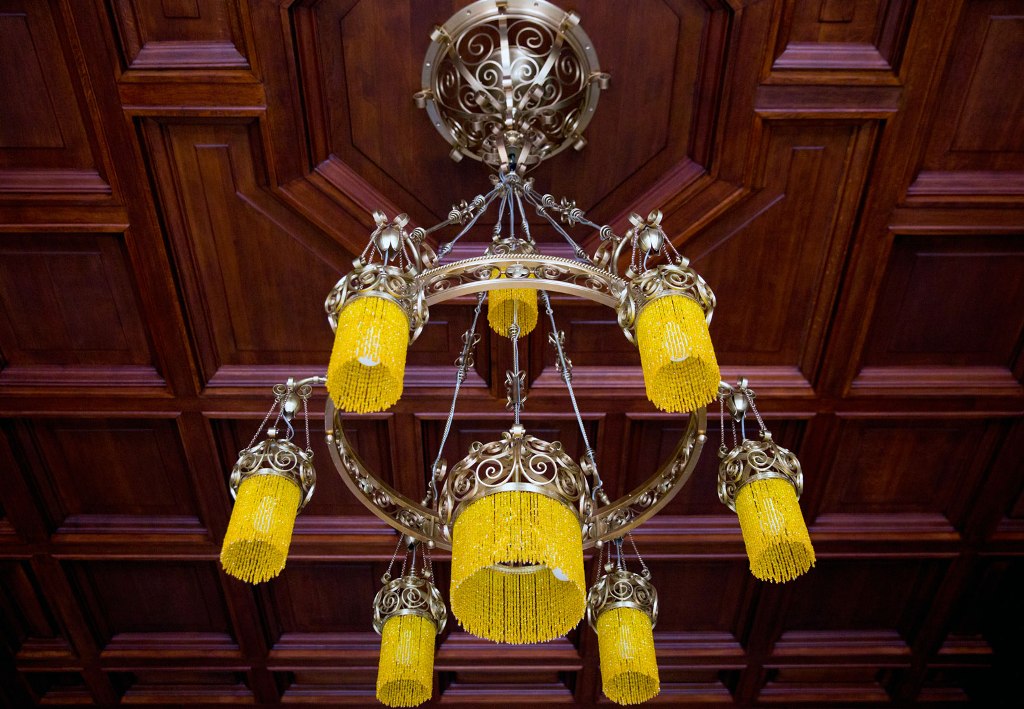
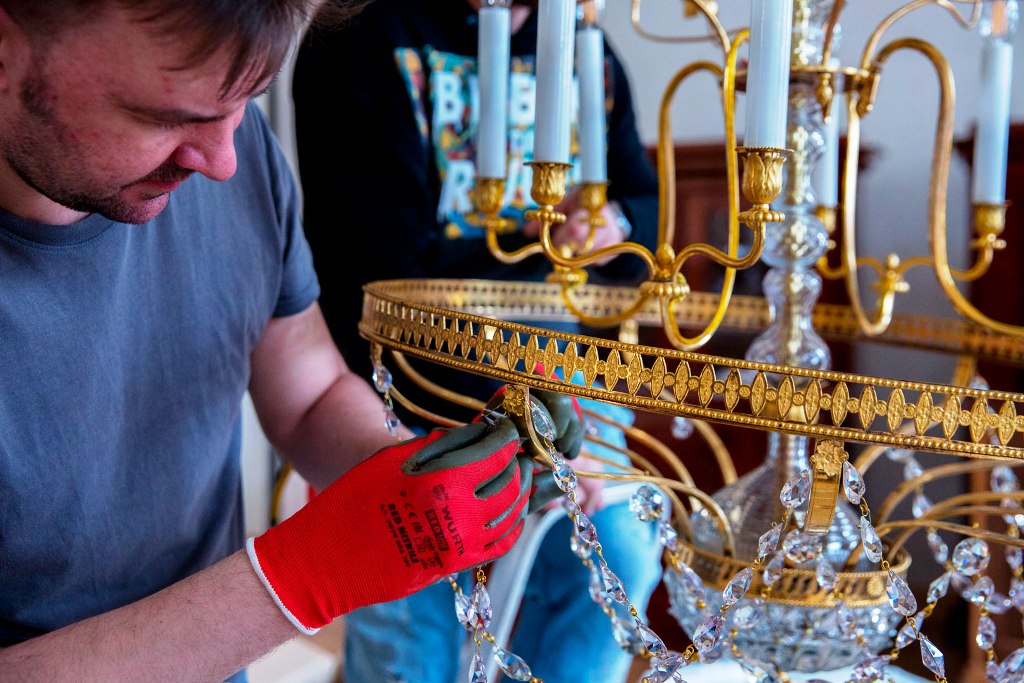
PHOTO: Chandelier for the Reception Room of Nicholas II

According to a press release from the Tsarskoye Selo State Museum, workers have now completed the restoration and recreation of the historic interiors of the private apartments of Nicholas II and Alexandra Feodorovna, situated in the eastern wing of the Alexander Palace.

Objects for the decoration of the interiors are now being moved into the palace. One of the first items of decoration to take their place are the lighting fixtures. Many of the graceful chandeliers and lanterns created in the St. Petersburg workshops during the 18th to 19th centuries have been preserved in the historical collection of the museum for more than a century.

PHOTO © Tsarskoe Selo State Museum-Reserve

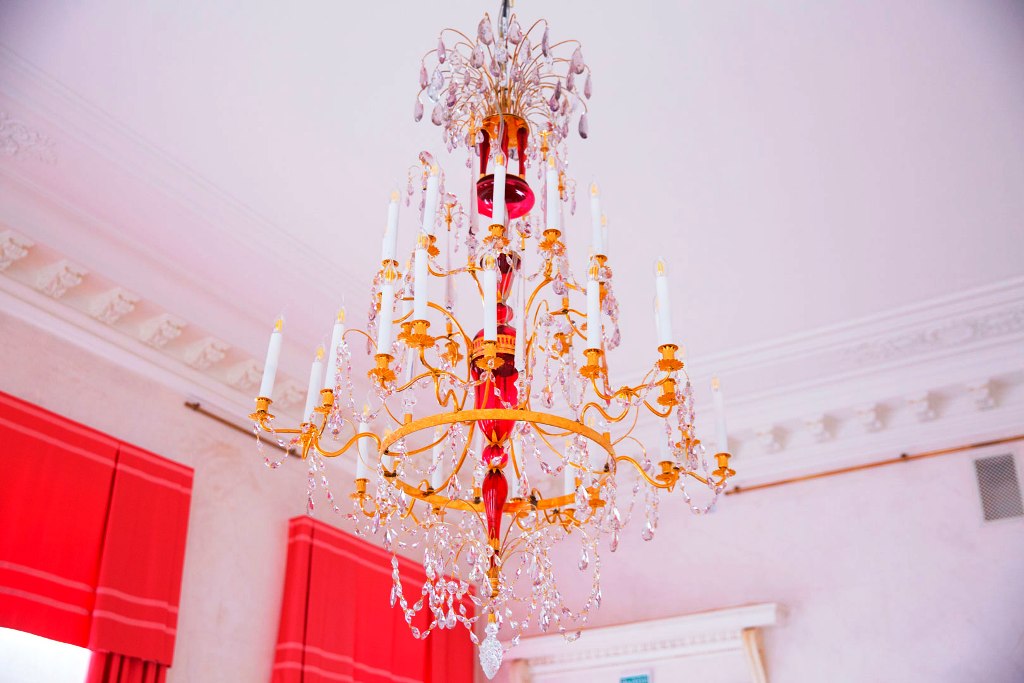
Among the lamps characteristic of the era of Catherine II’s reign, one can distinguish chandeliers of the late 18th century by their crystal headgear and coloured glass; their main feature is a multitude of faceted pendants of various shapes, connected in garlands, crystal obelisks and a “fountain” crowning the chandelier, reminiscent of a column of water … Such chandeliers adorn the Empress’s Mauve (Lilac) Boudoir, Alexandra Feodorovna’s Corner Reception Room and the Large Library.

PHOTO © Tsarskoe Selo State Museum-Reserve

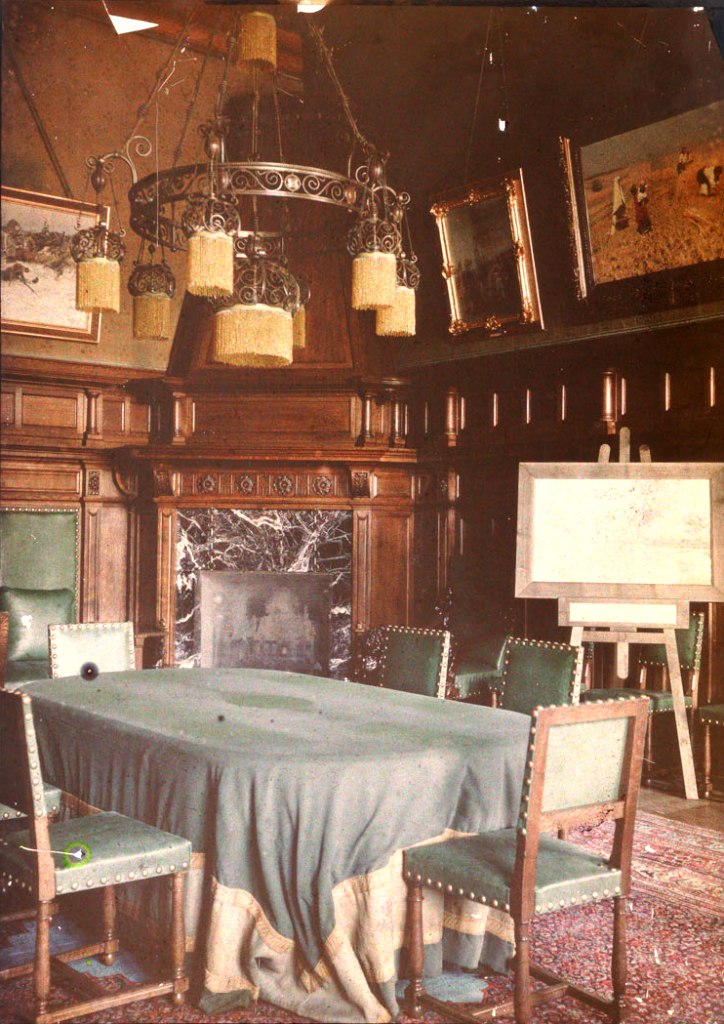
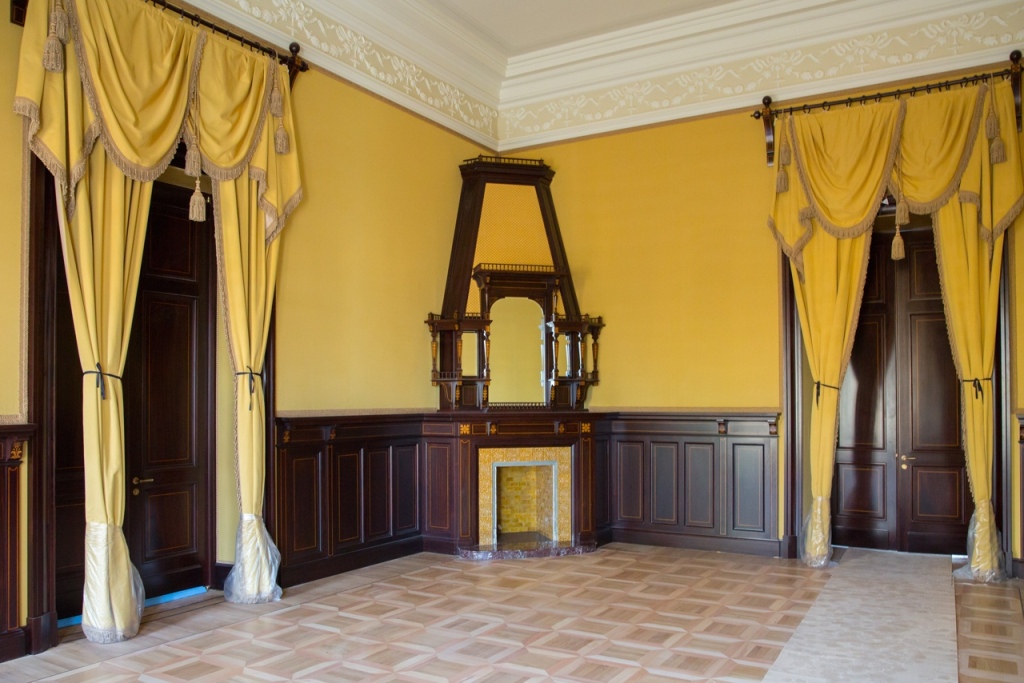
Among the unique lighting fixtures s is a chandelier from the Reception Room of Nicholas II. This interior was designed by the architect Roman Melzer in 1895-1896: walls and ceiling are finished with oak panels and furniture ordered from the F. Melzer & Co. factory. An electric chandelier was installed, with twelve bulbs in the form of a hanging openwork rim on six chains with hemispherical shades decorated with a fringe of yellow beads. The chandelier was not evacuated during the war years and remained in its place for almost a hundred years: it was removed in 1997. In 2015, specialists of the Yuzhakova Studio workshop in St. Petersburg carried out a restoration of the chandelier, which involved cleaning the metal surface, replaced the lost beads and installed new electrical wiring.

PHOTO © Tsarskoe Selo State Museum-Reserve

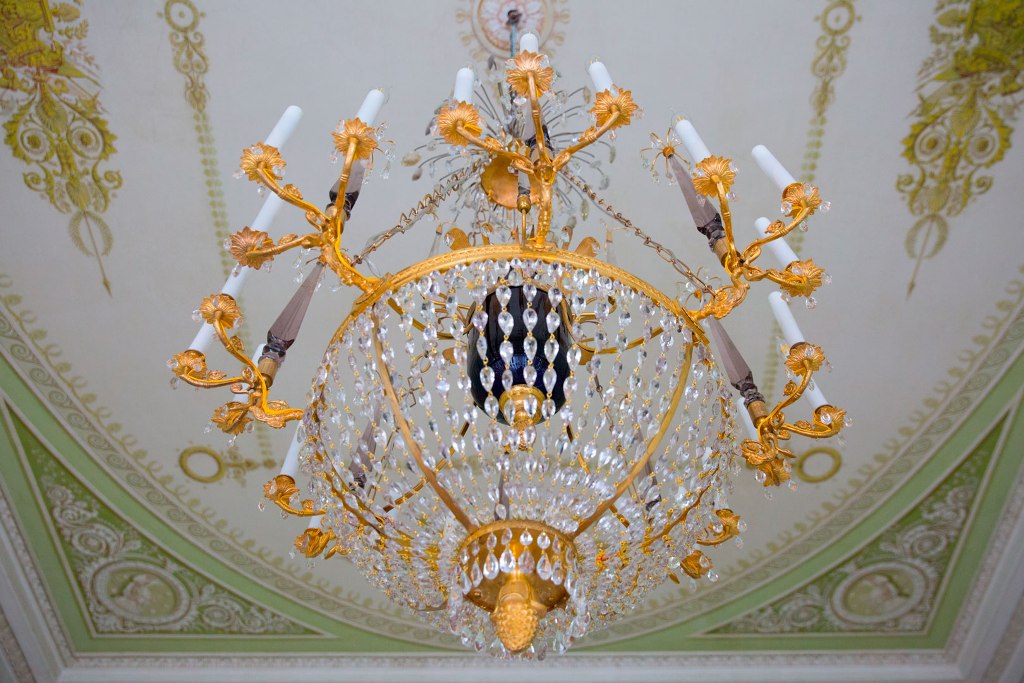
The pride of the collection are three chandeliers for a hundred candles each – from the State Halls of the Alexander Palace, which have been preserved in the museum’s funds. In 1796, an order for the production of eight identical chandeliers according to the design of the architect Giacomo Quarenghi was received by the St. Petersburg bronze-maker Johann Zech. They were intended for the St. George Hall of the Winter Palace. The master managed to make only three chandeliers, which adorned one of the halls of the Mikhailovsky Castle; subsequently they were transferred to the Alexander Palace. An interesting fact is that the “Karengiev” chandeliers were made for 50 candles each, but in 1829 the number of horns was increased to one hundred for better lighting of the halls. These large two-tiered chandeliers with ruby ​​glass balusters will take their historical place after the completion of the restoration of the central building of the palace.

FURTHER READING:

Restoration of Lighting Fixtures for the Alexander Palace, published on 16th December 2020

© Paul Gilbert. 14 April 2021

Roman Melzer: architect and designer of the Alexander Palace interiors


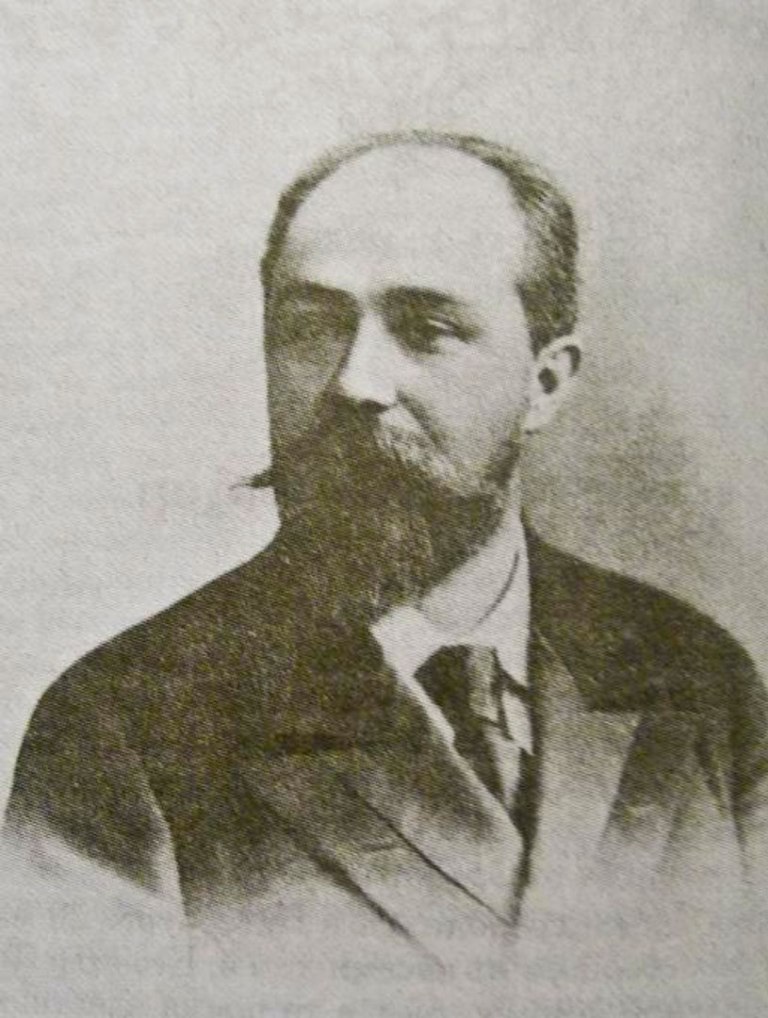
PHOTO: Roman Fedorovich (Robert Friedrich) Melzer (1860-1943)

Roman Fedorovich (Robert Friedrich) Melzer was born in St. Petersburg, on 1st April (O.S. 30th March) 1860. He was the eldest son of the coachman Johann Friedrich Meltzer (1831-1923), who later became the owner of his own furniture factory, and Sophie Christine Meltzer – nee Tatzky (1837-1915).

At the age of thirteen, Roman Meltser entered the St. Petersburg Commercial School, after graduation he continued his studies at the Academy of Arts. In 1888 he received the title of class artist of the first degree in architecture. One of his early projects was the front gate and ramp fences of the Winter Palace, created in collaboration with Nikolai Alexandrovich Gornostaev. In the late 1890s – early 1900s, Melzer worked on the construction of the Emmanuel Nobel (1801-1872) mansion in St. Petersburg.

In 1900 he was appointed chief architect of the Russian exhibition pavilions at the World Exhibition in Paris. The main building, the Pavillon des Confins Russes, looked like an old Russian town, complete with a bell tower. The architecture resonated with the images of the Moscow Kremlin. This ensemble, unusual for a European capital, was located just fifty meters from the Trocadero Palace.

Roman Melzer took part in the decoration of the interiors of numerous imperial palaces: the Winter Palace and Anitchkov Palace in St. Petersburg; Livadia Palace in Crimea; and the Cottage Palace in Peterhof. Among the buildings created according to his designs, included his own dacha on Kamenny Island (1901-1904), the building of the Orthopedic Institute (1902-1906), the palace of the Grand Duke Mikhail Alexandrovich (1910-1913), the complex of buildings of the Psychoneurological Institute (1910-1913), among many others.


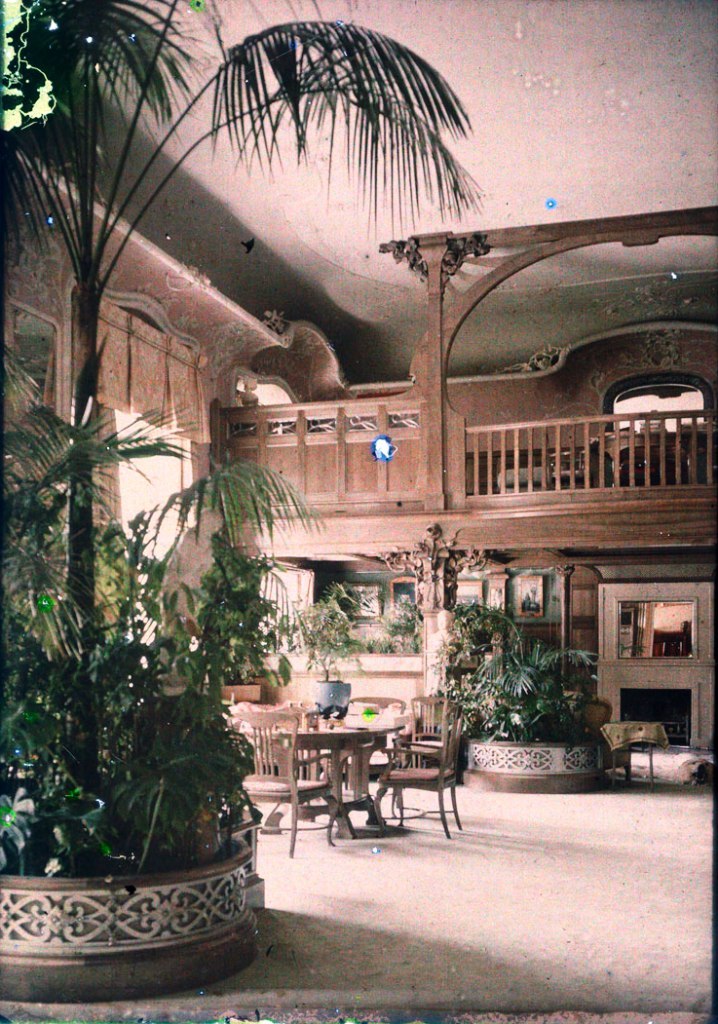
PHOTO: Colour autochrome of the Emperor’s Reception Room taken in 1917

At the end of 1894-1895, the renovation of the interiors of the Alexander Palace in Tsarskoye Selo began. Roman Melzer was invited to prepare the personal apartments of Emperor Nicholas II and Empress Alexandra Feodorovna in the eastern wing of the building. The work took place in several stages. The first interiors created were: the Dining Room (later known as the Reception Room) and the Working Study on the Emperor’s half of the wing, as well as the Imperial Bedchamber, the Mauve (Lilac) Drawing Room and the Pallisander (Rosewood) Drawing Room on the Empress’s half.

In the Emperor’s Reception Room, the walls were decorated with oak panels, and above they were covered with printed fabric. The interior decoration included a corner fireplace made of oak, trimmed with dark green marble. In the upper part of the windows, the architect used stained glass. The F. Meltzer & Co. in St. Petersburg, which was co-owned by Roman Melzer, produced a set of furniture for the room, which included a sofa with two folding tables, a round table for tea, a dining table consisting of a table and twenty-four chairs, a serving table, and a snack table.


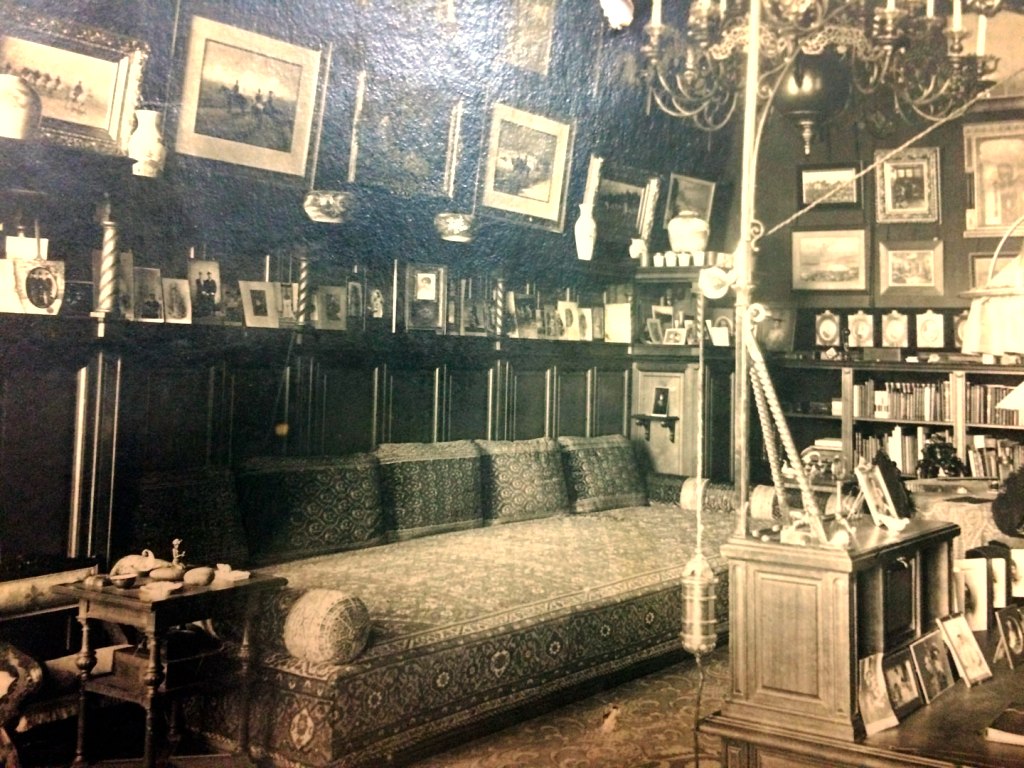
PHOTO: the Working Study of Nicholas II

At the same time, the Working Study of Nicholas II was in progress. The interior was designed in the English style, with walls painted in dark red at the top and walnut panels on the bottom. The room featured a large ottoman, in imitation of the cabinet of Alexander III, as well as an L-shaped writing table.

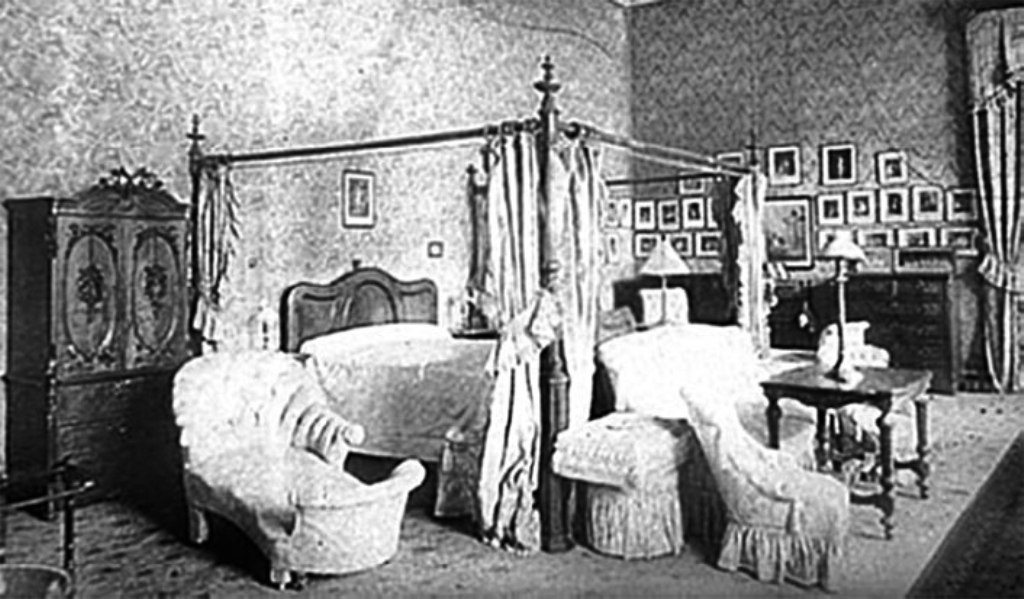
The Imperial Bedchamber was also renovated according to the architect’s project. The furniture, which was preserved from the previous decoration (a bedroom prepared in 1874 for the marriage of Alexander II’s daughter Grand Duchess Maria Alexandrovna to the Duke of Edinburgh), was repainted in white and draped with English chintz, and a pattern of wreaths of small pink flowers and ribbons. The same fabric was also used to make the curtains and alcove curtains for the room.

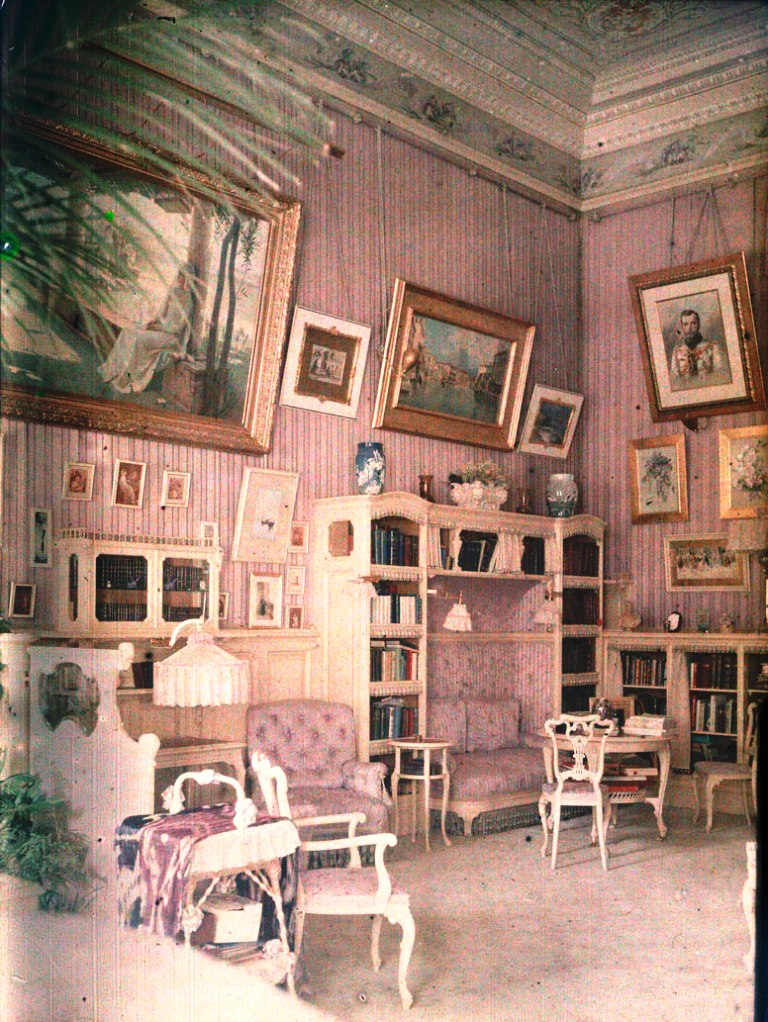
Roman Melzer also created the interior for the Mauve (Lilac) Drawing Room, which was to become one of the Empress’s favorite interiors. Here the walls were upholstered in mauve silk and crowned with a frieze bearing an iris flower pattern, furniture and a piano painted with ivory enamel paint. Some of the pieces of furniture were built-in, connected to the panels, forming comfortable corners.


PHOTO: Colour autochrome of the Mauve (Lilac) Drawing Room taken in 1917

Melzer was engaged in the creation of the Pallisander (Rosewood) Drawing Room, which was located next to the Mauve (Lilac) Drawing Room. Rosewood was chosen for decorating the wall panels and fireplace. The upper part of the walls was covered with a simple yet elegant yellowish silk fabric.

During this period, the children’s half on the second floor began to take shape, as the emperor’s family gradually grew and the “august children” needed their own bedrooms and classrooms.

Between 1898–1902, there were no major changes to the interiors of the Alexander Palace. In 1902, however, the decision was made to demolish the double-height Concert Hall and create in its place the Emperor’s New Study and the Empress’s Maple Drawing Room. Roman Melzer’s firm carried out not only the construction, but also the finishing and furnishing of these interiors. A mezzanine was also added, which connected the New Study with the Maple Drawing Room.


PHOTO: Colour autochrome of the Maple Drawing Room taken in 1917

Thanks to Melzer, the interiors of the Alexander Palace underwent a stunning transformation, one which provided a cozy residence for the Emperor and his family. A far cry from the luxurious and ostentatious interiors of the nearby Catherine Palace, the redesigned interiors of the Alexander Palace reflected the simple tastes of Nicholas and Alexandra.

After the 1917 Revolution, Roman Melzer left Russia, and lived for several years in Germany, from there in 1921 he moved to the United States, where he died in 1943.

In 2020, the square at the corner of Bolshoy Sampsonievsky Prospekt and Nobelsky Lane began in St. Petersburg, was renamed Meltserovsky Ploschad – in memory of the court architect. His work reflected the new trends of the turn of the late 19th to early 20th centuries, the emergence of the Art Nouveau style, which was becoming fashionable at the time.

© Paul Gilbert. 2 April 2021

UPDATE on the reopening of the Alexander Palace

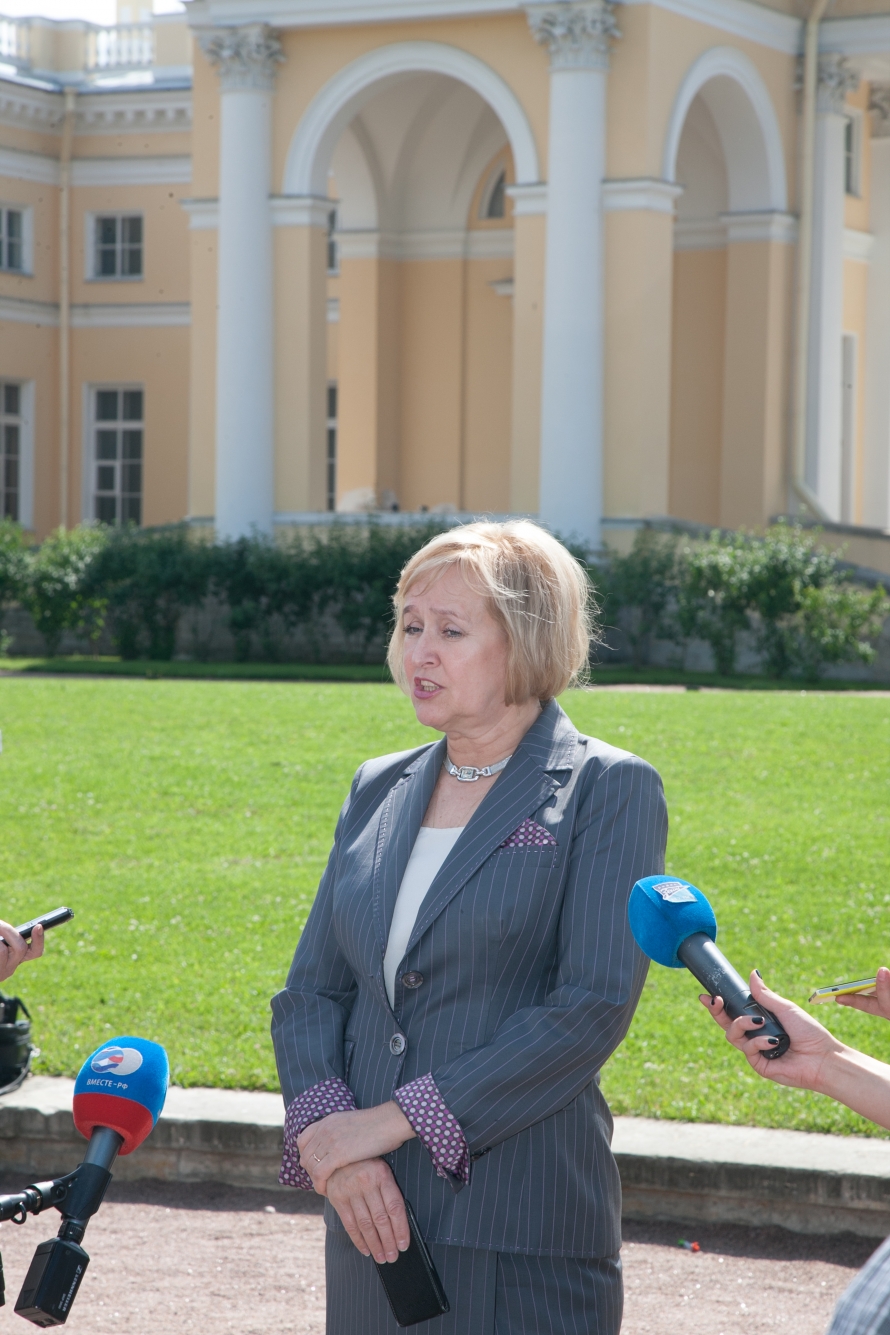
PHOTO: Director of the Tsarskoye Selo State Museum-Reserve Olga Taratynova

According to the Director of the Tsarskoye Selo State Museum-Reserve Olga Taratynova, the Alexander Palace will receive its first visitors in late May – early June 2021.

“The first stage, which includes 15 interiors of the private rooms of Emperor Nicholas II and Empress Alexandra Feodorovna is nearing completion, and I hope that within the coming weeks, we will be able to confirm the opening date. Once open to visitors again, we will organize tours for small groups, since the interiors themselves are small. The private life of Nicholas II and his family will be shown from a completely different perspective,” noted Taratynova.

More than 2 billion rubles ($26 million USD) were allocated for the first stage of the restoration of the Alexander Palace, which include the fifteen interiors situated in the eastern wing of the palace. The recreated interiors include the New Study of Nicholas II, Moorish Bathroom of Nicholas II, Working Study of Nicholas II, Reception Room of Nicholas II, Pallisander (Rosewood) Living Room, Mauve (Lilac) Boudoir, Maple Drawing Room, Alexandra’s Corner Reception Room, the Imperial Bedroom, among others.

Taratynova noted, that the second phase of the restoration of the palace will take about three more years. “We assume that the second stage will be approximately 2.5-3 years. Work on the second stage is already underway”.

The restoration of the Alexander Palace began in 2010, in which three State Halls were opened to visitors  marking the 300th anniversary of Tsarskoye Selo. In August 2015, the palace was closed for a comprehensive restoration and reconstruction project.

In the future, the Alexander Palace will become a memorial museum of the Romanov family – showcasing the private, domestic life of Nicholas II and his family, who used the palace as an official residence from 1905. The eastern wing of the palace will be known as the Museum of the Russian Imperial Family.

The restoration of the Alexander Palace, which includes the Western wing is scheduled for completion no earlier than 2024. After the completion of the work, the Alexander Palace will become a multifunctional museum complex, which will include exhibition halls, halls for temporary exhibitions, halls for research work and conferences, as well as a library and a children’s center. The basement floor will house a ticket booth, a museum shop, a café, a cloakroom, a tour desk, as well as technical and ancillary facilities.

© Paul Gilbert. 23 March 2021

***

Dear Reader: If you enjoy my articles on the history and restoration of the Alexander Palace, then please help support my research by making a donation in US or Canadian dollars to my project The Truth About Nicholas II – please note that donations can be made by GoFundMePayPal, credit cardpersonal check or money order. The net proceeds help fund my work, including research, translations, etc. Thank you for your consideration – PG


Recreation of the interiors of the Maple Drawing Room in the Alexander Palace

PHOTO: view of the sofa, recreated for the Maple Drawing Room
© Tsarskoye Selo State Museum-Reserve

This is the second of two articles on the recreation of the Maple Drawing Room, one of the personal rooms of Empress Alexandra Feodorovna situated in the eastern wing of the Alexander Palace. The first article The History and Restoration of the Maple Drawing Room in the Alexander Palace, was published on 25th November 2020.

***

PHOTO: view of the recreated Maple Drawing Room
© Tsarskoye Selo State Museum-Reserve

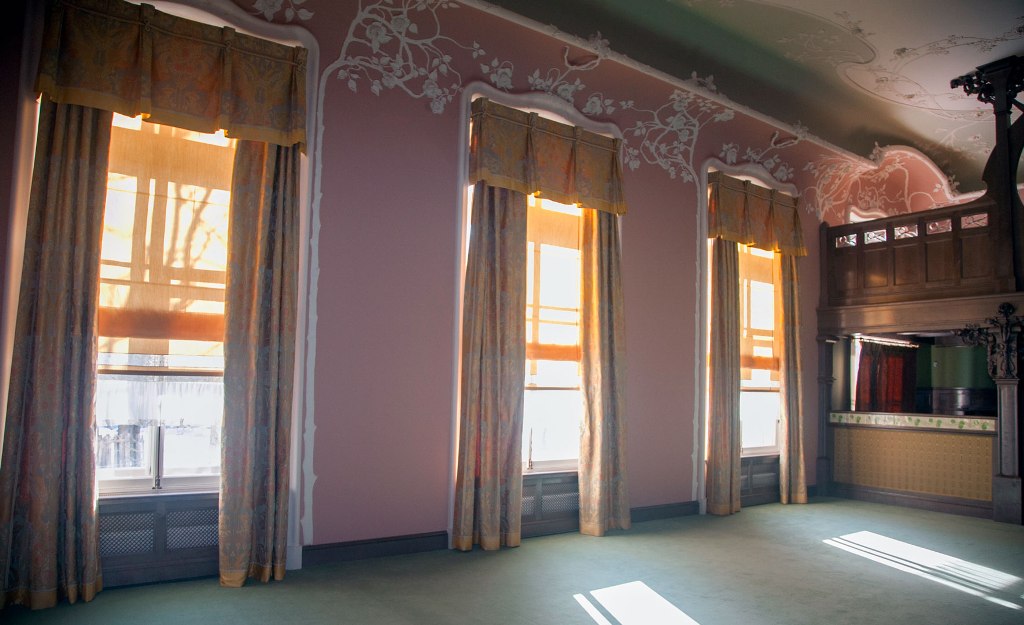
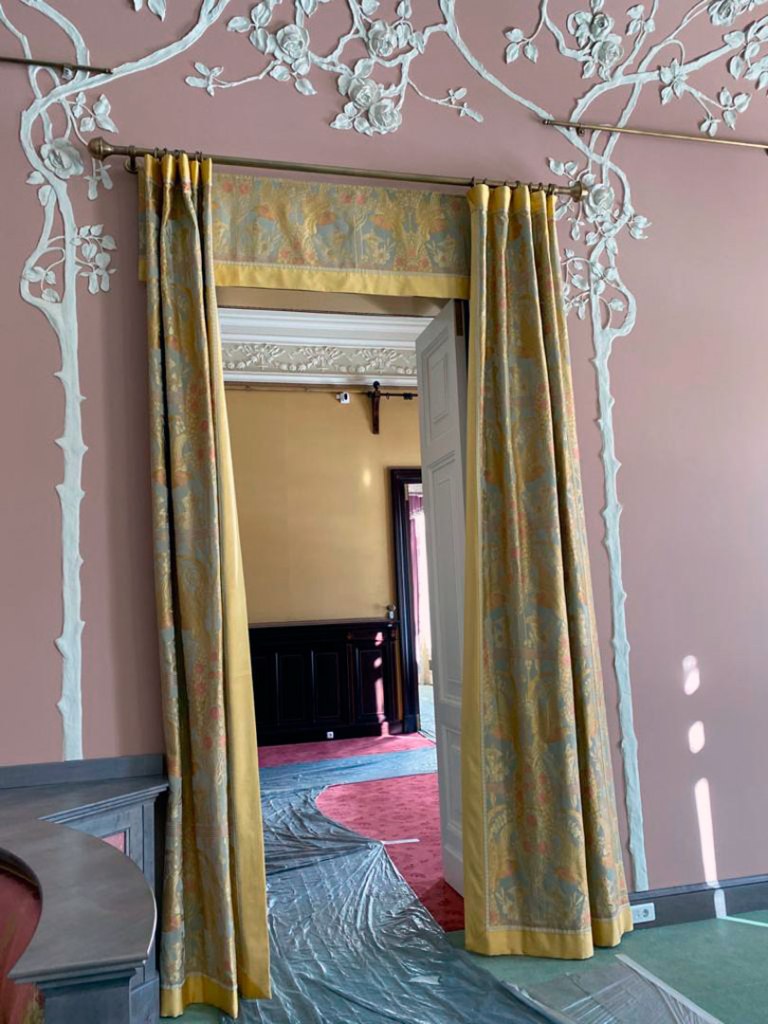
The recreation of the textile decoration for the Maple Drawing Room in the Alexander Palace is nearing completion, The craftsmen relied on small fragments of fabrics and historical photographs which had been preserved in the storerooms of the Tsarskoye Selo State Museum.

The interior decoration of the Maple Living Room is a classic example of Art Nouveau. The room features: moulding, carving, stained glass framed by a fireplace mirror and artistic textiles, which are best described as a “vividly manifested synthesis of the arts”.

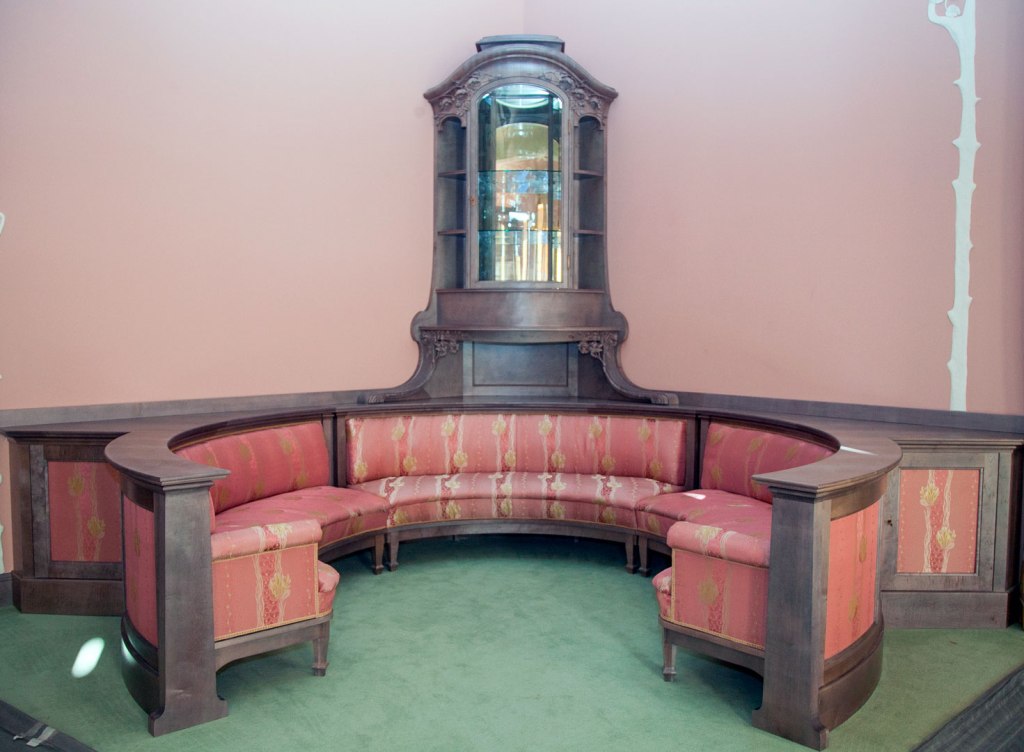
The Art Nouveau style is also reflected in the design of the fabric textiles: curtains on the windows and the doorway to the adjacent Pallisander (Rosewood) Drawing Room, furniture upholstery, in particular, on the corner sofa under the mezzanine and the bracket-shaped sofa – elements which add elegance to this room.. 

PHOTO: view of the recreated Maple Drawing Room
© Tsarskoye Selo State Museum-Reserve

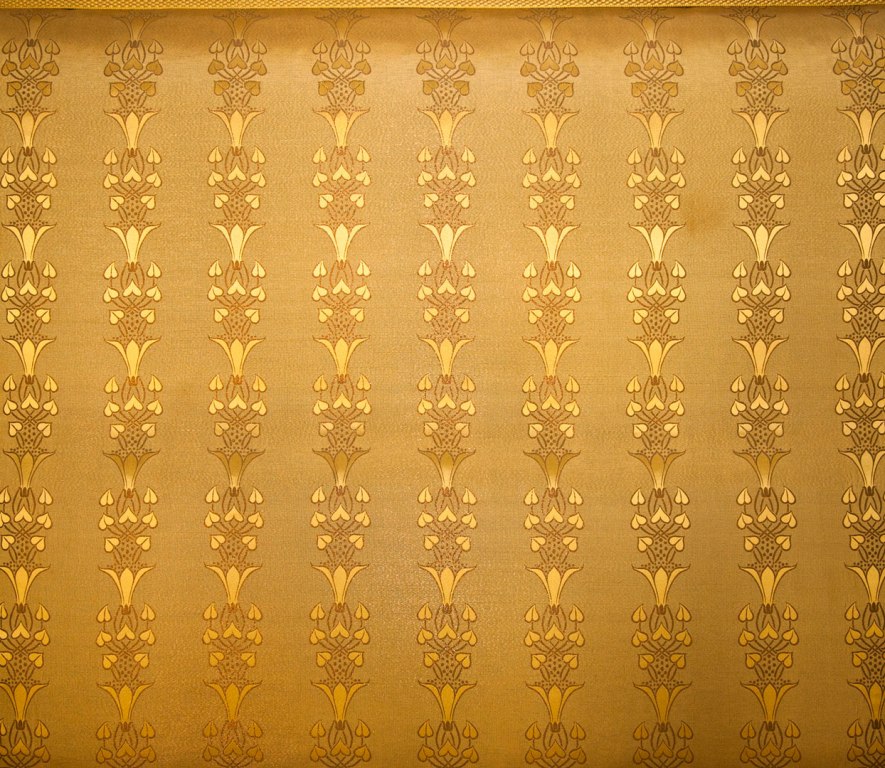
The corner sofa under the mezzanine is covered with greenish-olive moire silk with a pattern of stylized lilies and leaves in the form of hearts. The same fabric upholstered the panel of the wall under the mezzanine with a jardiniere [flower box].

The brace-shaped sofa, situated in the center of the room is covered with a pink silk lampas fabric decorated with a fawn pattern of plant shoots and roses.

PHOTO: recreated knurled white silk curtains with lace ornaments
© Tsarskoye Selo State Museum-Reserve

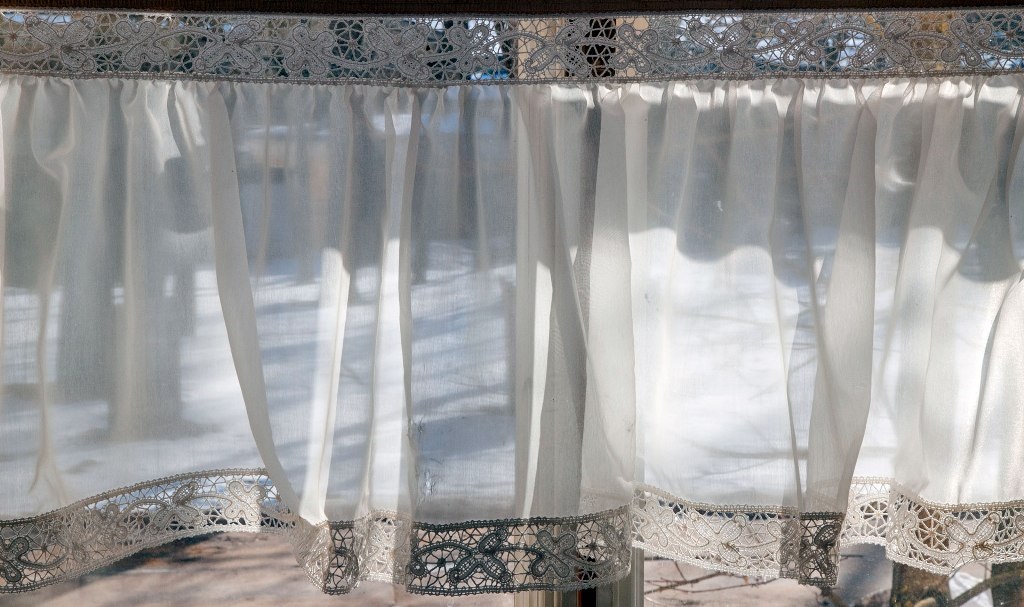
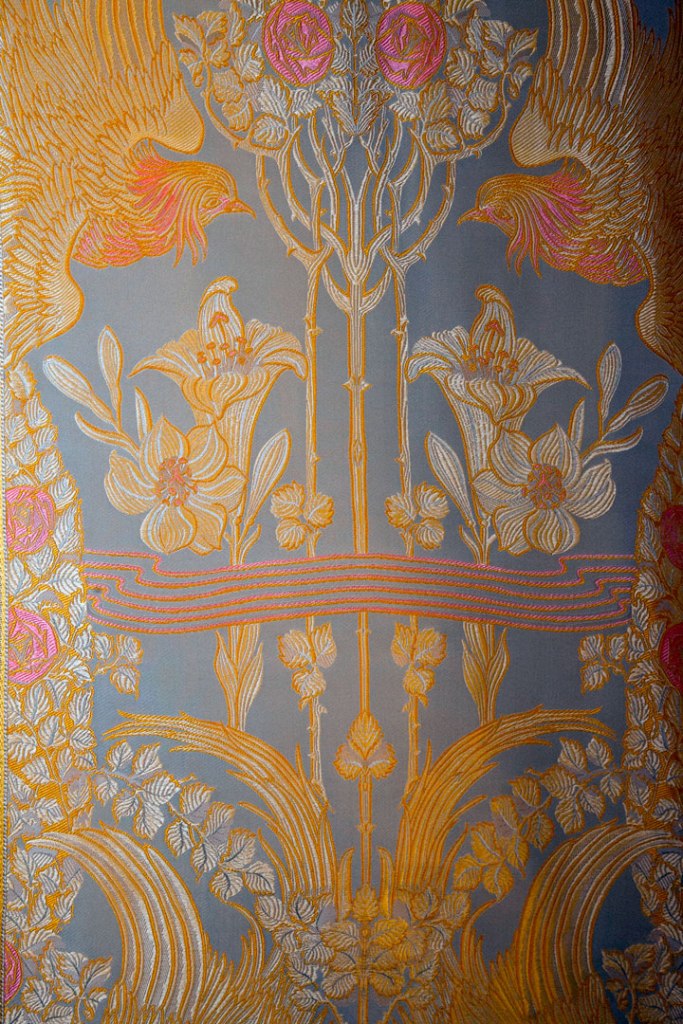
On the windows are knurled white silk curtains with lace ornaments and pink silk curtains with gold ornaments, made at the Sapozhnikov brothers factory in Moscow. Fabulous motifs in fabric ornamentation are highlighted with lily branches, rose bushes, and sirin-birds.

The floor in Empress Alexandra Feodorovna’s Maple Drawing Room was covered with a stitched gray-green beaver carpet. This design made it possible to replace individual elements of the carpet, which over time wore thin. The recreated stitched carpet of New Zealand wool covers an area of ​​182 m2 and weighs 400 kg. A fragment of the reseda-green carpet from the early 20th century, which had been preserved in the palace storerooms, allowed experts to recreate the carpet.

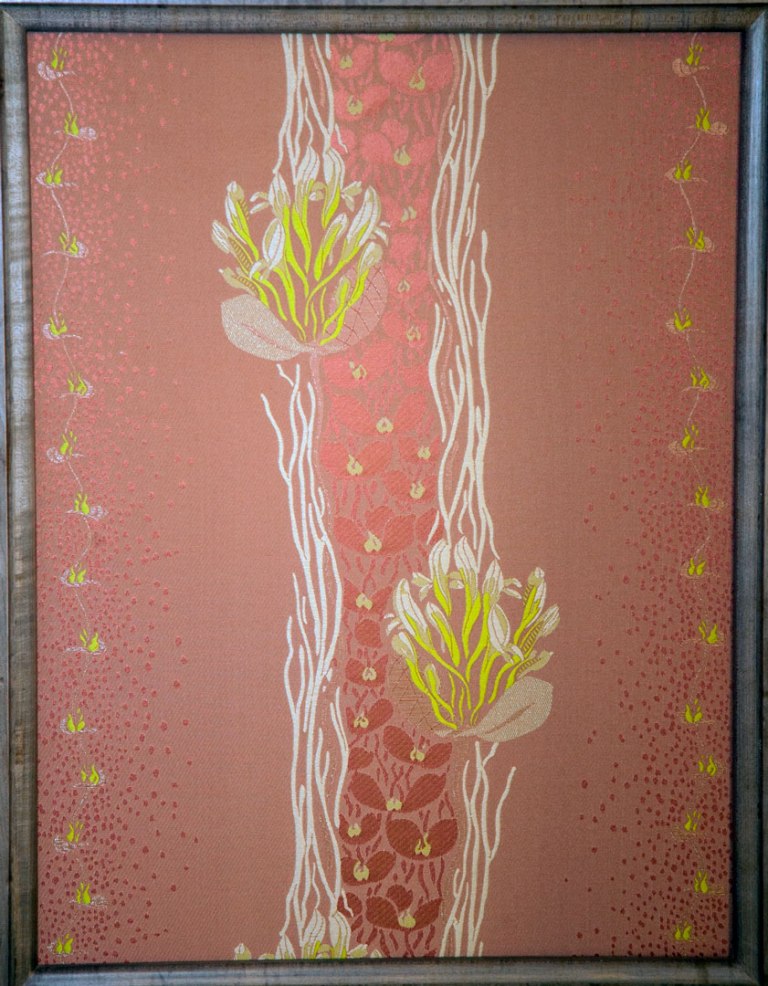
PHOTO: recreated fabric for the Maple Drawing Room
© Tsarskoye Selo State Museum-Reserve

PHOTO: recreated fabric for the Maple Drawing Room
© Tsarskoye Selo State Museum-Reserve

PHOTO: recreated fabric for the Maple Drawing Room
© Tsarskoye Selo State Museum-Reserve

The fabrics for curtains and upholstery were made by RUBELLI in Italy. Models were made from the recreated fabrics and the curtains were sewn at the “Le Lux” factory in St. Petersburg. The carpet, metallic braid and lace inserts were made at the “RE KON ART” factory in Poland.

Various pillows for the sofas and armchairs complemented the upholstered furniture for this room. The brocade pillows were made by the Sapozhnikov brothers’ manufactory, and velvet pillows decorated with peacock feather ornaments, are the works of students of the Stroganov School, as well as a purple pillow made of a veil-type shawl. 

In the future, various pieces of furniture will be recreated for the Maple Drawing Room, with fabrics made according to historical patterns.

NOTE: all photos © Tsarskoye Selo State Museum-Reserve

© Paul Gilbert. 11 March 2021

***

Fifteen interiors situated in the eastern wing of the palace, are now scheduled to open to visitors in 2021. Among the recreated interiors are the New Study of Nicholas II, Moorish Bathroom of Nicholas II, Working Study of Nicholas II, Reception Room of Nicholas II, Pallisander (Rosewood) Living Room, Mauve (Lilac) Boudoir, Maple Drawing Room, Alexandra’s Corner Reception Room, the Imperial Bedroom, among others.

In the future, the Alexander Palace will become a memorial museum of the Romanov family – from Catherine the Great to Nicholas II, showcasing the private, domestic life of the Russian monarchs who used the palace as an official residence. The eastern wing of the palace will be known as the Museum of the Russian Imperial Family. The multi-museum complex, which includes the Western wing is scheduled for completion no earlier than 2024.

***

Dear Reader: If you enjoy my articles on the history and restoration of the Alexander Palace, then please help support my research by making a donation in US or Canadian dollars to my project The Truth About Nicholas II – please note that donations can be made by GoFundMePayPal, credit cardpersonal check or money order. The net proceeds help fund my work, including research, translations, etc. Thank you for your consideration – PG


Furniture recreated for the Corner Reception Room in the Alexander Palace

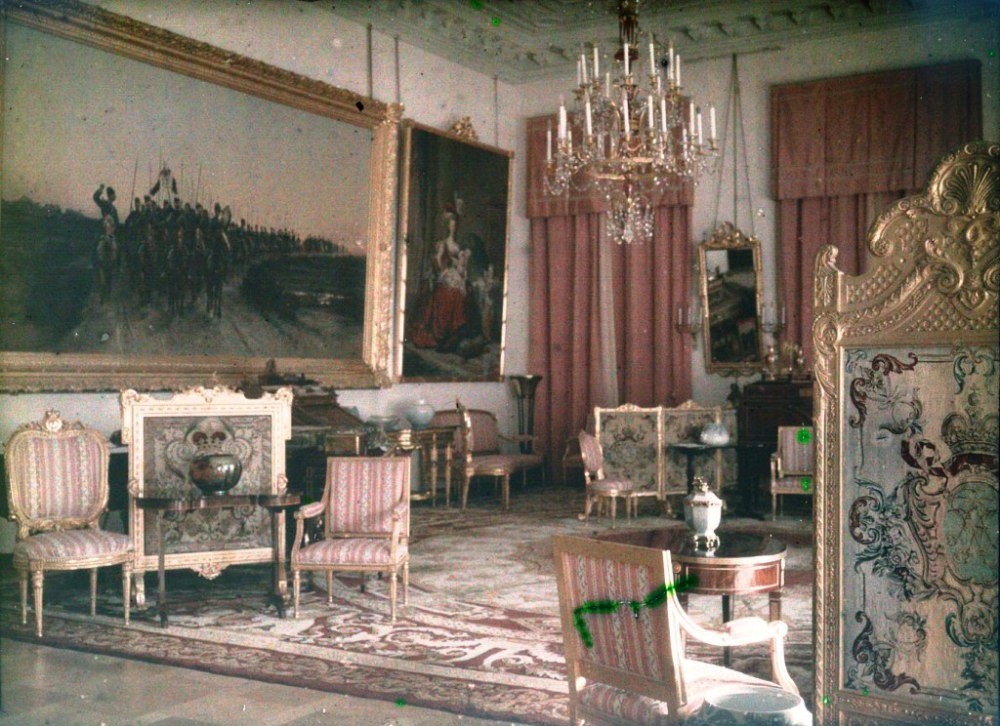
PHOTO: Colour autochrome of the Corner Reception Room, taken in 1917

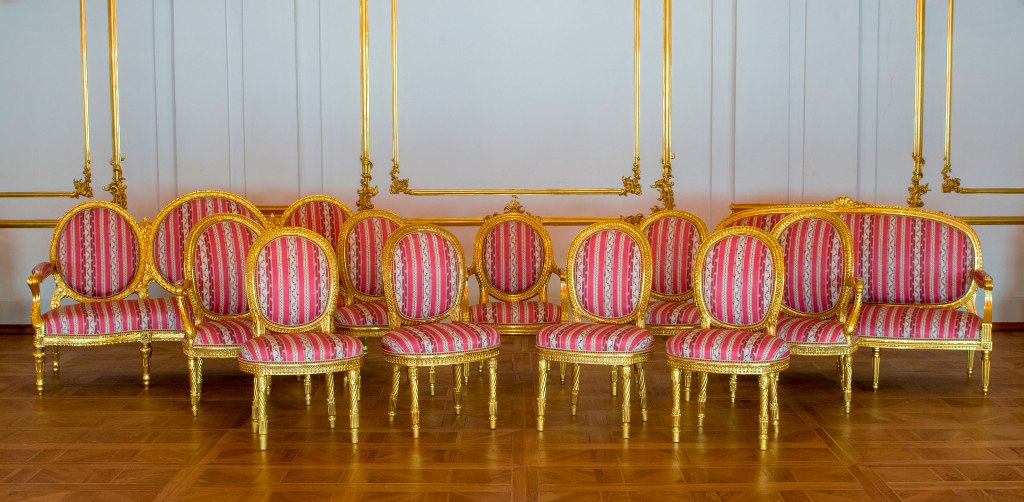
The restoration of the gilded furniture set (armchairs, chairs and sofas), which will decorate the Corner Reception Room of Empress Alexandra Feodorovna in the Alexander Palace has been completed.

The Corner Reception Room was originally connected to the Concert Hall by a door located along its central wall. In 1895, a fundamental restructuring of the eastern wing of the palace began, whereby the private apartments for Nicholas II and his family would be created. In 1902–1904, when the Maple Drawing Room and the New Study of Nicholas II were created on the site, the Corner Reception Room was connected to the corridor, becoming part of the personal imperial apartments, but at the same time retained its ceremonial function.

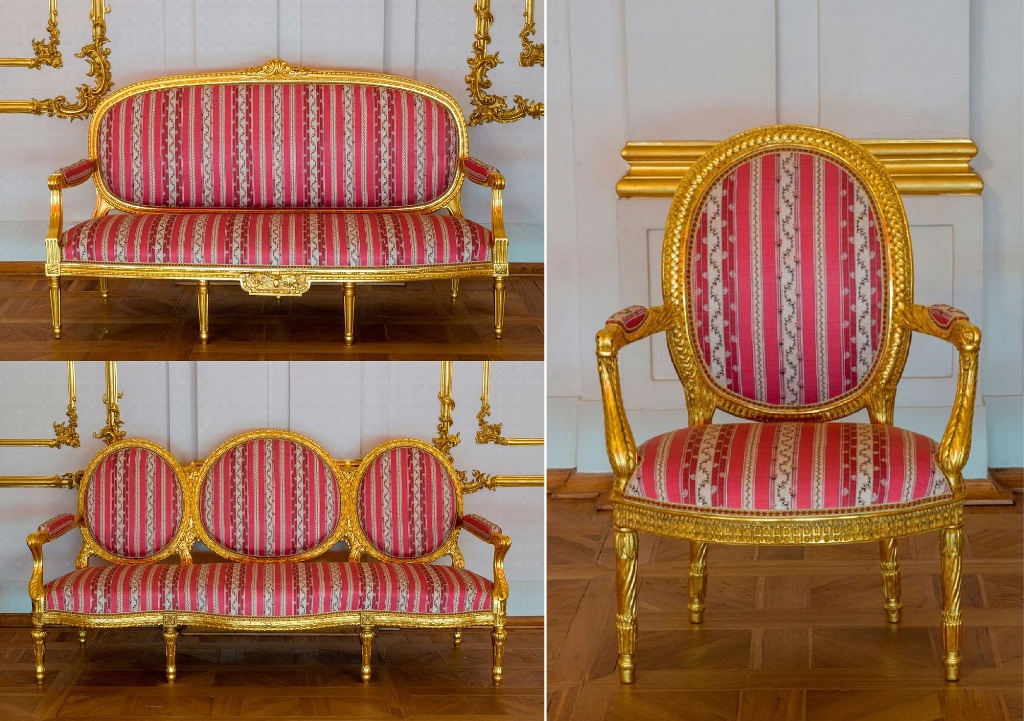
PHOTO: recreated chairs, armchairs and sofas for the Corner Reception Room

The furniture of the Corner Reception Room was almost completely lost during the Great Patriotic War (1941-45). For the new recreated interior set, the selected items were made in the classic style, since most of the gilded furniture that adorned this interior at the beginning of the 20th century – until 1941 – was executed in this style.

The set was restored by specialists from the Tsarskoye Selo Amber Workshop. The restored gilded chairs and armchairs with oval backs and seats were made in the 1770s. Before World War II, these items decorated interiors of the Catherine Palace, in the foyer of the Chinese Theater (in the Alexander Park) and in the White Hall of Gatchina Palace. Two sofas from the second half of the 19th century, also included in the furniture set, were transferred to the Tsarskoye Selo State Museum from the State Hermitage in 1959.

PHOTO: original upholstery sample for the furniture in the Corner Reception Room

In the process of restoration, the craftsmen removed all types of dirt, restored the gesso and gilding, recreated the lost carved details with the subsequent summing up of gesso, diverging and gilding, and upholstery works. In the seat cushion of one of the sofas, the craftsmen found fragments of the original  horsehair, used to fill it. Due to the fact that one of the fragments clearly reads the date – 1865, as well as the fact that the sofa was upholstered once, the object can be dated to that year.

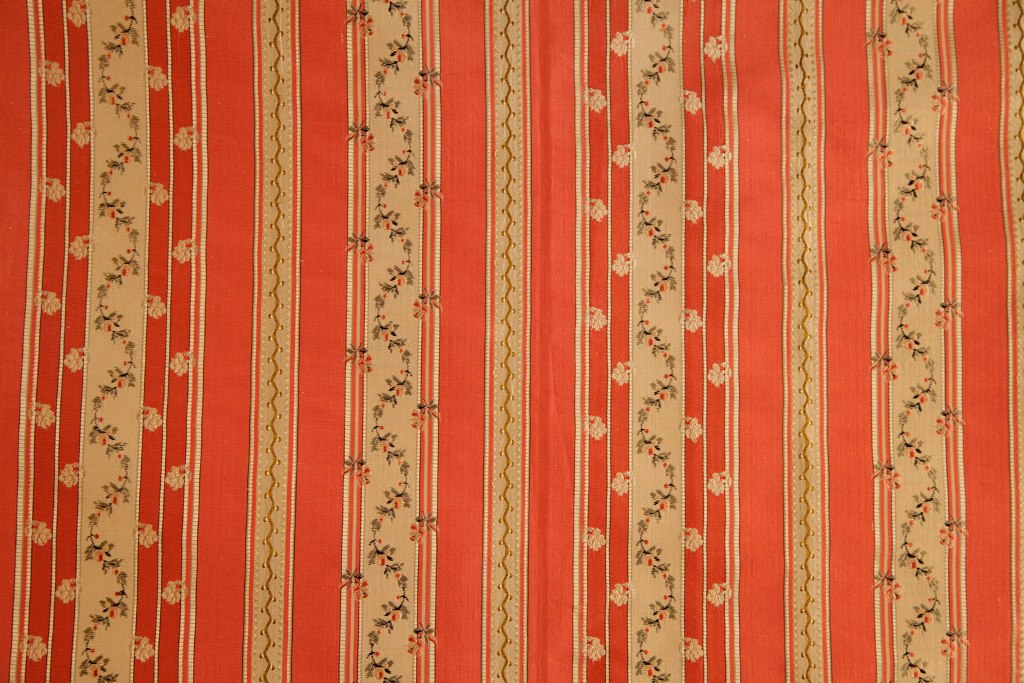
The chairs, armchairs and sofas share the same stylistic unity, as well as the upholstery fabric. In the an old 1917 brochure which describes the Alexander Palace, the furniture of the Corner Reception Room is described: “Furniture of the Louis XVI style of the Russian slave. late 18th century, re-gilded and upholstered in silk. the work of the Sapozhnikov factory in Moscow. / In the style of striped fabrics of the era of Louis XVI.” A fragment of the original upholstery fabric for the furniture of the Corner Reception Room, made in 1903, which had been preserved in the collection of the Tsarskoye Selo State Museum, served as a model for recreating the upholstery fabric of the restored items. A pattern of alternating light stripes and stripes of various shades of pink with small ornaments of roses, flower garlands and wavy lines is clearly visible on the silk fabric.

PHOTO: recreated chairs, armchairs and sofas for the Corner Reception Room

NOTE: all photos © Tsarskoye Selo State Museum-Reserve

© Paul Gilbert. 3 March 2021

***

Fifteen interiors situated in the eastern wing of the palace, are now scheduled to open to visitors in 2021. Among the recreated interiors are the New Study of Nicholas II, Moorish Bathroom of Nicholas II, Working Study of Nicholas II, Reception Room of Nicholas II, Pallisander (Rosewood) Living Room, Mauve (Lilac) Boudoir, Maple Drawing Room, Alexandra’s Corner Reception Room, the Imperial Bedroom, among others.

In the future, the Alexander Palace will become a memorial museum of the Romanov family – from Catherine the Great to Nicholas II, showcasing the private, domestic life of the Russian monarchs who used the palace as an official residence. The eastern wing of the palace will be known as the Museum of the Russian Imperial Family. The multi-museum complex, which includes the Western wing is scheduled for completion no earlier than 2024.

***

Dear Reader: If you enjoy my articles on the history and restoration of the Alexander Palace, then please help support my research by making a donation in US or Canadian dollars to my project The Truth About Nicholas II – please note that donations can be made by GoFundMePayPal, credit cardpersonal check or money order. The net proceeds help fund my work, including research, translations, etc. Thank you for your consideration – PG

The birth of the future Emperor Nicholas II in the Alexander Palace

PHOTO: the Blue Boudoir in the Alexander Palace, where Nicholas II was born

At 4 o’clock in the morning of 19th May (O.S. 6th May) 1868, Tsarevna Maria Feodorovna began having contractions. The future Empress Maria Feodorovna was about to give birth to her first child. Immediately, the midwife Mikhailova was summoned and instructed to rush to the nearby Catherine Palace, to inform Maria’s father-in-law Emperor Alexander II, that his grandchild’s entry into the world was imminent. The Emperor rushed to the Alexander Palace from his apartments located in the Zubov Wing of the palace, followed shortly thereafter by his wife, Empress Maria Alexandrovna.

At 12:50 p.m., Maria Feodorovna was taken into the bedroom [the Blue Boudoir, situated in the west wing of the palace – the interior has not survived], which had been specially prepared for the pending birth. Lying down on the sofa, she was surrounded by her father-in-law, Emperor Alexander II, her mother-in-law, Empress Maria Alexandrovna, and her husband, the Heir-Tsesarevich Alexander Alexandrovich [future Emperor Alexander III]. Her father-in-law and her husband kneeled on either side of the sofa, holding Maria Feodorovna’s hands when she gave birth – at 2.30 p.m. to her first child, a son – His Imperial Highness Grand Duke Nicholas Alexandrovich – the future Emperor Nicholas II.

PHOTO: Maria Feodorovna with her first son Nicholas Alexandrovich. 1868

The happy young father wrote in his diary that day: “At long last, the final minute arrived and all suffering ceased at once. God has sent us a son whom we named Nicholas. What a joy it is, it is impossible to imagine, I rushed to hug my darling wife, who at once cheered up and was terribly happy. I cried like a child, it was so pleasant and easy on my soul. I hugged dear Papa and Mama heartily.”

The happy parents decided to name their son in memory of Alexander’s brother Tsesarevich Nicholas Alexandrovich, who died from cerebro-spinal meningitis in 1865. Had he lived, he would have ascended the throne as Emperor Nicholas II.

Emperor Nicholas II was born on 19th May (O.S. 6th May) 1868, the day of St. Job of the Long Suffering.

© Paul Gilbert. 26 February 2021
Home Church of the Imperial Family in the Alexander Palace

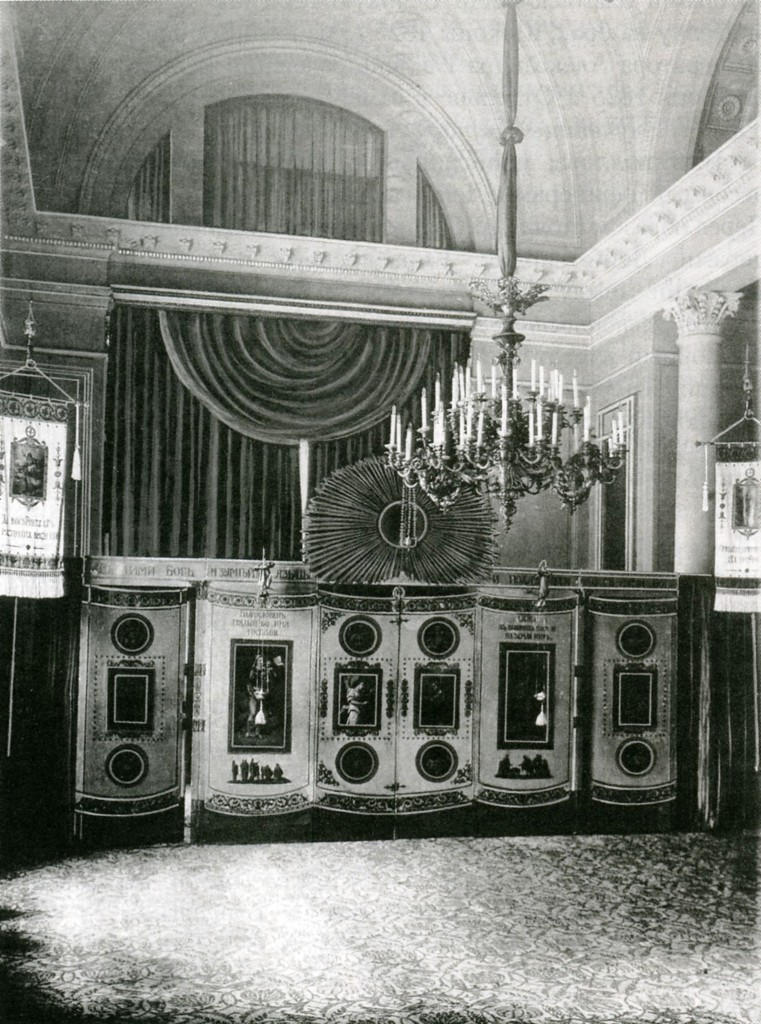
PHOTO: the home church of the Imperial Family in the Alexander Palace in the 1930s

On 9th March (O.S. 24th February) 1897, the first liturgy was performed in the home church of the Alexander Palace. “We went to the service in the red corner living room, where the camp church was set up – it is very convenient and pleasant,” Nicholas II wrote in his diary that day.

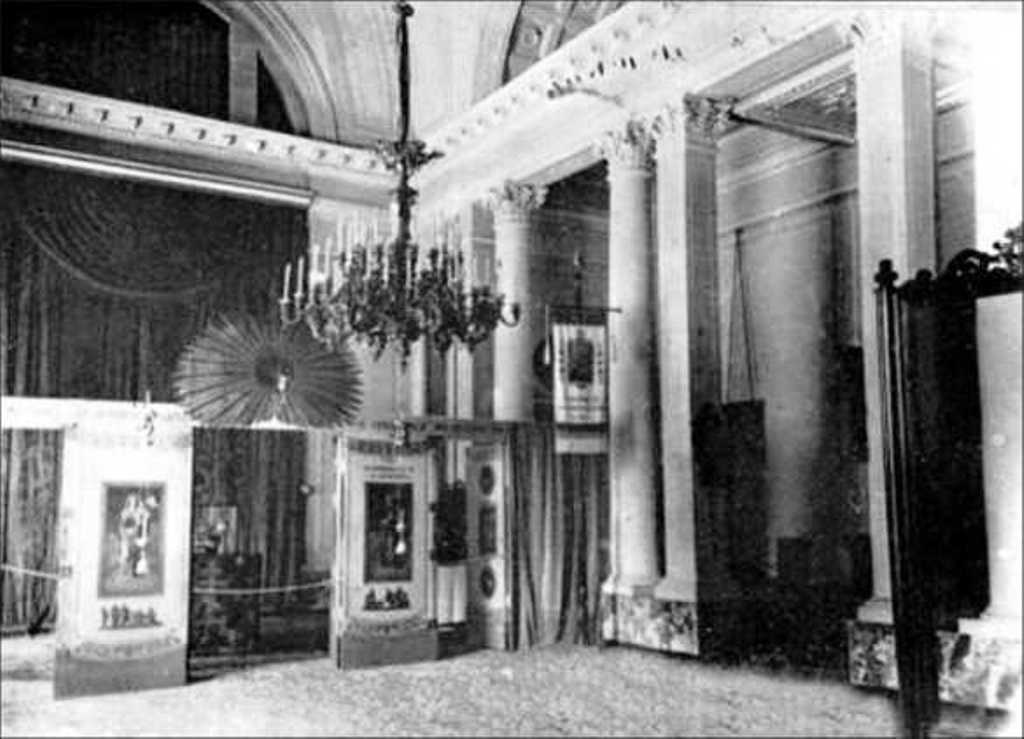
Initially, a house church had not been built in the New Palace (as the Alexander Palace was called until 1856), Following the tragic death of his beloved daughter Grand Duchess Alexandra Nikolaevna (Adini) on 10th August (29th July) 1844, Emperor Nicholas I, ordered a small chapel (see photo below) to be organized in the western wing of the building, decorated in the Old Russian style.

Russian historian and author Igor Zimin describes the room: “there was a little door in the wall, leading to a tiny dark chapel lighted by hanging lamps, where the Empress [Alexandra Feodorovna, wife of Nicholas I] was wont to pray.”

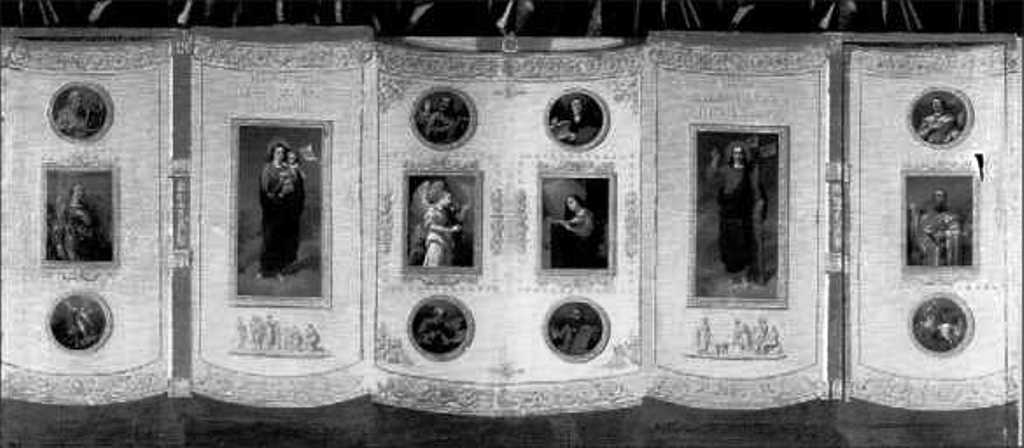
Since the wife of Nicholas II, Alexandra Feodorovna, due to poor health, could not always attend the service in the church of the nearby Catherine Palace, the emperor decided to create a comfortable and simple house church in one of the ceremonial halls of the Alexander Palace: the Crimson Drawing Room was redesigned for these needs. The Travelling Iconostasis of Emperor Alexander I, made by Vasily Shebuev, was installed.

The Travelling Iconostasis of Emperor Alexander I was created for the emperor’s use during his travels. Very simple by imperial standards, it reflected simplicity, convenience and ease of use, and adaptable for moving from place to place. It could be quickly and easily disassembled, easily stowed in crates with all accessories and just as quickly reassembled. Nicholas II sometimes took this iconostasis with him on his travels.

PHOTO: Red and “Crimson” Drawing Rooms. Artist: Luigi Premazzi (1814-1891)
From the Collection of the State Hermitage Museum

In the photos, the iconostasis of Alexander I can be seen stretched across the center of the chapel. This screen followed the Emperor from Russia to Paris and back as part of the furnishing of Alexander’s travelling camp church. The iconostasis is now in the General Staff Building [part of the State Hermitage Museum] in St. Petersburg.

In addition, a small prayer room was installed for Empress Alexandra Feodorovna, where a lectern and a sofa were added for her convenience. The church was consecrated in honour of the Holy Prince Alexander Nevsky.

Divine liturgies were held here for more than 15 years, right up until 1913, when the Feodorovsky Sovereign Cathedral was consecrated in Tsarskoye Selo, which from then on served as the family church of Nicholas II and his family.

PHOTOS: View (above) of the Travelling Iconostasis of Emperor Alexander I. 1930s.
The iconostasis (below) is now in the General Staff Building in St. Petersburg. 1930s

On 12th August (O.S. 30th July) 1917, the last divine liturgy was held in the home church of the Alexander Palace. In his diary, Archpriest Alexander Belyaev recalled this day: “After arriving at the palace at 10 o’clock in the morning, we immediately went, under guard, straight to the church. The valet came from the former empress, bringing a small bunch of carnations and said: “Her Majesty asks that you put these flowers on the icon of the Znamensky Mother of God, which will be brought at two o’clock, into the palace church. These flowers are to remain on the icon during the moleben, and then returned to Her Majesty. She wishes to take them with her on her journey <…> The liturgy began at 11 o’clock. Somehow, I could not help but feel that this was the last Divine Liturgy to be served in the former Tsar’s dwelling . . .”,

The home church existed in the Alexander Palace for exactly 20 years. During the Great Patriotic War (1941-45), its interiors were damaged, but the iconostasis had been evacuated and after the war it was transferred to the Central repository of museum funds of suburban palaces-museums. In 1956, it was transferred to the State Hermitage Museum in Leningrad. Today, it is exhibited in the former interiors of the Ministry of Foreign Affairs of the General Staff Building, which is now a branch of the State Hermitage Museum.

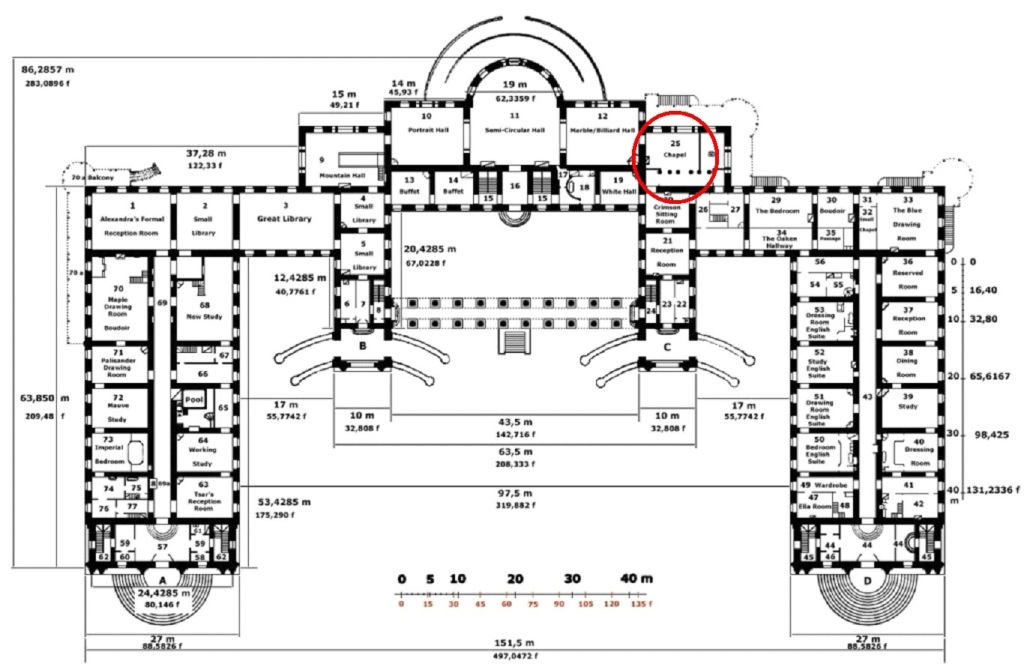
PHOTO: the home church of the Imperial Family in the Alexander Palace is circled in RED

© Paul Gilbert. 26 February 2021
Recreation of the interiors of the Pallisander (Rosewood) Drawing Room in the Alexander Palace


PHOTO: view of the recreated Pallisander (Rosewood) Drawing Room

This is the second of two articles on the recreation of the Pallisander (Rosewood) Drawing Room, one of the personal rooms of Empress Alexandra Feodorovna situated in the eastern wing of the Alexander Palace. The first article The history and restoration of the Pallisander (Rosewood) Drawing Room in the Alexander Palace, was published on 11th November 2020.

***

The Pallisander (Rosewood) Drawing Room was originally conceived as a “reception room” and a music salon with a grand piano, decorated with comfortable furniture for guests.

During the mid-19th century, the room was known as the Blue Drawing Room, one of the former private rooms of the Grand Duchess Maria Alexandrovna (1853-1920), daughter of Emperor Alexander II (1818-1881). By the 1890s, the Blue Drawing Room was outdated and slightly dilapidated. In 1895-1896, the interior was renovated according to the project of the architect Roman Melzer – co-owner and head of the artistic department of the Meltzer Furniture Trading House, in St. Petersburg.

Prior to the decoration of the room’s interior in the 1890s, a selection of French fabric samples for wall decoration, furniture upholstery and curtains, were presented to Nicholas II and Alexandra Feodorovna for their consideration. On 24th May 1895, Nicholas recorded in his diary: “After breakfast, we chose materials and carpets for our rooms in the Alexander Palace.”

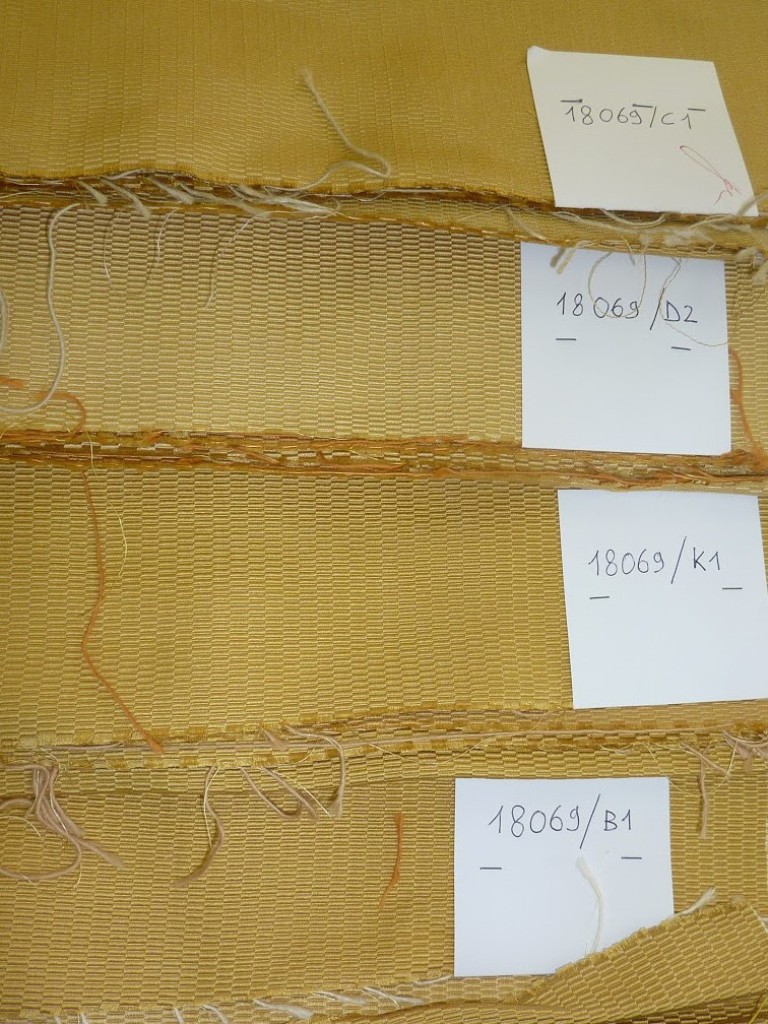
PHOTO: samples of yellowish French fabric for the walls

A month later, on 24th June 1895, the terms of the contract for the implementation of the finishing of the former “reception room” and the supply of the necessary upholstery fabrics and trimmings from France were entered into the order book of Meltzer and Company.

The renovated interior was named Pallisander (Rosewood) Drawing Room: the walls were covered with yellowish French fabric on top, the fireplace and the lower part of the walls were faced with panels of polished rosewood, and rosewood furniture was placed throughout the interior. Some items of the headset were decorated with oak intarsia. The drawing room was completed with rosewood doors.

Over time, the interior was decorated with numerous items related to the tastes and interests of members of the Imperial Family. On the mantelpiece, Art Nouveau clocks coexisted with Royal Danish Porcelain; works of Russian and foreign artists decorated the walls. Many items were reminders of the Empress’s homeland – Darmstadt and the Hesse Landgrave: the large landscape by Bracht depicted a view of the ancestral castle of her family Romrod. Watercolours with views of Darmstadt and its environs were inserted into a wide screen. The shelves of rosewood panels were adorned with objects and framed photographs of members of the Imperial Family.

During the first years of their lives in the Alexander Palace, Nicholas II and Alexandra Feodorovna often spent time in solitude in this room. The room also served as the preferred place for breakfast and lunch for the entire family. Close relatives and distinguished guests were often invited to informal dinners with the Imperial Family in the Pallisander (Rosewood) Drawing Room.

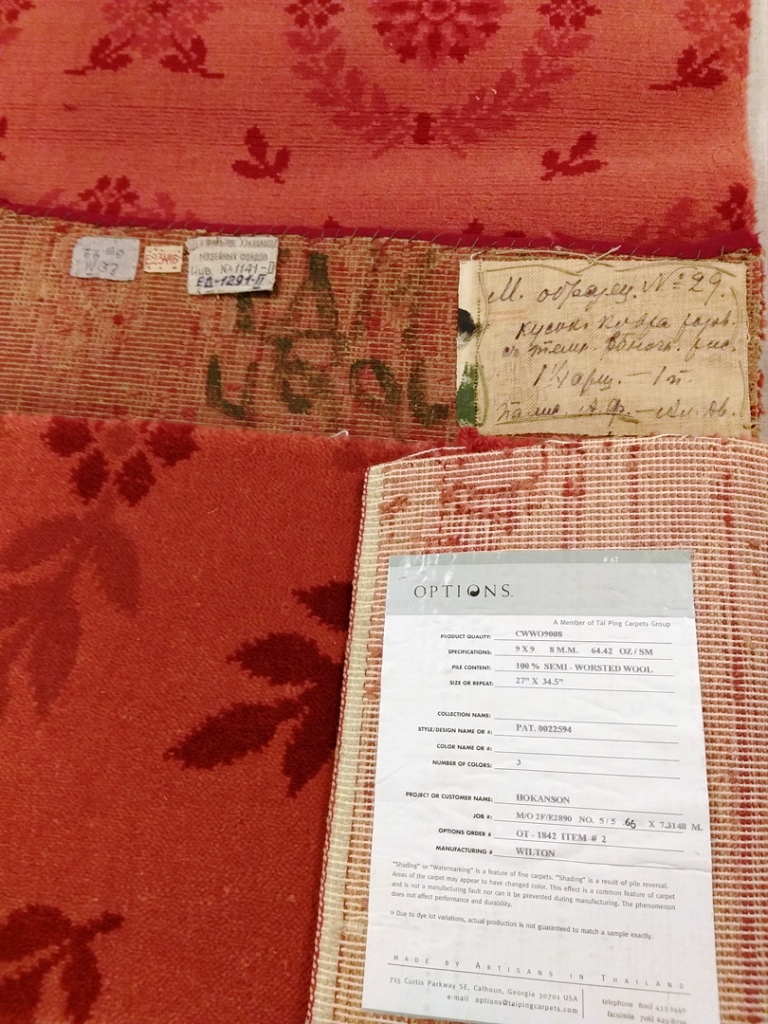
PHOTO: old and new carpet samples from Pallisander (Rosewood) Drawing Room

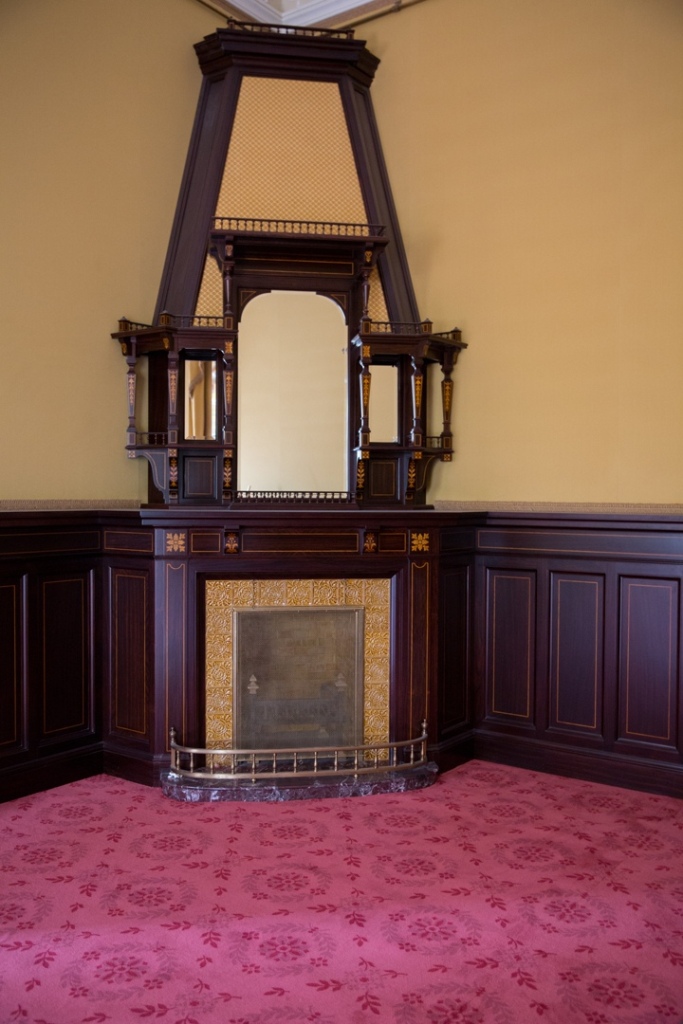
PHOTO: the purple Wilton carpet in the recreated Pallisander (Rosewood) Drawing Room

Sadly, the decoration of the Pallisander (Rosewood) Drawing Room were lost during the Great Patriotic War (1941-45). In 2013, the year marking the 300th anniversary of St. Petersburg, the Alexander Palace was presented with an exact copy of the Wilton carpet that once decorated the interior. Larry Hokanson, a carpet designer in the United States recreated the colour and pattern, based on the historical sample preserved in the museum’s collection.

In 2018–2020, expert Russian craftsmen recreated the Rosewood finish for the interior. The work on the manufacture of wood panels and fireplace cladding was carried out at the Stavros firm in St. Petersburg. Fabrics and trimmings for walls and curtains were recreated at the Rubelli in Italy and “Re Kon Art” in Poland. They were all able to achieve success, thanks to historical photographs and samples preserved in the Tsarskoye Selo and Pavlovsk museum-reserves. The fabric for the upper part of the fireplace was provided by the Alpina company.

In January 2020, the Tsarskoye Selo announced that they would recreate frames for original works of art, which decorated the room before the 1917 Tevolution. Now restoration specialists of the Tsarskoye Selo Amber Workshop are recreating pieces of the furniture set of the Pallisander (Rosewood) Drawing Room.

NOTE: all photos © Tsarskoye Selo State Museum-Reserve

© Paul Gilbert. 20 February 2021

***

Fifteen interiors situated in the eastern wing of the palace, are now scheduled to open to visitors in 2021. Among the recreated interiors are the New Study of Nicholas II, Moorish Bathroom of Nicholas II, Working Study of Nicholas II, Reception Room of Nicholas II, Pallisander (Rosewood) Living Room, Mauve (Lilac) Boudoir, Alexandra’s Corner Reception Room, the Imperial Bedroom, among others.

In the future, the Alexander Palace will become a memorial museum of the Romanov family – from Catherine the Great to Nicholas II, showcasing the private, domestic life of the Russian monarchs who used the palace as an official residence. The eastern wing of the palace will be known as the Museum of the Russian Imperial Family. The multi-museum complex, which includes the Western wing is scheduled for completion no earlier than 2024.

***

Dear Reader: If you enjoy my articles on the history and restoration of the Alexander Palace, then please help support my research by making a donation in US or Canadian dollars to my project The Truth About Nicholas II – please note that donations can be made by GoFundMePayPal, credit cardpersonal check or money order. The net proceeds help fund my work, including research, translations, etc. Thank you for your consideration – PG


The History and Restoration of the New Study of Nicholas II in the Alexander Palace

PHOTO: view of the New Study of Nicholas II, as it looked in 1917

In 1902–1904, Roman Feodorovich Meltser’s (1860-1943) firm carried out the construction, decoration and furnishing of the New Study of Emperor Nicholas II in the Alexander Palace. The work had to be carried out according to precise calculations and drawings, which were submitted for consideration by the Technical Committee organized under the Cabinet of His Imperial Majesty.

The emperor’s spacious four-window study had a mezzanine with marble columns, made by the German company Duckerhoff & Neumann (Nassau, Rhineland-Palatinate, Germany), which was connected to the mezzanine of the Maple Drawing Room on the opposite side of the eastern wing of the palace. The interior was heated by fireplaces ordered from Vienna. Several types of electric lamps were specially made to illuminate the office, based on the best technological achievements of Russian scientists Alexander Ladygin and Werner von Bolton, as well as the developments of General Electric. Meltzer decorated the lamps with Tiffany style shades with variegated glass. These cylindrical coloured glass “tulip lanterns” have not survived, but are clearly visible in historic photographs, which will allow restorers to recreate them exactly to their original.

PHOTO: view of the staircase leading to the mezzanine, which connected the New Study of
Nicholas II with the Maple Drawing Room, as it looked in 1917 (above); and in 1944 (below)

The ceiling in the Emperor’s study was made of mahogany, including the trim. The walls were painted with a deep blue-green mastic paint and stencilled with ornamental friezes around the tile cladding above the fireplace and a niche behind the table. The walls of the mezzanine were painted in light yellow tones with the same stencil ornament.

An important decorative element of the decoration of the rooms of the Alexander Palace during the late 19th to early 20th centuries, including the New Study were the beautiful oriental carpets. The New Study of Nicholas II, was decorated with large Persian carpets, on top of a seamed crimson carpet.

A pool table occupied the space along the northern wall of the New Study, with a fireplace decorated with blue relief tiles. The pool table was made according to Russian standards, developed and produced by the St. Petersburg manufacturer Adolf Freiberg. A large corner sofa was placed next to the table.

Near the opposite wall was a large desk with an upper shelf and an attached electric lamp on a block. The desk, was covered with many family photographs, writing instruments and other accessories and small memorabilia. Near the window on a high mahogany curb stone stood a plaster bust of Emperor Alexander II by the Italian sculptor Pietro Canonica (1869-1959). It is known that Canonica made a modified bronze copy of the sculpture, which was approved by Nicholas II. A copy of this bust is preserved in the collection of the Museum of Pietro Canonica in Rome, therefore, it will be possible to recreate the lost sculpture based on a historical analogue.

In the central part of the New Study was a large round table, armchairs and chairs, a soft sofa and an armchair with an oval tea table between them. The table, armchair and chair have been preserved and are today in the collection of the Pavlovsk Museum-Reserve. The first meeting in the New Study is noted in the diary of Nicholas II on 3rd May 1903.

The New Study of Nicholas II was filled with works of Danish and Russian porcelain, family photographs, books, and memorabilia. In the bookcases, in addition to works on history, politics and religion, there were the collected works of Shakespeare and Tennyson, works of Byron, Merimee, Gaultier, Hugo, Tolstoy, Chekhov, Merezhkovsky among many others.

The New Study is one of the few interiors of the Alexander Palace, the decoration of which partially survived the Great Patriotic War of 1941-45: the ceiling lining with brass overlays, a mahogany door, two fireplaces, and columns on the mezzanine have all been preserved.

PHOTO: the New Study of Emperor Nicholas II, as it looked between 1997-2015

The interior of the New Study of Emperor Nicholas II was partially restored in 1997 for the opening of the Memories in the Alexander Palace exhibition. Several years later, the interior decoration was reconstructed, which included built-in wardrobes, sofas, chairs, a desk, lighting fixtures, draperies on the windows, made from photographs of the 1930s and inventory drawings of the Tsarskoye Selo Artistic and Historical Commission of 1918. These items were made in 2000 for the filming of Gleb Panfilov’s film The Romanovs. Crowned Family

The current restoration of the interior began in 2015. In 2019, restorers discovered the original color and a fragment of the stencil painting that framed the fireplace portal, which made it possible to restore the historic color of the cabinet walls. The discovery of surviving samples of English tiles made it possible to recreate the cladding of the fireplace inserts and fireplaces.

PHOTO: the restored fireplace in the New Study (above); and a detail of the tile (below)

Furniture lost during the war will be recreated for the New Study. A corner sofa for the billiard table has already been made, a display cabinet, bookcases, wall sconces with Tiffany lanterns and other lighting fixtures are being recreated; work is underway to restore the writing table and billiards, matched by analogy. One future project, is a plan to restore the window frames with cathedral (stained-glass) glass based on information from archival sources.

The Russian company “Tissura” together with the Swiss company Fabric Frontlain, have recreated the silk fabric decorated with hyacinths for the window decoration based on historical samples preserved in the Collection of the Tsarskoye Selo State Museum. The window curtains will be made by the St. Petersburg firm “Le Lux”.

PHOTO: the current look of the restored New Study of Emperor Nicholas II

Specialists from the Studio 44 architectural bureau, will soon begin work on the reconstruction of the lost pieces of furniture and lighting fixtures for the New Study.

Paintings, porcelain, and interior sculptures which have been preserved in the Pavlovsk State Museum-Reserve, will be returned to the Alexander Palace. Among them – paintings, sculptures, busts, Danish porcelain, etc. Following the completion of the restoration of the New Study, these items will be returned to their historical places in the Alexander Palace.

© Paul Gilbert. 10 February 2021
The fate of the contents of the Alexander Palace in the 20th century

PHOTO: the Alexander Palace was established as a museum in June 1918

Thousands of items from the Alexander Palace were destroyed or stolen in the decades that followed the 1917 Revolution. Thousands more were moved to other locations, where they remain to this day. This article examines the fate of the Alexander Palace collection, researched from Russian archival sources.

The ‘Romanov Museum’

On 1st August 1917, Emperor Nicholas and his family left the Alexander Palace for the last time. It was on this day that the Imperial family were sent into exile to Tobolsk, where they spent 8 months under house arrest, before being transferred to Ekaterinburg, where they were murdered by the Ural Soviet on 17th July 1918.

In June 1918, the Alexander Palace was established as a museum and opened to the public. Throngs of visitors – among them many revolutionaries and their families – filed silently through the state halls located in the central part of the building and the private apartments of the last tsar and his family located in the east wing of the palace.

The Bolsheviks had led the Russian people into believing that Nicholas II and his family lived in great luxury, however, the interiors of the Alexander Palace proved otherwise. Compared to their 18th century ancestors, Nicholas II and his family lived rather modestly. The Alexander Palace lacked the ostentatious interiors of the nearby Catherine Palace the Great Palace at Peterhof, and even that of the Winter Palace in Petrograd (St. Petersburg).

Following the uncertainty of the political climate during 1917, members of the Tsarskoye Selo Commission prepared for the evacuation of highly artistic items from the collection of the Imperial residences, including the Alexander Palace. These included paintings by outstanding artists, sculptures, the finest examples of furniture, bronze, porcelain and crystal. In total, 50 crates with items from the Alexander Palace were packed and transported by train to Moscow in two separate shipments – 15-17th September 6-8th October. The items were placed in storage in the Armoury and the Grand Kremlin Palace.

In October 1917, the Artistic and Historical Commission began to compile descriptions of the interiors of the Alexander Palace. They refused to compile new inventories, preferring instead to draw up cards with descriptions of objects, carry out plans for the arrangement of furniture, explication of interiors and take photographs of each room, its possessions and decoration.

This decision was made due to the fact that there was an enormous number of items in the Alexander Palace, which meant that to list every item, not to mention their description, would take a lot of time, which the Artistic-Historical Commission did not have, due to the growing political unrest in Petrograd.

In December 1920, the valuables evacuated in 1917 were returned to Tsarskoye Selo from Moscow, among them were 32 crates containing items from the Alexander Palace. In parallel with the rest of the work, the researchers began unpacking the re-evacuated exhibits, examining them, checking against the inventories, and by 1923 all items were returned to their historical places in the Alexander Palace.

The Soviet regime were always hostile towards the ‘Romanov Museum’ and made constant threats  to close the museum and sell off its treasures. Luckily, the museum staff managed to dissuade the government from this step and the museum operated up until the beginning of the Second World War.

In 1941 the Alexander Palace was closed, the children’s toys and furniture were transferred to the Toy Museum in Moscow [in 1931, the museum was transferred to Zagorsk – renamed Sergiev Posad – where many of OTMAAs toys remain to this day – PG].

PHOTO: the damaged Alexander Palace and SS cemetery, 1944

Nazi occupation

In the first months of the Great Patriotic War (1941-44), only a part of the contents of the Alexander Palace was evacuated: chandeliers, carpets, some pieces of furniture, marble and porcelain. The bulk of the contents remained in the palace during the war, and suffered great losses.

By mid-September 1941, the Alexander Palace – along with the rest of Pushkin [Tsarskoye Selo] – was near the front line. During the occupation of Pushkin, the Nazi Headquarters was located in the Alexander Palace, the torture chambers of the Gestapo located in the basement, and a cemetery for 85 SS officers was created in the lawn, situated in front of the palace.

When Soviet troops entered the city in 1944, the Alexander Palace, like all other palaces, was in a terrible state. Historical interiors had been looted, thousands of items stolen or destroyed, some interiors had been completely destroyed.

The building itself suffered to a much lesser extent than the nearby Catherine Palace. The former sustained some shelling by the Soviets, who were determined to drive the Nazi invaders from the Alexander Palace, where they were holed up. The palace had been looted by the retreating Nazi’s which resulted in many of the palaces treasures being stolen. According to the Ministry of Cultural Affairs of the Russian Federation, the registered inventory for the Alexander Palace had 30,382 items, of which 22,628 items – more than two thirds – were recorded as lost or stolen at the end of World War II.

PHOTO: the Alexander Palace surrounded by security fence and barbed wire

Post-war years 

At the end of the war, the palace was mothballed and in 1946 was handed over to the USSR Academy of Sciences to store the collections of the Institute of Russian Literature and to house the exposition of the All-Union Museum of Alexander Pushkin. Between 1947-1951, restoration work began on the Alexander Palace, during which it was planned to restore the surviving interiors of the plans of the architect Giacomo Quarenghi (1744-1817), and the surviving fragments of the decoration, as well as to recreate the interiors of the time of Emperors Nicholas I and Nicholas II. However, during the work, many elements of the decoration of the Maple and Rosewood drawing rooms of Empress Alexandra Feodorovna, as well as the Moorish Bathroom of Nicholas II were lost. Instead, these interiors were modified according to the project of the Soviet architect Lev Moiseevich Bezverkhny (1908–1963).

‘In 1951, by a government decree, the Alexander Palace was transferred to the Ministry of Defense. The Naval Department used the building as a top-secret, submarine tracking research institute of the Baltic Fleet. As a result, the former palace would be strictly off-limits to visitors for the next 45 years. The Alexander Palace was surrounded by a security fence and barbed wire and closed to the public. Even historians could not gain access inside.

‘The palace’s collection which was among the evacuated items in the Central Repository of Museum Stocks from the Suburban Palace-Museums was transferred to the Pavlovsk Palace Museum. A total of 5,615 items were moved from the palace to Pavlovsk. Of these, nearly 200 pieces were originally from the Alexander Palaces’ three ceremonial halls: the Portrait, Semi-Circular and Marble Halls. These include 39 pieces of porcelain, 41 paintings, 73 decorative bronze pieces, and 28 pieces of furniture.’¹

At the time, no one could have imagined that the Soviet Union would end, so it was just automatically assumed that these items would remain part of the Pavlovsk collection. Most of these items remain at Pavlovsk to this day.

PHOTO: most of the interiors in the “Memories in the Alexander Palace” exhibition,
featured huge floor to ceiling photos depicting the original look of each room,
and served as backdrops, against which items of furniture were displayed

The Post-Soviet years

In 1996, a grant from the World Monuments Fund (WMF) was received for the restoration of the Alexander Palace, and work began to repair the building’s roof.

In 1997, the first museum exposition “Memories in the Alexander Palace” was opened in the east wing of the Alexander Palace. Since almost all the historic interiors of Nicholas II and his family were lost, large floor to ceiling photos depicting the original look of each room, served as backdrops, against which items of furniture were displayed.

In 2009, the Alexander Palace was transferred to the administration of the Tsarskoye Selo State Museum-Reserve. In June 2010, the year marking the 300th anniversary of Tsarskoye Selo, the Portrait, Semi-Circular and Billiard Halls were opened to the public after an extensive restoration.

PHOTO: Empress Alexandra Feodorovna’s dresses on display at Pavlovsk

It is interesting to add, that in 2007, Pavlovsk opened a costume museum in one of the wings of the palace. The permanent exhibit showcases a mere fraction of dresses, hats, gloves, fans, and other personal items of Empresses Maria Feodorovna and Alexandra Feodorovna, as well as Grand Duchesses Olga, Tatiana, Maria and Anastasia.

Given that Nicholas II and his family never resided at Pavlovsk, how is it that these items from the wardrobes of the last Imperial family are today part of the Pavlovsk collection? As it turns out, they are among the many thousands of items transferred from the Central Repository of Museum Stocks from the Suburban Palace-Museums in 1951.

Since the fall of the Soviet Union in 1991, and in particular since the restoration of the Alexander Palace, the return of the collection has been a bone of contention between the two palace-museums. During a visit to Pavlovsk several years ago, I raised the subject with one of the Directors at Pavlovsk. “If we return these exhibits to the Alexander Palace, then we [Pavlovsk] will have nothing,” he declared.

Surely, the Pavlovsk Palace State Museum have a moral responsibility to return all of the items to their rightful home? Their history belongs to the Alexander Palace. It seems that the Minister of Culture of the Russian Federation Olga Lyubimova will have the final say. Let us hope that she does the right thing, and order the return of these items to the Alexander Palace, where they can be put on display in the rooms from which they originated.

It is interesting to note that during the course of the restoration of the Alexander Palace, which began in 2015, some items which were stolen during the Great Patriotic War have found their way home to the Alexander Palace. In recent years, a number of items have been returned by the descendants of German soldiers who stole from the palace during the Nazi retreat in 1944. Let us hope that their actions set an example to others.

Fifteen interiors situated in the eastern wing of the palace, are now scheduled to open to visitors in 2021. Among the recreated interiors are the New Study of Nicholas II, Moorish Bathroom of Nicholas II, Working Study of Nicholas II, Reception Room of Nicholas II, Pallisander (Rosewood) Living Room, Mauve (Lilac) Boudoir, Alexandra’s Corner Reception Room, the Imperial Bedroom, among others.

In the future, the Alexander Palace will become a memorial museum of the Romanov family – from Catherine the Great to Nicholas II, showcasing the private, domestic life of the Russian monarchs who used the palace as an official residence. The eastern wing of the palace will be known as the Museum of the Russian Imperial Family. The multi-museum complex, which includes the Western wing is scheduled for completion no earlier than 2024.

© Paul Gilbert. 17 January 2021

¹ ‘My Russia. The Rebirth of the Alexander Palace’ by Paul Gilbert. Published in ‘Royal Russia No. 3 (2013), pgs. 1-11
***


Paul Gilbert’s Romanov Bookshop on AMAZON

I have published nearly 50 titles to date through AMAZON – featuring one of the largest selections of books on Nicholas II, the Romanov dynasty and the history of Imperial Russia.

Please CLICK on the BANNER or LINK above to review my current selection of titles in hardcover, paperback and ebook editions. Listings provide a full description for each title, pricing and a Look inside feature.