‘You reap what you sow’ – Monarchists take revenge on the regicide Peter Ermakov

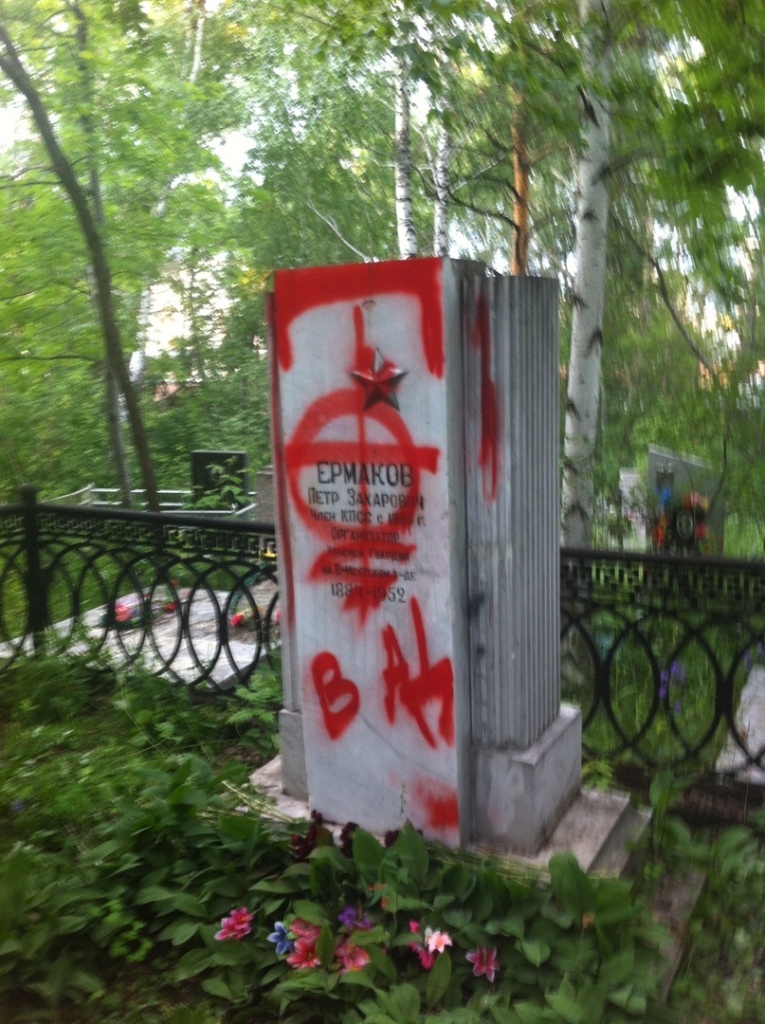
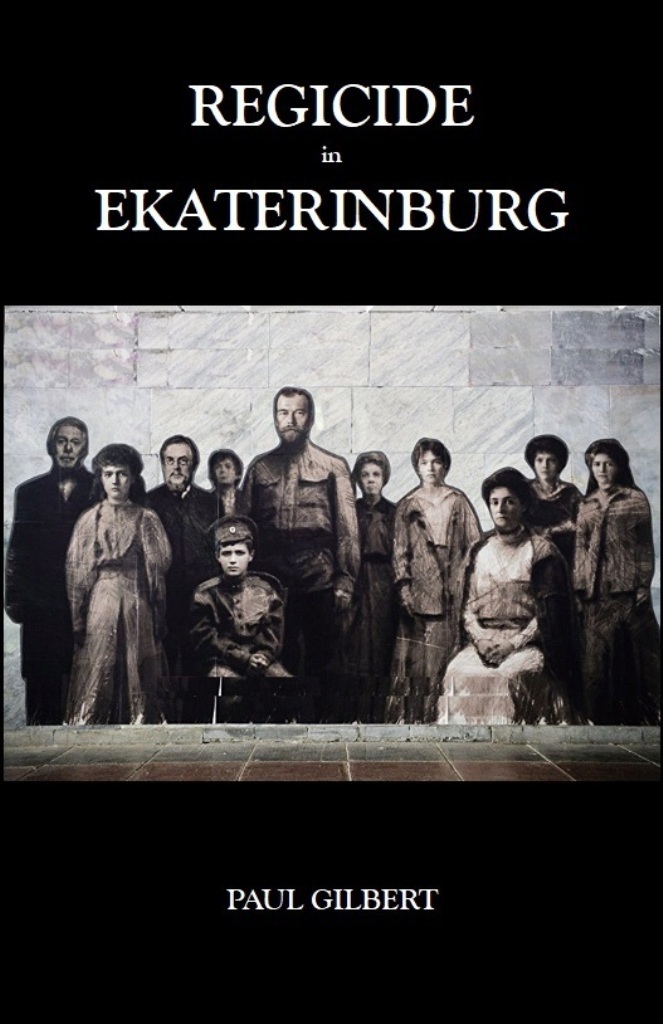
PHOTO: the desecrated grave of the regicide Peter Ermakov in Ivanovo Cemetery in Ekaterinburg

Every year on 17th July – the day marking the anniversary of the murder of Emperor Nicholas II and his family – the grave of the Bolshevik revolutionary Peter Ermakov, has been vandalized by local monarchists, who douse his gravestone with red paint.

This annual protest began shortly after the fall of the Soviet Union in the early 1990s. The red paint symbolizes the blood which this evil man spilled, and his involvement in the regicide.

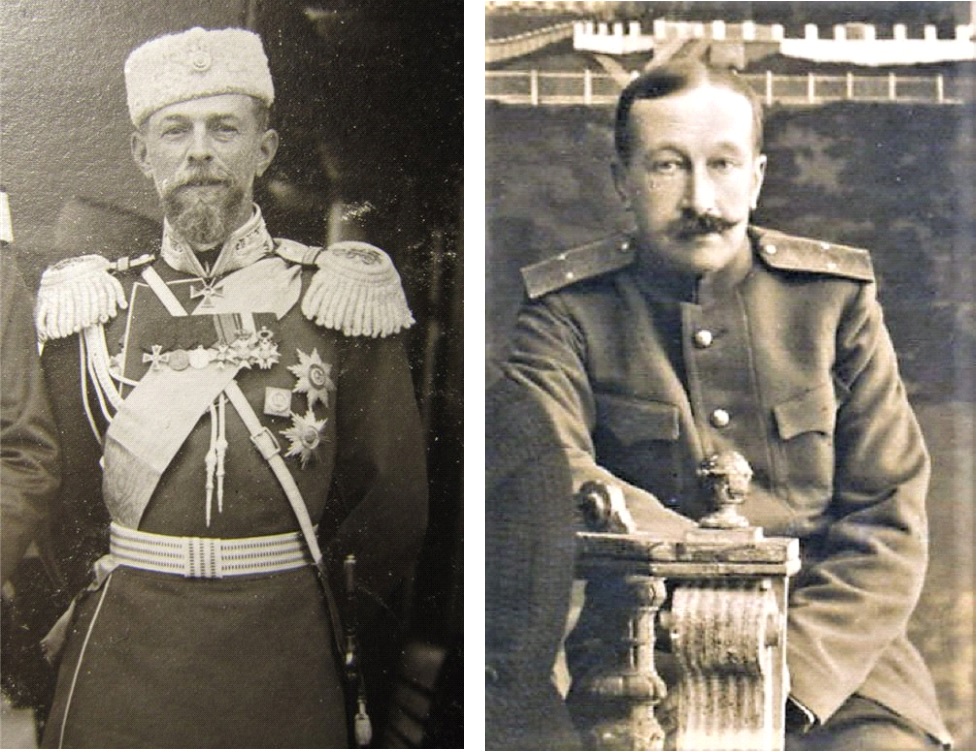
Pyotr (Peter) Zakharovich Ermakov (1884–1952), was one of several men responsible for the murder of Emperor Nicholas II, his wife, their five children, and their four faithful retainers in the basement of the Ipatiev House in Ekaterinburg.

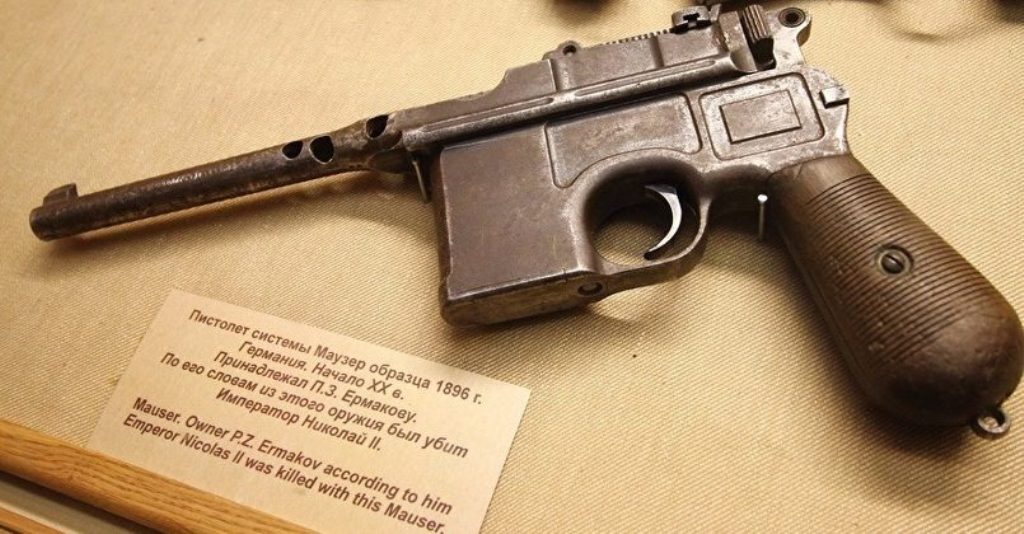
He was also among the men in the firing squad, and considered to be the most bloodthirsty of the executioners. His Mauser revolver, which he alleges fired the fatal shot which ended the life of the Tsar is preserved today in the permanent exhibition The Romanovs in the Urals opened at the Poklevsky-Kozell House Museum in Ekaterinburg.

According to his own recollections, it was he who also murdered the Empress Alexandra Feodorovna, the cook Ivan Kharitonov and the doctor Eugene Botkin. He often boasted of his crime, without feeling any sense of remorse: “I shot the Tsarina who was seated only six feet away, I could not miss. My bullet hit her right in the mouth, two seconds later she was dead. Then I shot Dr. Botkin. He threw up his hands and half turned away. The bullet hit him in the neck. He fell backwards. Yurovsky’s shot knocked the Tsesarevich to the floor, where he lay and groaned. The cook Kharitonov was huddled over in the corner. I shot him first in the torso and then in the head. The footman Troupe also fell, I don’t know who shot him … ”

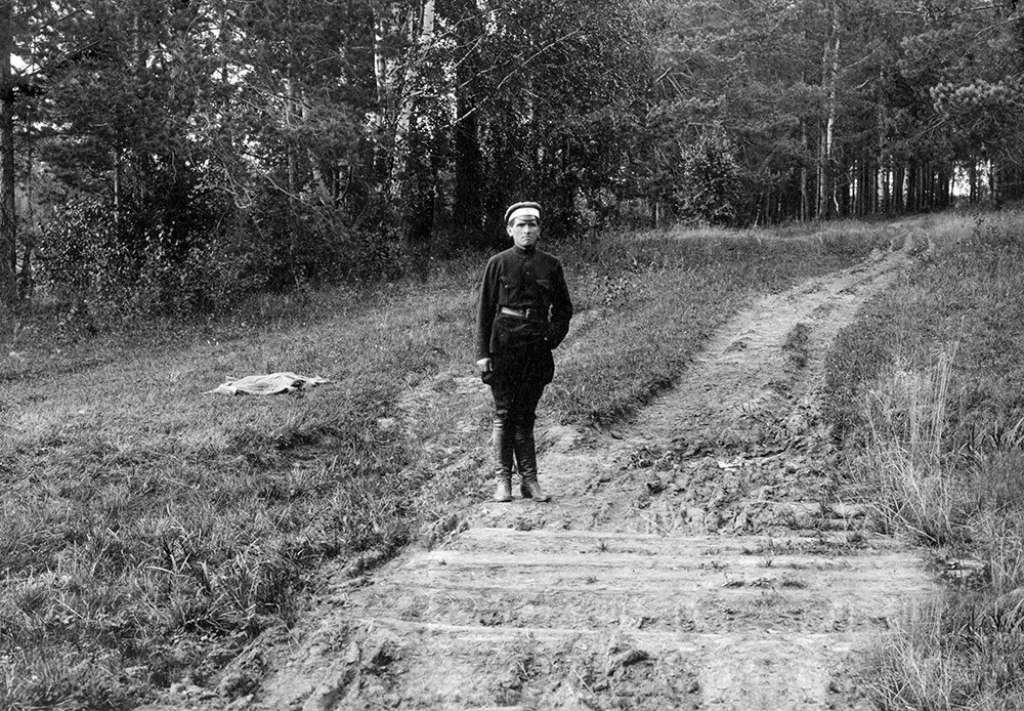
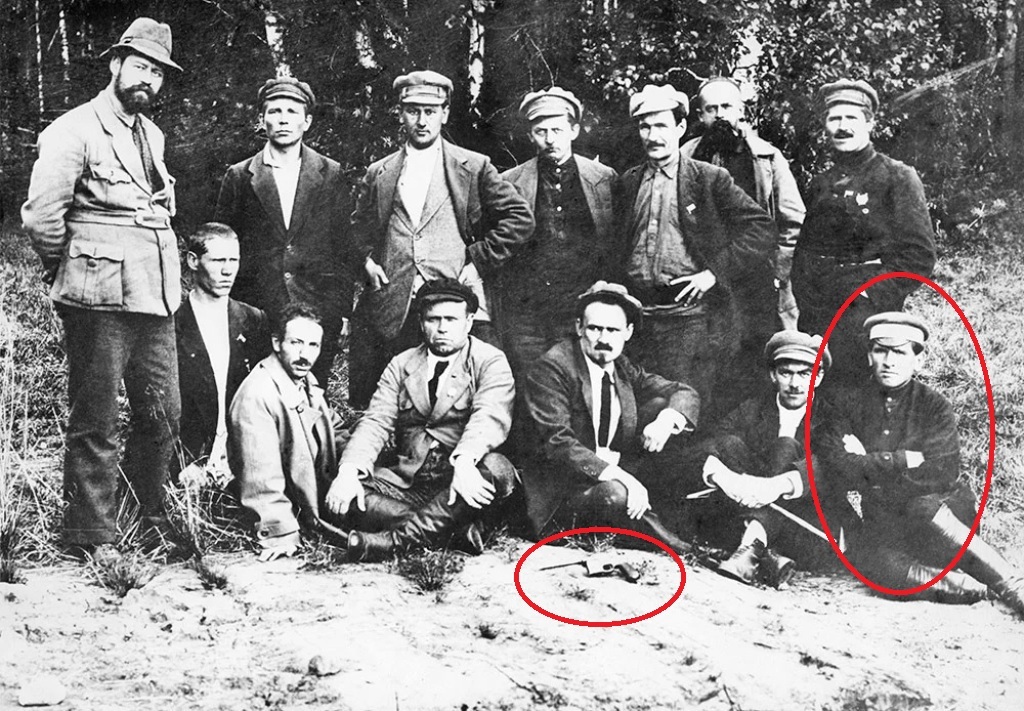
PHOTOS: (above) Ermakov standing on the grave of members of the Imperial Family and their retainers at Porosenkov Log in the 1920s; (below) Ermakov (far right) posing with a group of prominent Ural Bolsheviks on the Tsar’s grave, his Mauser pistol can be seen in the foreground in front of P.M. Bykov, author of The Last Days of Tsardom (1934)

In the 1920s, Yermakov returned to Porosenkov Log where he had his photograph taken standing on the railway ties which concealed the second grave of the Imperial Family. On the reverse of this photo, he wrote: “I am standing on the grave of the Tsar”.

In 1951, at a reception, which gathered all the local Party elite in Sverdlovsk [Ekaterinburg], Peter Ermakov approached Soviet Red Army General Georgy Zhukov (1896-1974) and held out his hand. Frowning in disgust Zhukov looked Ermakov in the eye, and muttered, “I do not shake the hands of the murderers.”

Ermakov died in Sverdlovsk on 22 May 1952 from cancer at the age of 67, he was buried in Ivanovo Cemetery in Ekaterinburg.

In January 2022, the famous Russian sculptor Konstantin Vasilievich Grunberg has proposed replacing monuments of the Bolshevik leaders Vladimir Ulyanov (Lenin) and Yakov Sverdlov in Ekaterinburg.

Grunberg also called for debunking the image of the revolutionary “hero” Pyotr Yermakov. “People still bring flowers to his grave. We need to destroy this regicide’s grave!” the sculptor said.

PHOTO: Ermakov’s Mauser revolver, which he alleges fired the fatal shot which ended the life of Russia’s last Tsar is preserved today in the new permanent exhibition The Romanovs in the Urals opened at the Poklevsky-Kozell House Museum  in Ekaterinburg

Click HERE to read my article Yakov Yurovskys’ ashes remain hidden from vandals in Moscow, originally published on 23rd November 2019

Click HERE to read my article The fate of the regicides who murdered Nicholas II and his family, originally published on 28th October 2020

© Paul Gilbert. 17 January 2023

***

The following NEW title was compiled and edited by independent researchers and Romanov historian Paul Gilbert was published in August 2024. 

This fascinating new study features 14 chapters on this tragic event, which include the memoirs of a British intelligence officer and journalist, and two First-English translations. In addition, 11 chapters were written by Paul Gilbert, based on new documents sourced from Russian archival and media sources over the past decade.

Please refer to the link provided for further details about the content of this new title . . .

CLICK HERE TO READ MORE ABOUT THIS TITLE

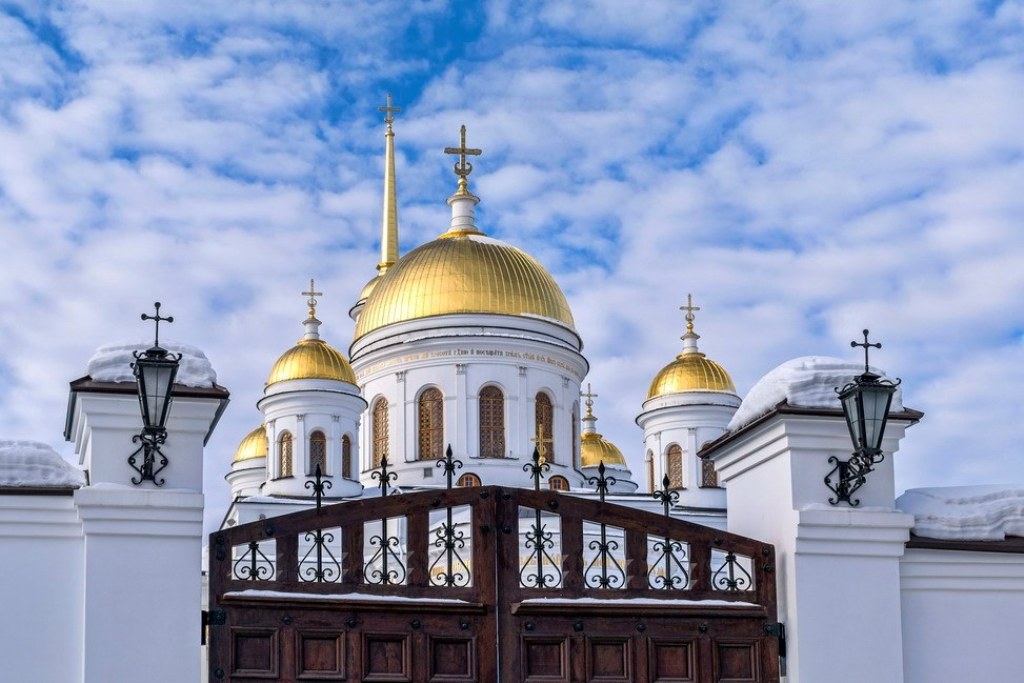
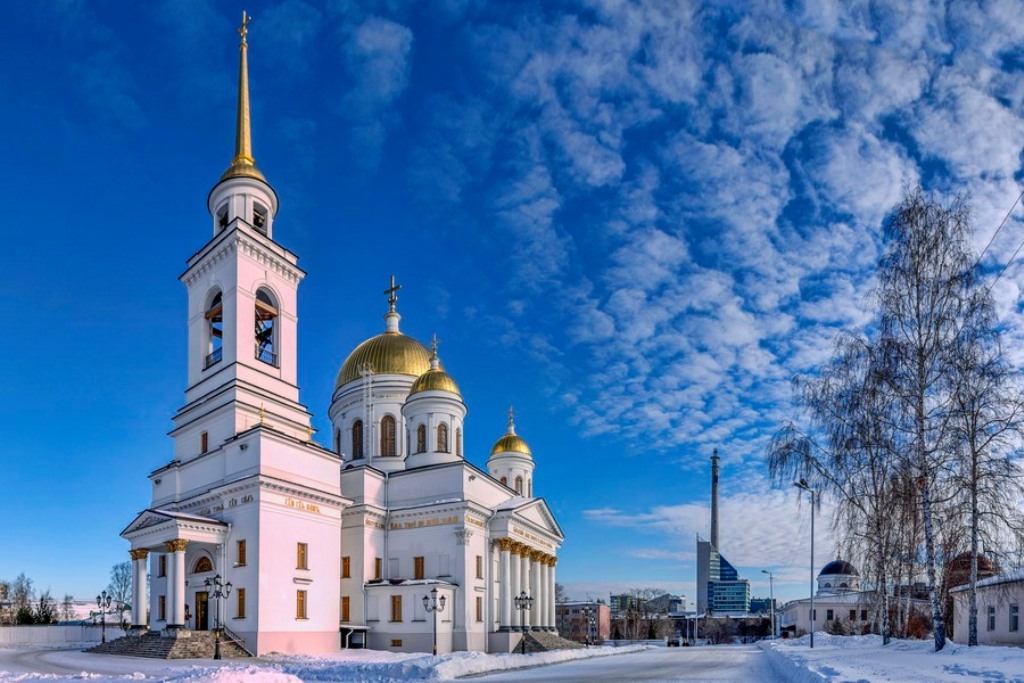
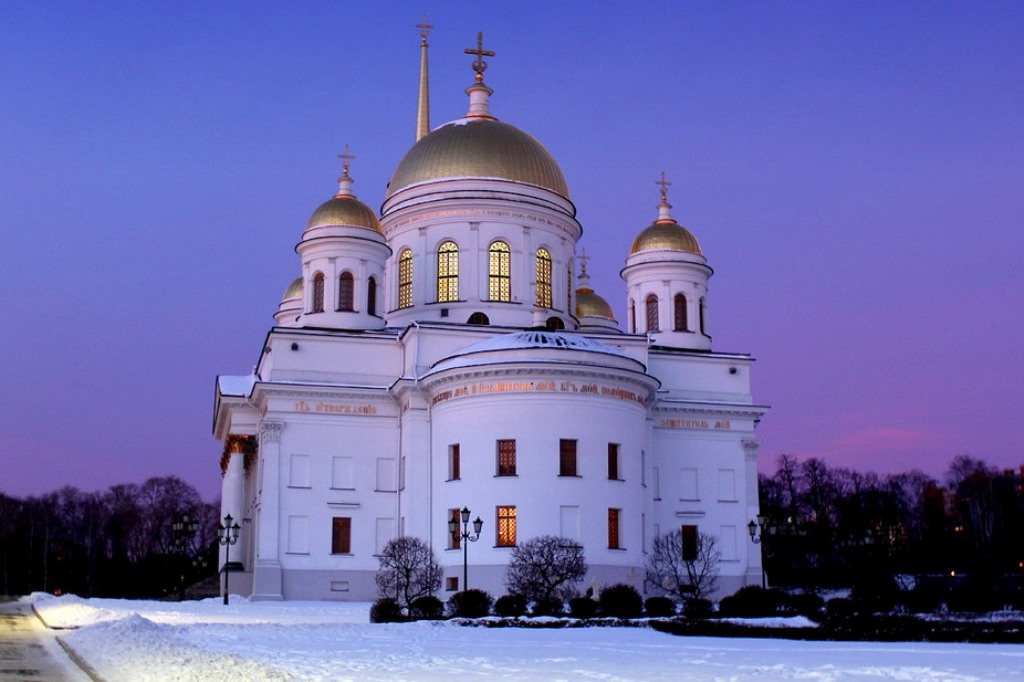
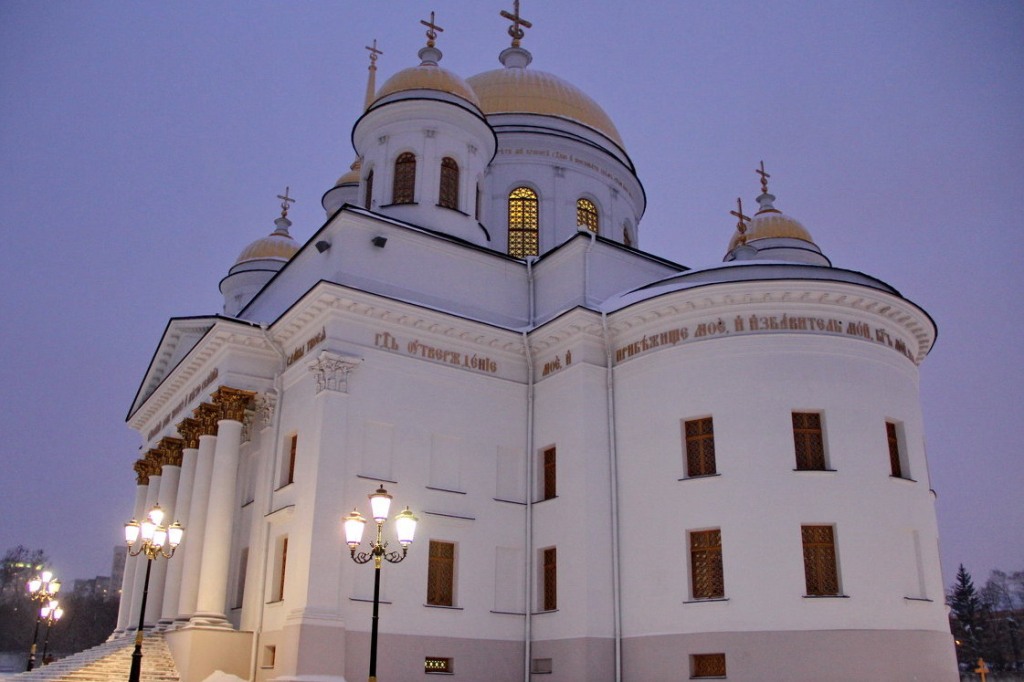
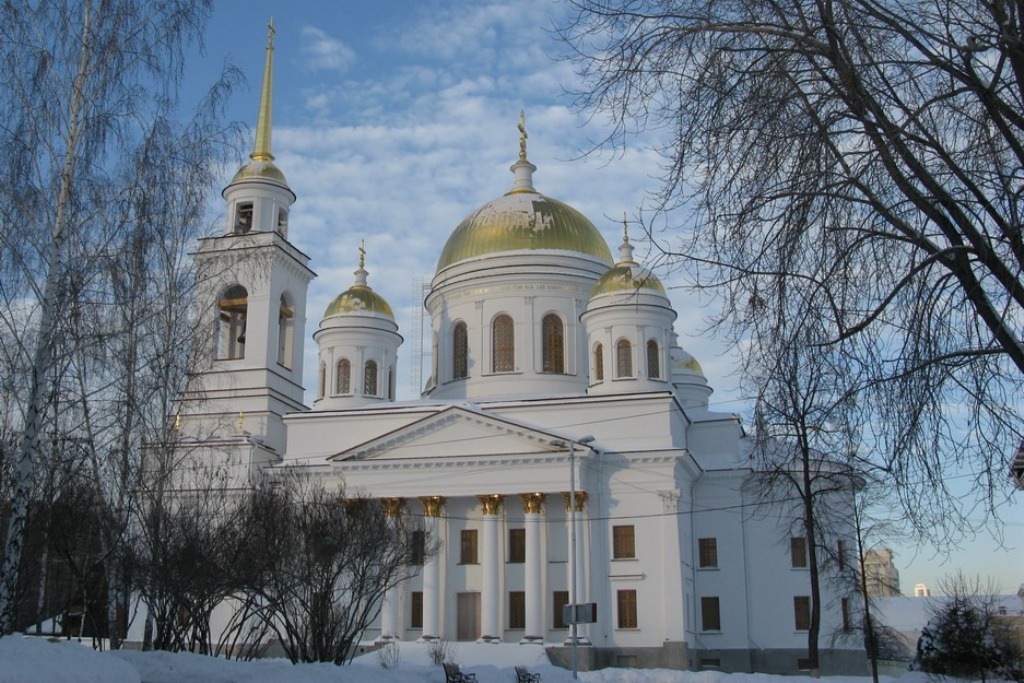
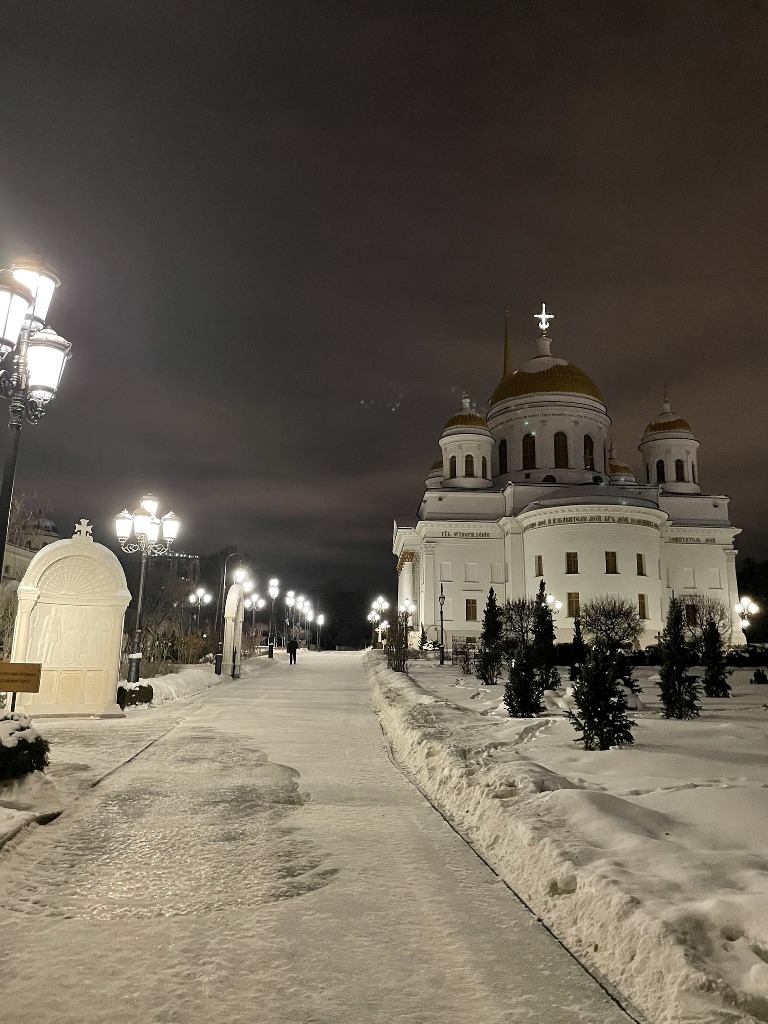
Beautiful winter views of the Novo-Tikvinsky Convent, Ekaterinburg

PHOTO: the Cathedral of St. Alexander Nevsky in the Novo-Tikvinsky Convent
© Ново-Тихвинский женский монастырь

Snow-covered paths, trees covered in hoarfrost, early evening twilight reflect the silent beauty of winter which surrounds the Cathedral of St. Alexander Nevsky, depicted in these beautiful photos.

The Novo-Tikhvin Monastery is a community of female monastics. It was founded in the late 18th century, growing out of an alms-house at the cemetery church in Ekaterinburg. It is the home of the icon of the Tikhvin Mother of God. Closed in 1920 by the Bolsheviks, monastic life at the monastery was restored in 1994.

In 1918, when Nicholas II and his family were being held under arrest in the Ipatiev House, the nuns of the Novo-Tikhvinsky Convent were praying for them, asking God to relieve their sufferings,and to give them the strength to bear everything with Christian humility.

The sisters’ help came not only through prayer but also through deeds: disregarding their own safety, they supported the Tsar and his family by bringing various foods to them through the guards. On 18th June 1918, a month before their murder, Empress Alexandra Feodorvna made the following entry in her diary: “The kind nuns are now sending milk and eggs for Alexei and for us, as well as cream.”

I have spent many hours praying in the Cathedral of St. Alexander Nevsky, during my visits to the Ural city in 2012, 2016 and 2018 respectively. It was during my visit to Ekaterinburg in the summer of 2016, that my hotel was situated behind the convent, and I had a clear view of the cathedral from my window. I went every morning to the cathedral to pray, and every afternoon in the beautifully landscaped gardens which surround the Cathedral.

Click HERE to read why Ekaterinburg is my favourite Russian city.

PHOTO: the Cathedral of St. Alexander Nevsky in the Novo-Tikvinsky Convent
© Ново-Тихвинский женский монастырь

PHOTO: the Cathedral of St. Alexander Nevsky in the Novo-Tikvinsky Convent
© Ново-Тихвинский женский монастырь

PHOTO: the Cathedral of St. Alexander Nevsky in the Novo-Tikvinsky Convent
© Ново-Тихвинский женский монастырь

PHOTO: the Cathedral of St. Alexander Nevsky in the Novo-Tikvinsky Convent
© Ново-Тихвинский женский монастырь

PHOTO: the Cathedral of St. Alexander Nevsky in the Novo-Tikvinsky Convent
© Ново-Тихвинский женский монастырь

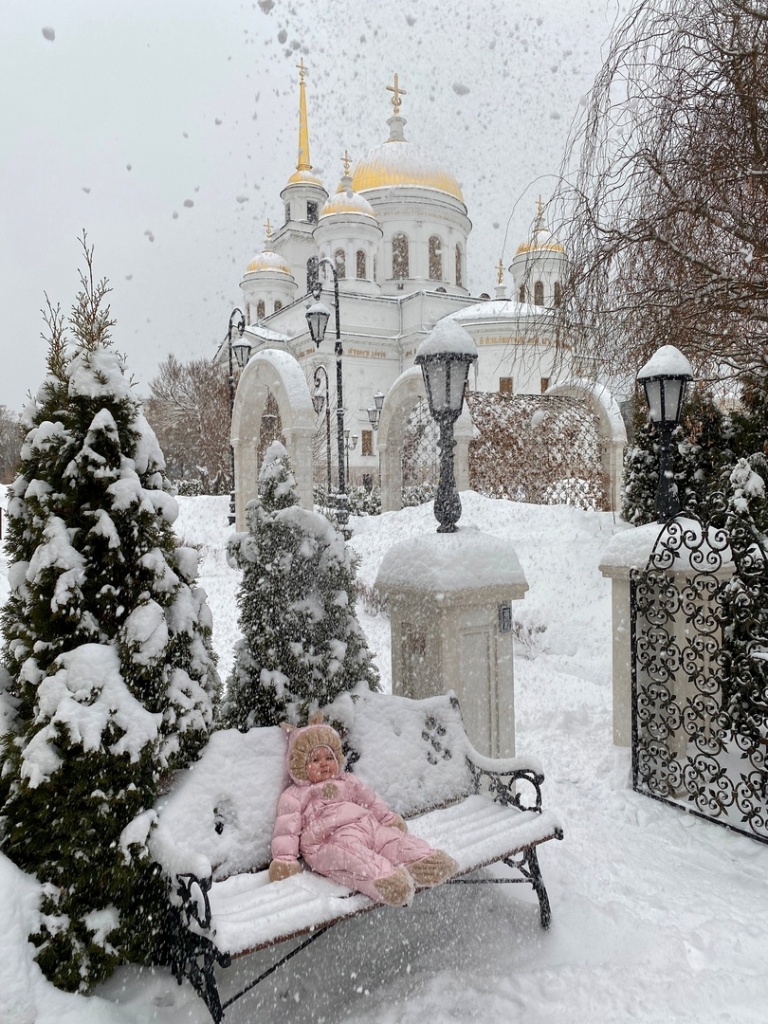
PHOTO: I simply could not resist sharing this photo . . . A mother takes a photo of her little one [who looks like a little angel] sitting on a bench in the garden of the Novo-Tikhvinsky Convent in Ekaterinburg. The magnificent Cathedral of St. Alexander Nevsky can be seen in the background. The snow simply enhances the beauty of this photo. © Ново-Тихвинский женский монастырь

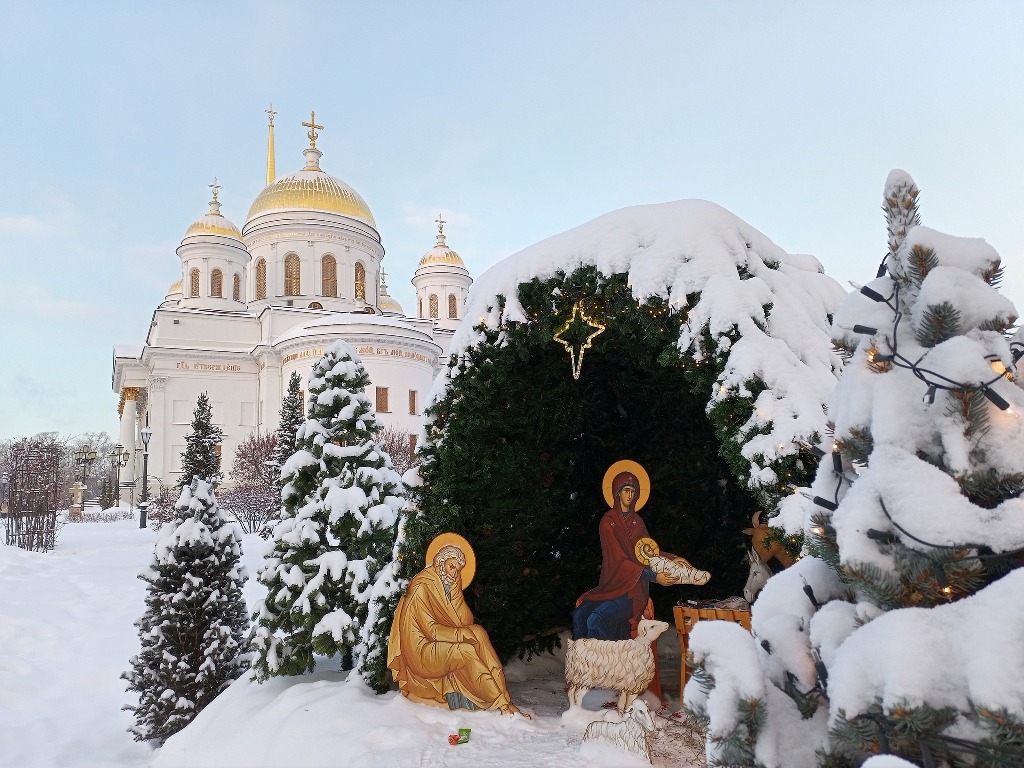
PHOTO: the Nativity set against the backdrop of the Cathedral of St. Alexander Nevsky at the Novo-Tikvinsky Convent, Ekaterinburg. © Ново-Тихвинский женский монастырь

PHOTO: A lovely winters night view of St. Alexander Nevsky Cathedral at the Novo-Tikhvinsky Convent in Ekaterinburg. On the left, you can see the new monument to four faithful servants of Emperor Nicholas II, which was installed and consecrated this past summer, on the grounds of the Convent. © Ново-Тихвинский женский монастырь

© Paul Gilbert. 9 January 2023

The fate of Anna Kuzminykh, a servant in the Ipatiev House

PHOTO: Anna (right) with her mother and son Ivan in 1916

NOTE: the publication of this article has been met with both great interest and some skepticism. As Anna “Anyuta” Vasilievna Kuzminykh (1890-1954), did not leave any paper trail, which documented her brief period in the Ipatiev House, there is much to her story which allows for speculation, therefore, her story – as told through her niece and historian many years later, should be taken with a cautionary view – PG

Thanks to the research of a Russian historian, we now have a better understanding of the fate of Anna Vasilievna Kuzminykh (1890-1954), one of the lesser known servants in the Ipatiev House, during the summer of 1918.

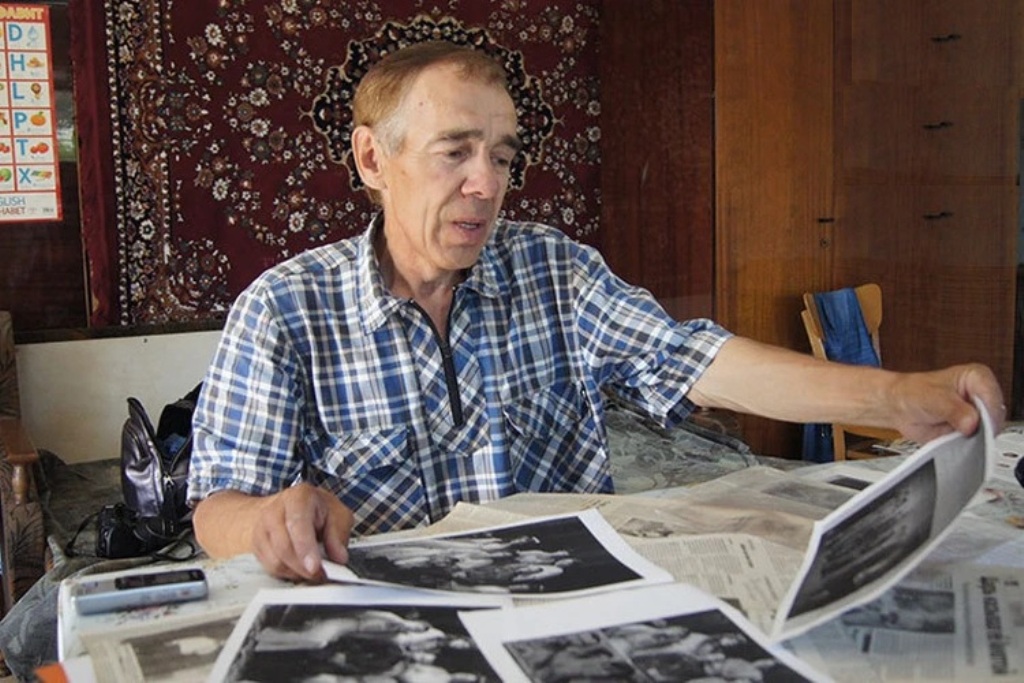
According to the Kambarka (Udmurt Republic in Russia) historian and archivist Razif Mirzayanov, shortly before the murder of the Imperial Family in Ekaterinburg, the Tsar ordered Anna Kuzminykh, to leave the Ipatiev House, and thereby saved her life.

“I learned about the fate of Anna Kuzminykh in 1999, from her niece Zoya Grigoryevna Zhizhina” – says Mirzayanov. Anna herself was no longer alive by that time – she had died in 1954. The historian added, that Anna had not told anyone about her brief period as a servant in the Ipatiev House, during the summer of 1918, except for her niece Zoya Grigoryevna.

Anna was born on 9th February 1890, in the village of Kambarsky Zavod (now Kambarka), into the family of a local tailor Vasily Michkov. She married Yegor Kuzminykh, when the First World War broke out, who was ordered to the Front in 1914. Following the February 1917 Revolution, Anna left Kambarka the following year to work in Ekaterinburg, leaving behind her young son Ivan and mother. By some miracle, Anna was able to get a job at the Ipatiev House, the mansion requisitioned by the Bolsheviks and renamed the “House of Special Purpose”, where Emperor Nicholas II and his family were held under house arrest from April to July 1918. Anna was entrusted with the care of two cows, which provided milk for the prisoners.

PHOTO: in 2017, Razif Mirzayanov, Chairman of the Society of Historians and Archivists of the Kambarsky District, was awarded a medal in honour for his research on the Romanov’s

THE TSAR CALLED HER ANYUTA

One day, after having milked one of the cows, Anna went up to the house with a full bucket of milk, only to be rebuffed by the Empress herself: “Anna, once again, you milked both cows in one bucket. The milk will turn sour!” “What are you talking about,” Anna replied, “this bucket is from one cow that gives so much milk.” After straining the milk, Anna returned to the barn to milk the second cow. Then, pouring flour into a bucket for a mash to feed the cattle, she heard someone’s footsteps enter the barn.

Looking around, Anna saw Nicholas II and Alexandra Feodorovna standing before her. “Now I understand why cows are milked in buckets,” said Nicholas. One of the cows reached out to him with her muzzle, which was covered in flour, the Tsar gently stroked the animal. “Don’t you feel sorry, Anyuta, for using so much flour?” he asked the servant. “Yes, there is a lot of it, but it will be enough for a long time,” she replied briskly. From then on, the Tsar called her Anyuta.

Since there were few servants, Anna also had to work in the kitchen, helping the cook to prepare and serve meals, says Mirzayanov. She later recalled that the guards present in the dining room during lunch, often helped themselves to the food prepared for the Imperial Family.

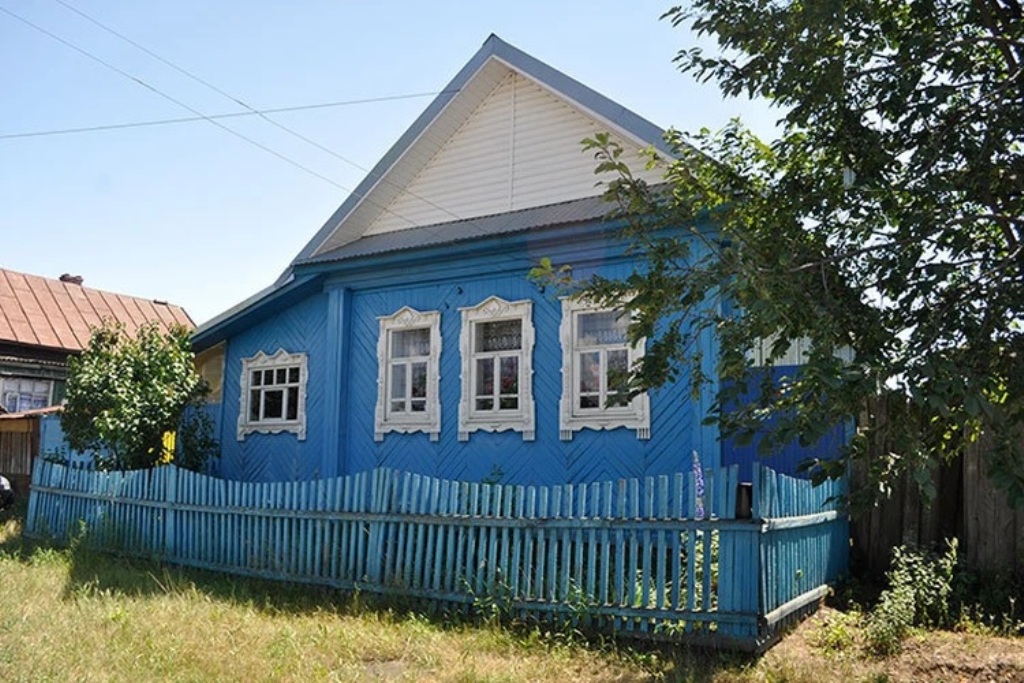
PHOTO: the house in Kambarka, where Anna lived with her family. Her descendants still live here

THANKED FOR HER WORK AND ORDERED TO LEAVE

“On a hot summer day in early July 1918, a search was conducted in the Ipatiev House,” Razif Mirzayanov continues his story. A band of Chekist thugs examined the personal belongings of the Imperial Family, even roughly leafing through books and rummaging through linens. The captives and their faithful servants stood in silence while they carried out their work. Anna stood frightened in the doorway of the room where the Tsar knelt before a kiot with icons and prayed. He never turned around or stood up while the search was going on. One of the Chekists, while turning out suitcases, cursed and swore filthy obscenities at the Tsar. In one of the suitcases, the Chekist found a long black lace shawl. Turning it in his dirty hands, he angrily threw it to Anna and shouted: “Take it, it will come in handy for you, while you are still young!”

This black lace shawl was kept for a long time in the Kuzmin family: Anna’s daughter-in-law sometimes wore it to church, and many parishioners noted it’s beautiful workmanship, none even suspecting that it had once belonged to one of the female members of the Imperial Family.

After the search, the guards in the house were completely changed – and this detail of Anna’s story is also confirmed by historians. On 4th July 1918, Yakov Yurovsky was appointed commandant of the “House of Special Purpose”, instead of Alexander Dmitrievich Avdeev (1887-1947), the first commandant of the Ipatiev House, who was considered unreliable.

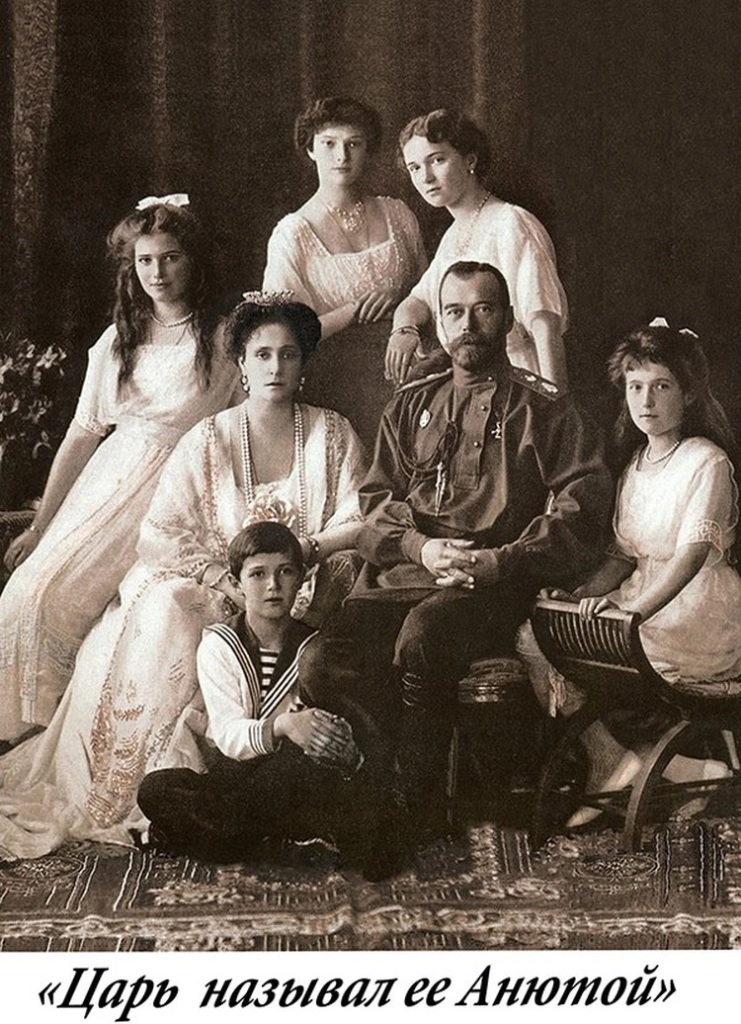
Shortly thereafter, the Tsar approached Anyuta, he thanked her for her work, and told her that his children had fallen in love with her, – says Razif Mirzayanov. He then told her to leave the Ipatiev House and never come back. He ave Anna a souvenir photo on a passe-partout, which depicted the Imperial Family, taken in 1913. With tears in her eyes, Anyuta said goodbye to the Imperial Family and left, concealing the photo and black lace shawl.

A few days later, on the night of 16/17 July, the Bolsheviks woke the Imperial Family in the middle of the night and ordered them to dress and go downstairs. The Emperor and Empress with their five children, along with four retainers: the doctor, the cook, the valet and the maid went to the basement of the house. At the request of Alexandra Fedorovna, two chairs were brought for her and her ailing son, the rest stood along the wall. Then Yurovsky brought in a firing squad, read out the verdict and gave the command to shoot every one – there were no survivors of the regicide.

PHOTO: the Emperor presented Anna with a copy of this famous photograph – taken in 1913 – as a keepsake. The Russian caption “Царь назыбал ее Анютой” translated reads “The Tsar called her Anyuta”.

COOKED “ROYAL DISHES”

There is no evidence to suggest that the Imperial Family could have guessed their captors plans to murder them in such a violent manner that fateful night, however, Anna Vasilyevna was sure that it was thanks to Nicholas II’s request that she leave the Ipatiev House that saved her life.

“After leaving the Ipatiev House, and her conversation with the Emperor, Anna went home. Her husband who had been a German prisoner of war, returned home to Russia, some 11 years after leaving for the front. Soon they had another son, Sergei, who then participated in the Great Patriotic War,” – says Razif Mirzayanov.

Subsequently, Anna Vasilievna often recalled her life in Ekaterinburg, but only her niece Zoya knew the details of her story. She didn’t keep any records, as it it was too dangerous during the Bolshevik and Soviet years. Zoya, however, remembered how Anna Vasilievna came to visit her with unusual dishes – for example, fried pike stuffed with grains and onions. “Such a dish was prepared for the Tsar’s table,” she said. The photograph of the Imperial Family – gifted by the Emperor – Anna carefully kept in a chest, but after her death, the picture was placed on a chest of drawers, and in 1970 it disappeared.

© Paul Gilbert. 9 October 2022

Myrrh-streaming icon of Tsar Nicholas II brought to Ekaterinburg for Tsar’s Days

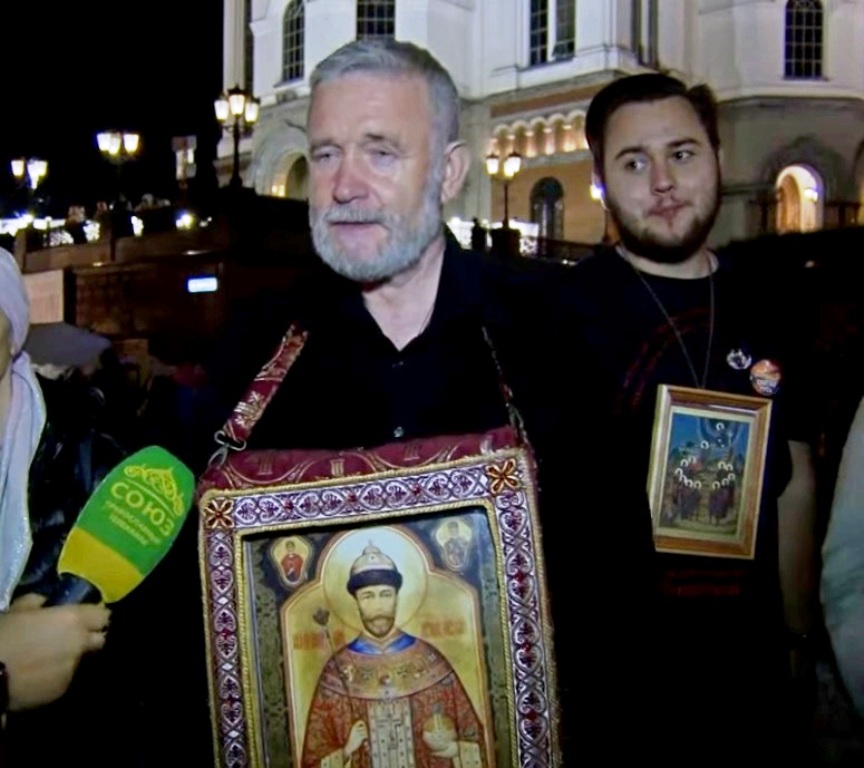
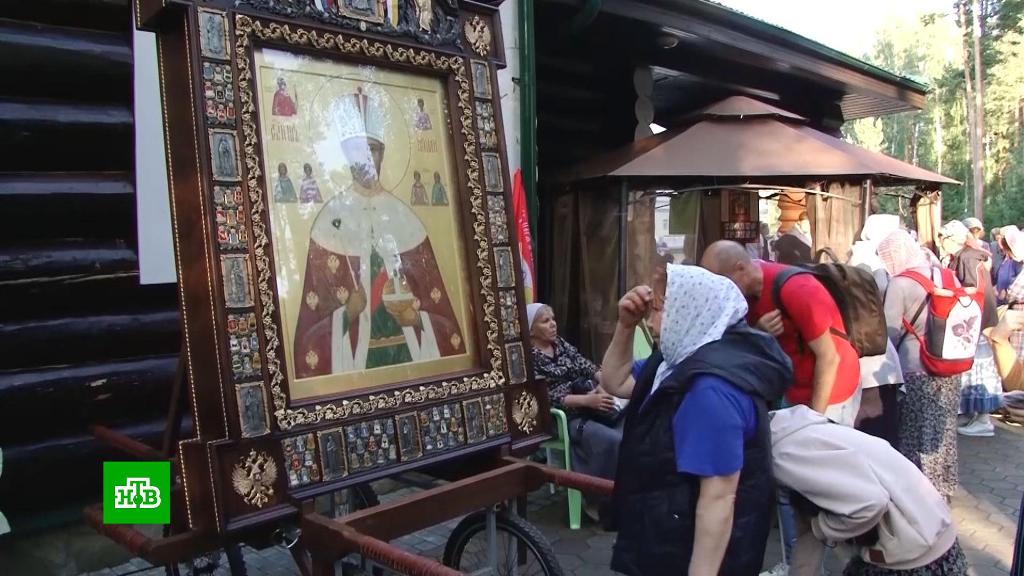
PHOTO: Alexander Chernavsky carries the miraculous Myrrh-Streaming Icon of Tsar-Martyr Nicholas II, during the 21-km Cross Procession from the Church on the Blood in Ekaterinburg to the Monastery of the Holy Royal Martyrs at Ganina Yama

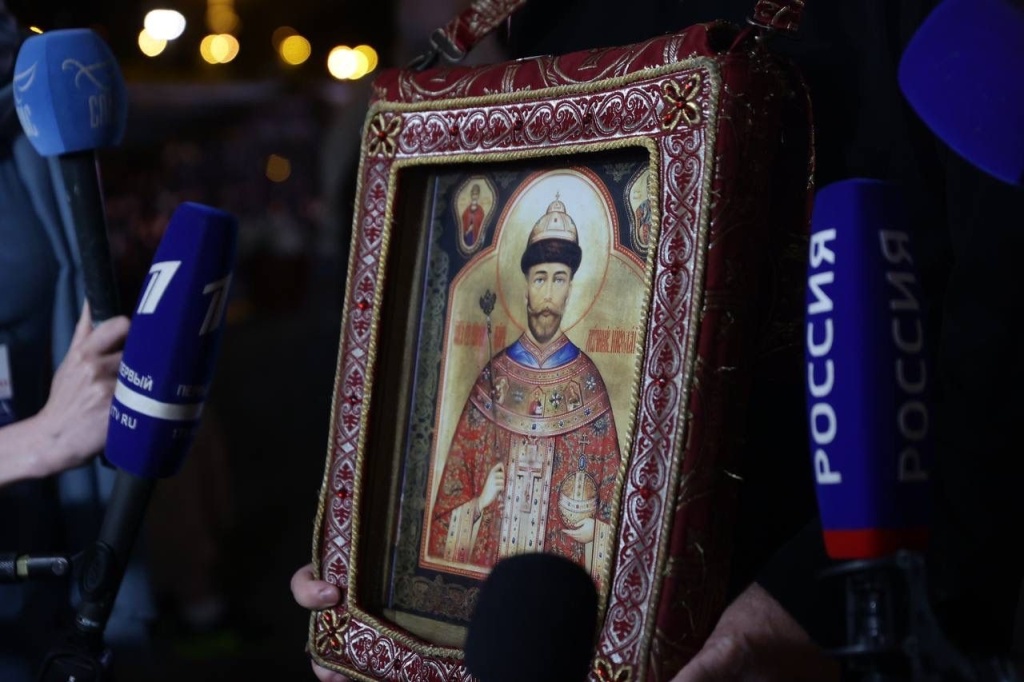
The annual Cross Procession held during Tsar’s Days in Ekaterinburg on 17th July is known for many miraculous events. It was during this year’s procession, that the miraculous Myrrh-Streaming Icon of Tsar-Martyr Nicholas II, once again began to stream myrrh. The icon was brought from Moscow, by the head of the Military Orthodox Mission, Alexander Chernavsky, and this miracle was witnessed by the film crew of the Orthodox Soyuz TV channel, headed by correspondent Svetlana Ladina.

“This is the 30th annual Cross Procession in which we are taking part. The icon of the Tsar-Martyr Nicholas II has been streaming myrrh since 1998, and today, look, droplets of myrrh on the icon itself and along the frame have appeared like “diamonds”. I think the Sovereign is happy that we are here, and these “diamonds” bless all the participants in the procession. Kiss and pray for the sovereign to open our eyes and heart,” – said Alexander Chernavsky.

The icon of the Russian Emperor Nicholas II was painted in the United States of America even before the sovereign was glorified in Russia by the Moscow Patriarchate. And this event has an amazing story . . .

VIDEO: interview with Alexander Chernavsky, and coverage of the Cross Procession from the Church on the Church on the Blood in Ekaterinburg to the Monastery of the Holy Royal Martyrs at Ganina Yama

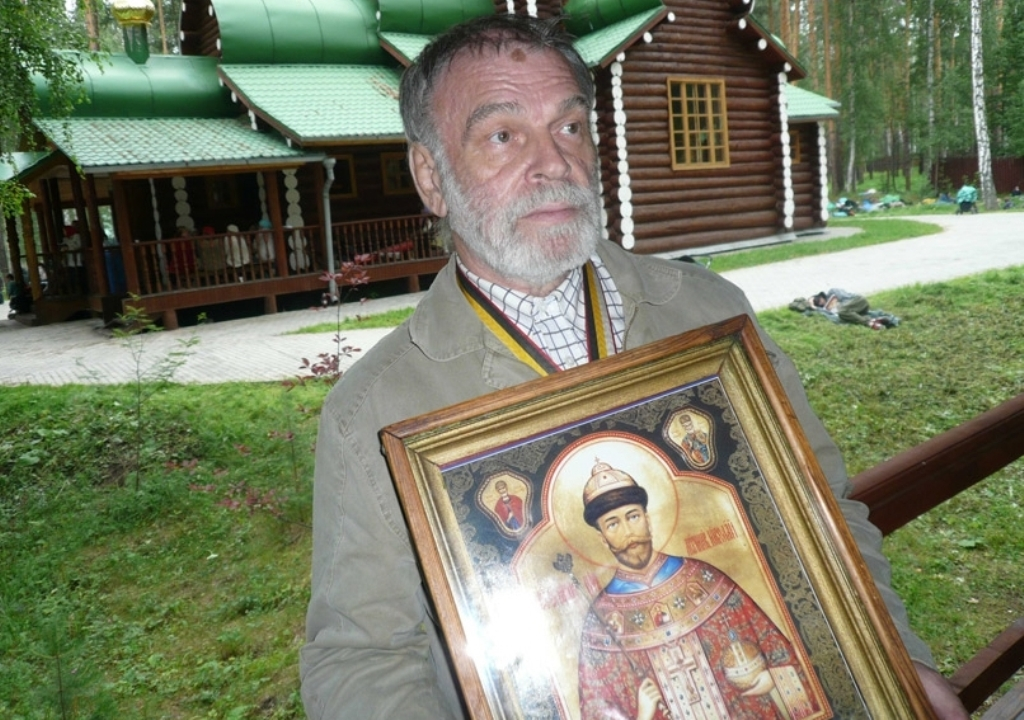
The miraculous Myrrh-Streaming Icon of Tsar-Martyr Nicholas II

The Icon of Tsar-Martyr Nicholas was commissioned by Ija Schmit (1936-2018), a Russian émigré in the United States, who used money inherited from her mother to have the icon painted in 1996.

Paul Gilbert first met Ija in 1998, when she joined his annual Romanov Tour to Russia, which that year included Moscow and Crimea. Ija was accompanied by her husband Harvey and their daughter Nina. It was during this visit that she told me about this icon, a copy of which she later gifted me.

The icon would be dedicated to the future canonization of Tsar-Martyr Nicholas in Russia[1], and in memory of her mother. After Ija’s initial inspiration to have the icon painted, she contacted iconographer Paul Tikhomirov, himself a Russian immigrant, to see if he was interested in her project. Tikhomirov’s response was, “I will make the icon shine!” They decided to depict Nicholas II in coronation robes [1996 was the 100th anniversary of his coronation in Moscow], with St. Nicholas, his patron saint, and St. Job, on whose feast day Nicholas was born, in the upper right and left hand corners. Below the figures would be printed in Russian, “This Holy Icon is for the Canonization of the Tsar-Martyr in Russia.”

Ija received the finished icon on 12th May 1996 and then traveled to Texas, where it was blessed by Bishop Constantine (Yesensky), an old family friend, who had served as Bishop of Great Britain. The icon, however, was not intended solely for family veneration. Ija and her husband, Harvey Schmit, had already arranged to have paper copies of the icon printed to commemorate the 100th anniversary of the coronation of Tsar Nicholas II on 27th May (O.S. 14th) 1996.

Forty-four thousand copies of the icon were printed. The distribution of the icons [printed in three sizes], was handled by Ija’s own non-profit organization, the Society Honoring Russian Nobility, and income from the icons sold in the West purchased food and medicine for needy pensioners and orphans in Russia. A fourth, smaller version of the icon was printed by the thousands and given away in Russia without charge.

As word of the icon spread, Christians from Russia, Ukraine, Belarus, and even Serbia, began writing and requesting copies. The Society has met all these requests and distributed more than twenty thousand icons in Russia alone.

PHOTO: Alexander Chernavsky holding the miraculous Myrrh-Streaming Icon of Tsar-Martyr Nicholas II, at the Monastery of the Holy Royal Martyrs at Ganina Yama

On a visit to Russia in late 1996, Father Herman [Ija Schmit’s brother] presented a number of prints to Fr. Juvenaly, the priest at the St. Nicholas Almshouse in Ryazan. On 16th (O.S. 2nd) March 1998 (the anniversary of Tsar Nicholas II’ abdication and the miraculous appearance of the Reigning Icon of the Mother of God. Fr. Juvenaly blessed Dr. Oleg Belchenko with one of the prints, which the doctor took with him back to Moscow. The paper icon had been given to him in a glassfronted, three-dimensional wooden icon-case (a kiot) and Dr. Belchenko set it in a prominent place in his Moscow apartment. On 5th September, Dr. Belchenko noticed that a red spot had appeared over the right eyelid of the Tsar. The following day a second red spot appeared over the left eye. Dr. Belchenko first compared the icon with a smaller print to be sure that he had simply overlooked the distinctive marks. The smaller icon did not match. Dr. Belchenko then called Sretensky Monastery of the Meeting of the Lord to ask what he should do. The monks asked him to bring the icon of Tsar Nicholas to the monastery the following morning. Dr.Belchenko arrived early and stood through the liturgy holding the icon in a plastic bag at his side. At the end of the liturgy a moleben and blessing of the waters was held. The officiating priest recognized Dr. Belchenko, and knowing that he had come with the icon, had the choir sing a troparion for Tsar-Martyr Nicholas. Following the troparion, Dr. Belchenko noticed one of the parishioners staring at him. Finally, the man approached and asked, “What is that fragrance?” Dr. Belchenko replied: “You are probably smelling incense – I am sorry, I can’t smell anything myself because I have a cold.” The man persisted: “No. I tell you, the fragrance is coming from somewhere around you… the smell is much more refined than incense.” Dr. Belchenko replied impatiently, “You should be ashamed of talking such nonsense while the service is going on!” The man moved away embarrassed, but within a few moments other worshippers filtered over, curious about the fragrance and asking what was in the package. “Nothing, only an icon,” he replied. “Show it to us.” As Dr. Belchenko opened the package and took out the icon, the remarkable scent filled the church.

The icon of Tsar Nicholas II was displayed for veneration in the monastery church for three weeks. After Dr. Belchenko took it home, the fragrance continued to a lesser degree, and as word began to spread, Muscovites increasingly asked to come to his apartment to venerate the icon. Dr. Belchenko felt that his home was too small to accommodate many visitors, so he asked an Orthodox friend, Alla Dyakova, to keep the icon in her flat, where those who wished could venerate it. When asked how he was able relinquish such a treasure, Dr. Belchenko answered, “The icon is not mine. It belongs to all Russians.”

On 19th October, Alla Dyakova and Fr. Peter Vlashchenko, a married priest from the Ivanovo region, took the icon to Elder Kyril of St. Sergius Lavra, who was in Peredelkino, outside Moscow. Elder Kyril venerated the icon and blessed Fr. Peter and Alla with the words, “Go. Take the icon to whomever asks for it.”

On 1st November, the icon was brought to the Martha-Mary Convent in Moscow, founded by Grand Duchess Elizabeth Feodorovna, the sister- in-law of Tsar Nicholas II and herself a new-martyr. The day not only marked the birthday of Elizabeth, but the anniversary of Tsar Nicholas’ assuming the throne at his father’s death in 1894. The icon of Tsar Nicholas was placed on the analogion next to an icon of Grand Duchess Elizabeth. Throughout the Divine Liturgy the icon of the Tsar poured forth waves of fragrance, filling the chapel.

It is worth mentioning that the popular veneration of the Tsar-Martyr played an important role in the canonization of the Imperial Family at the Jubilee Bishops’ Council of the Russian Orthodox Church in 2000 among the Holy New Martyrs and Confessors of Russia.

In August 2000, the Russian Church met at a synod in the Christ the Saviour Cathedral, Moscow. Amongst the things discussed was the issue of canonization. The eagerly-awaited news finally escaped the cathedral’s walls to the faithful gathered outside: Tsar Nicholas II and his family were now recognized as Saints! The date of their martyrdom was now recorded in Orthodox calendars around the world as their feast day. It is certain that influential in this decision were two paper icons of the martyrs, both of which exuded sweet-smelling myrrh and so revealed those Saints to be themselves “a sweet aroma of Christ unto God” (2 Cor 2:15).

The keeper of the miraculous image, the Moscow surgeon Oleg Ivanovich Belchenko, has travelled around Russia for many years, bringing the icon to to churches and monasteries arousing veneration of the Holy Royal Martyrs wherever it went through its aromatic myrrh. Many Orthodox Christians believe that their prayers have been answered by God through the intercession of the Tsar and his family.

Lately, due to his age, Oleg has handed over this honourary mission to Alexander Fedorovich Chernavsky, a publicist, head of the Orthodox Mission for the Revival of the Spiritual Values of the Russian People. The Myrrh-Streaming Icon of Tsar Nicholas II, appears with the same unpretentious simplicity with which the late Tsar laid down his throne and bore his final months of house arrest before his death and martyrdom.

Holy Tsar Martyr Nicholas II, Pray to God for Us! 

NOTES:

[1] The desire of many Russian Orthodox Christians for the canonization of Tsar Nicholas and his family does not stem from a belief that their personal lives were blameless, although from historical accounts and the family’s own letters it is obvious that they were Christians of great integrity. The widespread desire for the family’s canonization is based on the fact that Tsar Nicholas and his family were murdered as a result of his position as the sacramentally anointed Orthodox monarch of Russia.

© Paul Gilbert. 21 July 2022

Divine Liturgy 16th July 2022, Church on the Blood, Ekaterinburg

On 16/17 July – the eve marking the 104th anniversary of the death and martyrdom of Emperor Nicholas II, his family and four faithful retainers, commemorative services were held in the Ural city of Ekaterinburg and in the Monastery of the Holy Royal Martyrs at Ganina Yama.

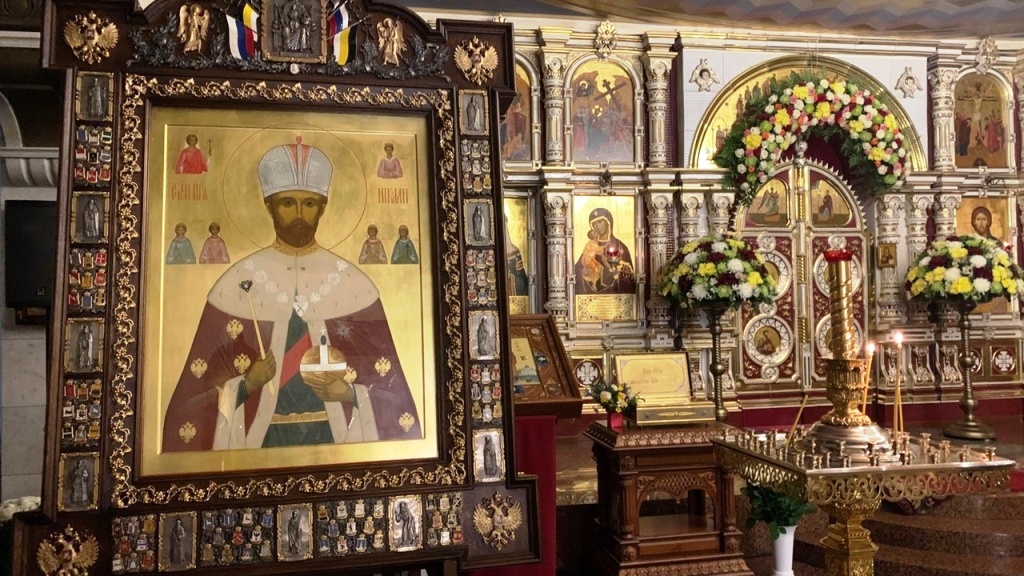
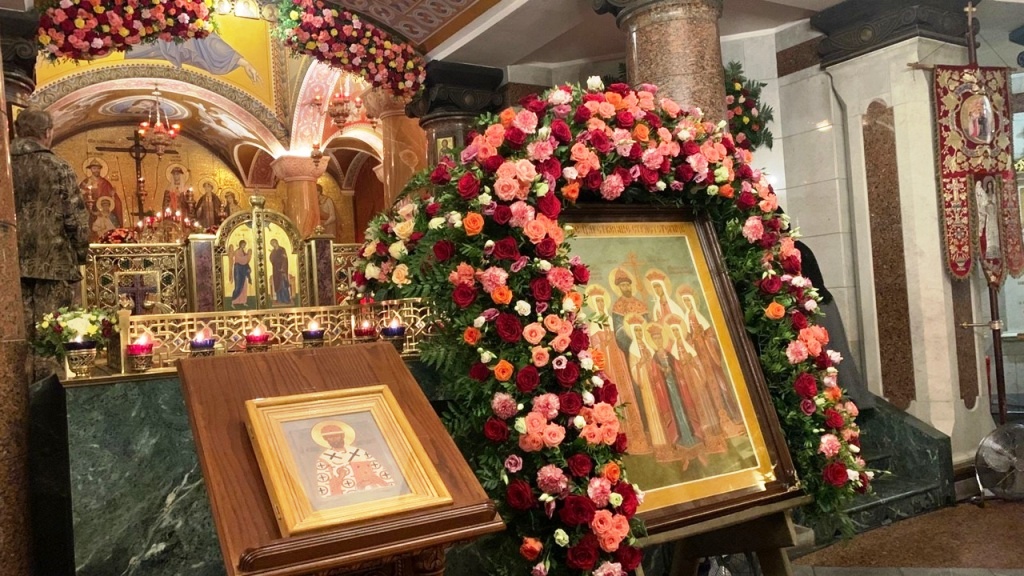
PHOTO: icon of the Holy Tsar-Martyr Nicholas II, Lower Church

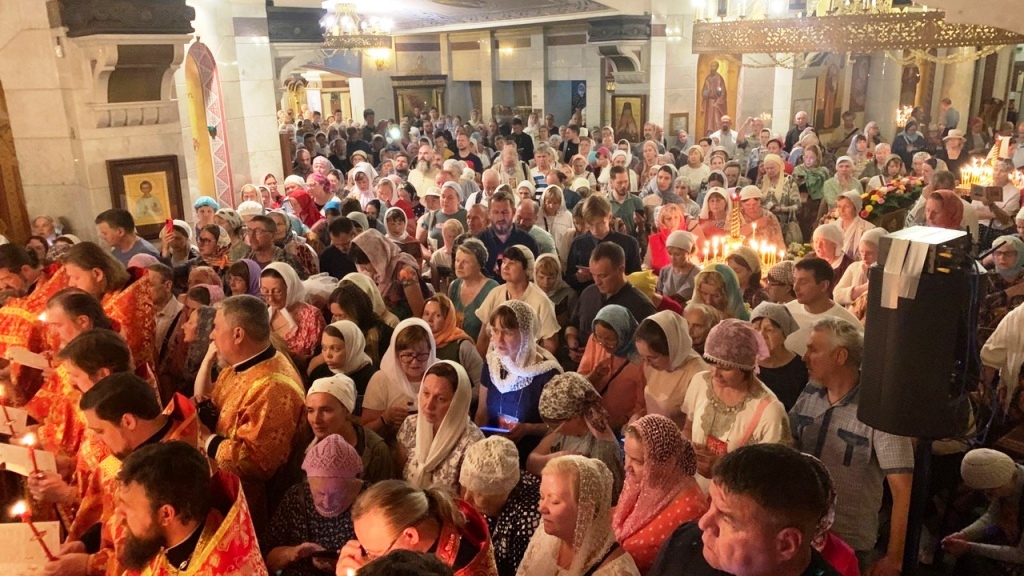
PHOTO: pilgrims attend vespers in the Lower Church

PHOTO: view of the Imperial Room (above and below), Lower Church

On the afternoon of 16th July, small vespers with an akathist to the holy Royal Passion-Bearers were performed by the archpastors of the Russian Orthodox Church, headed by Metropolitan Vincent of Tashkent and Uzbekistan, in the lower church of the Church on the Blood.

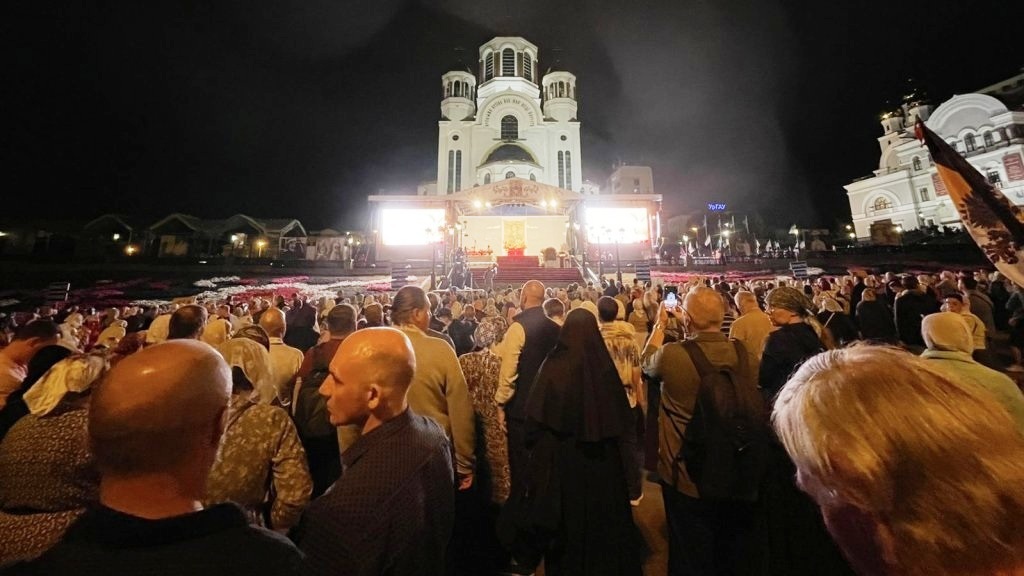
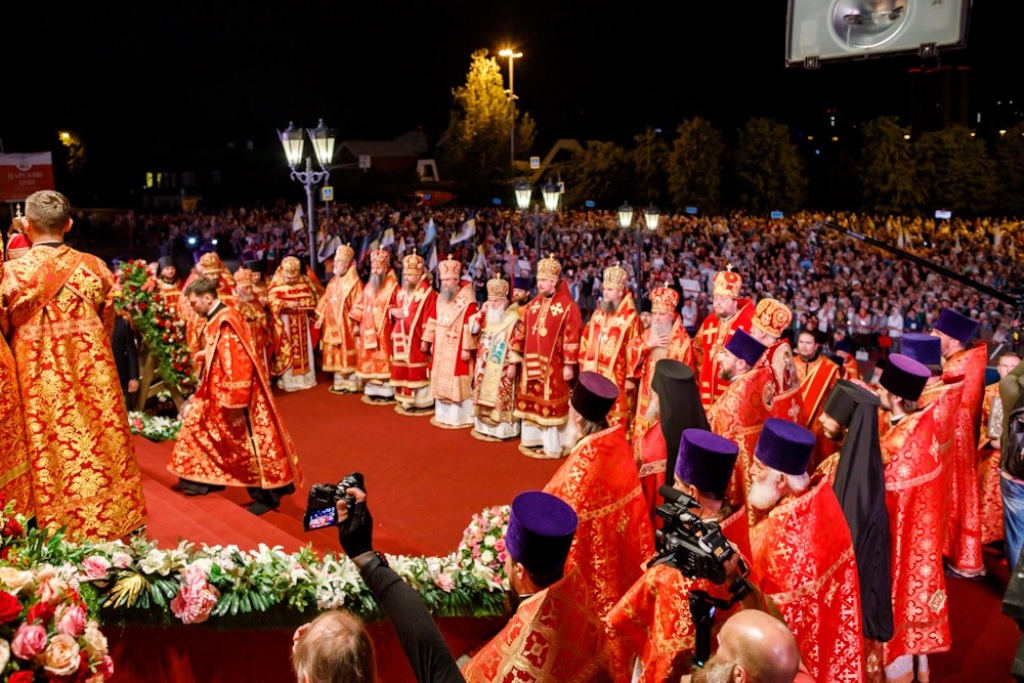
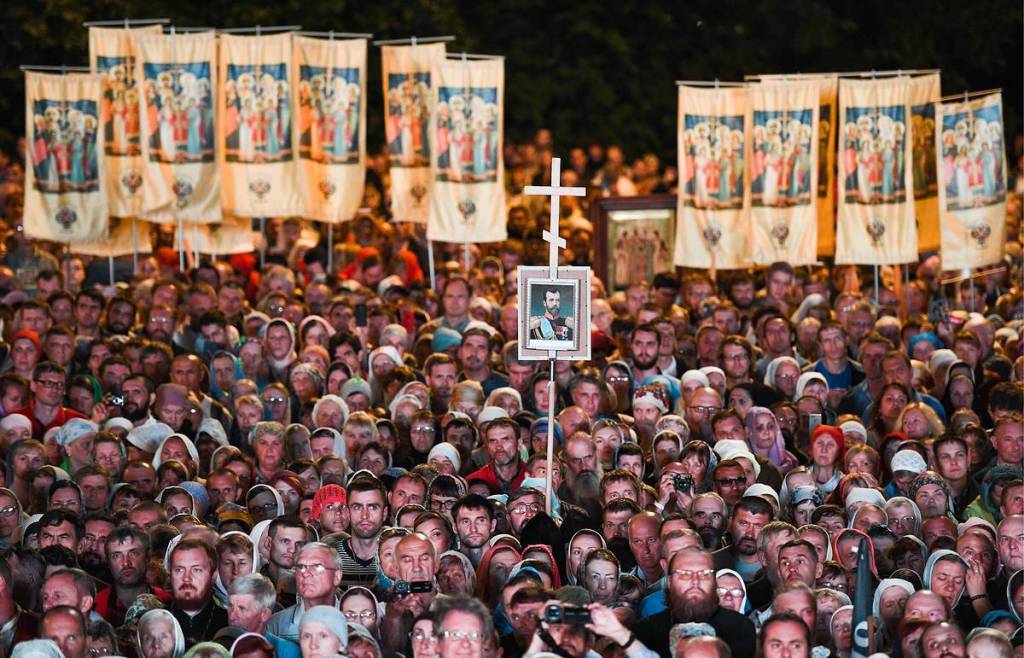
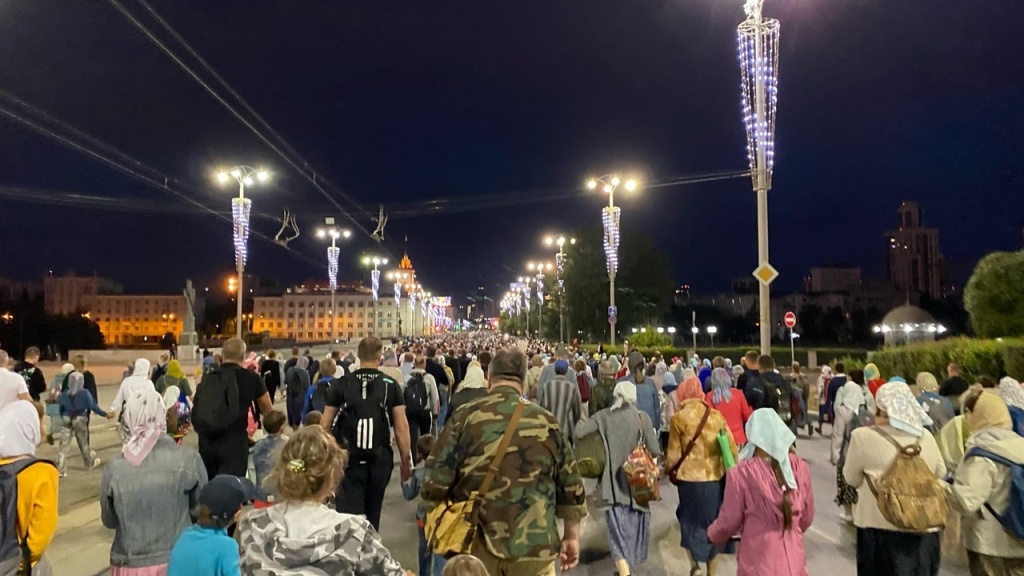
On the night of 16th July, an all night vigil was held on the square in front of the Church on the Blood. An estimated 46,000 Orthodox pilgrims took part in the Divine Liturgy, followed by a Cross Procession to the Monastery of the Holy Royal Martyrs at Ganina Yama.

The Divine Liturgy began at 23:30, and was broadcast live across Russia by the Orthodox TV channel Soyuz, and available to watch on the YouTube channel and on the website of the Soyuz TV channel.

PHOTO: pilgrims gather on the night of 16th July on the square in front of the Church on the Blood

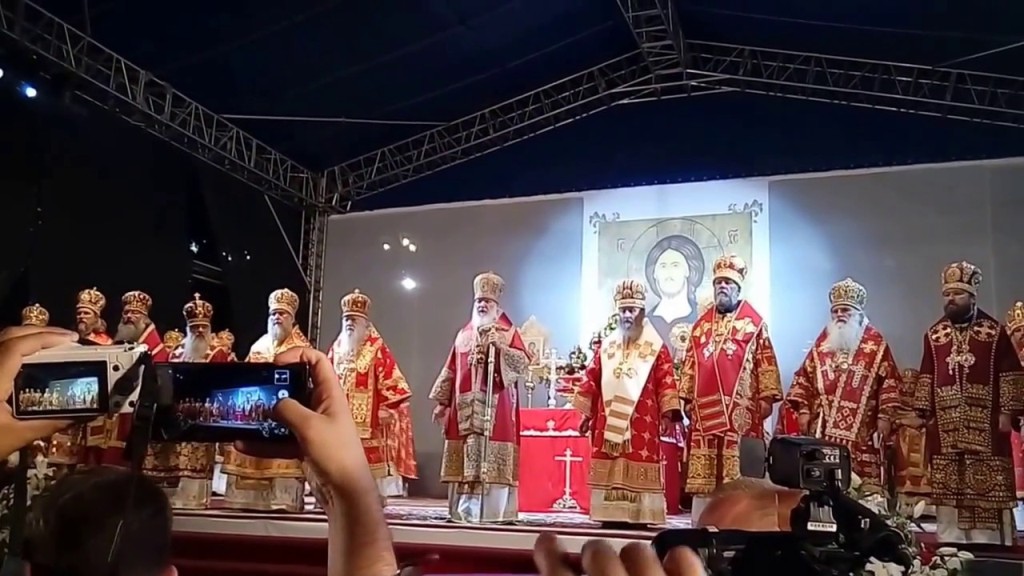
The Divine Liturgy was led by nine bishops of the Russian Orthodox Church: Metropolitan Eugene of Yekaterinburg and Verkhoturye; Metropolitan Vikenty of Tashkent and Uzbekistan; Metropolitan Alexy of Chelyabinsk and Mias; Archbishop Nikolay of Salekhard and Novo-Urengoysk; Bishop Feodosy of Isikul and Russko-Polyansk, Bishop Theodosius of Nizhny Tagil, Bishop Methodius of Kamensk and Kamyshlov, Bishop Vladimir of Shadrinsk and Dalmatov, Bishop Vikenty of Zlatoust and Satka. The archpastors were co-served by the clergy of the Yekaterinburg Diocese.

Special guests at this years’ Divine Liturgy included: governor of the Sverdlovsk region Yevgeny Vladimirovich Kuyvashev, and historian and writer Pyotr Valentinovich Multatuli, the great-grandson of Ivan Kharitonov (1872-1918), who served as the Head Cook of the Imperial family. 

“I consider the story of the murder of Emperor Nicholas II and his family in Ekaterinburg, an important part of Ural history, Ural self-consciousness – this tragic page in history will forever remain with us, many future generations will have to remember this and repent of this sin,” – said Kuyvashev.

PHOTO: the miraculous Myrrh-Streaming Icon of Tsar-Martyr Nicholas II

PHOTO: the Divine Liturgy was led by nine bishops of the Russian Orthodox Church

The expedition commander of the International Space Station, Oleg Artemiev, delivered a message of congratulation to those participanting in Tsar’s Days: “I want to convey to the parishioners and pilgrims of the Church on the Blood my warmest congratulations on the Tsar’s Days, and to all Ekaterinburg residents on the upcoming 300th anniversary of the city of St. Catherine, which, God willing, we will celebrate together in 2023″.

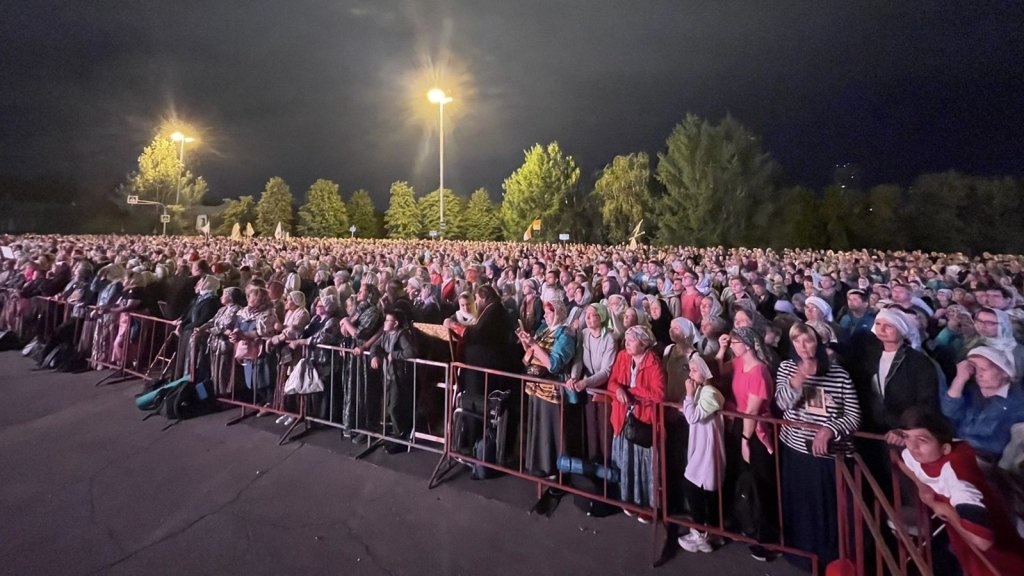
PHOTO: an estimated 46,000 pilgrims took part in this year’s 21-km Cross Procession from the Church on the Blood in Ekaterinburg to the Monastery of the Holy Royal Martytrs at Ganina Yama

PHOTO: the procession nears the Monastery of the Holy Royal Martyrs at Ganina Yama

Following the Divine Liturgy, at about three o’clock in the morning, the combined choirs of the Ekaterinburg Diocese began to sing God Save the Tsar!, they were enthusiastically joined by the tens of thousands of pilgrims on the square.

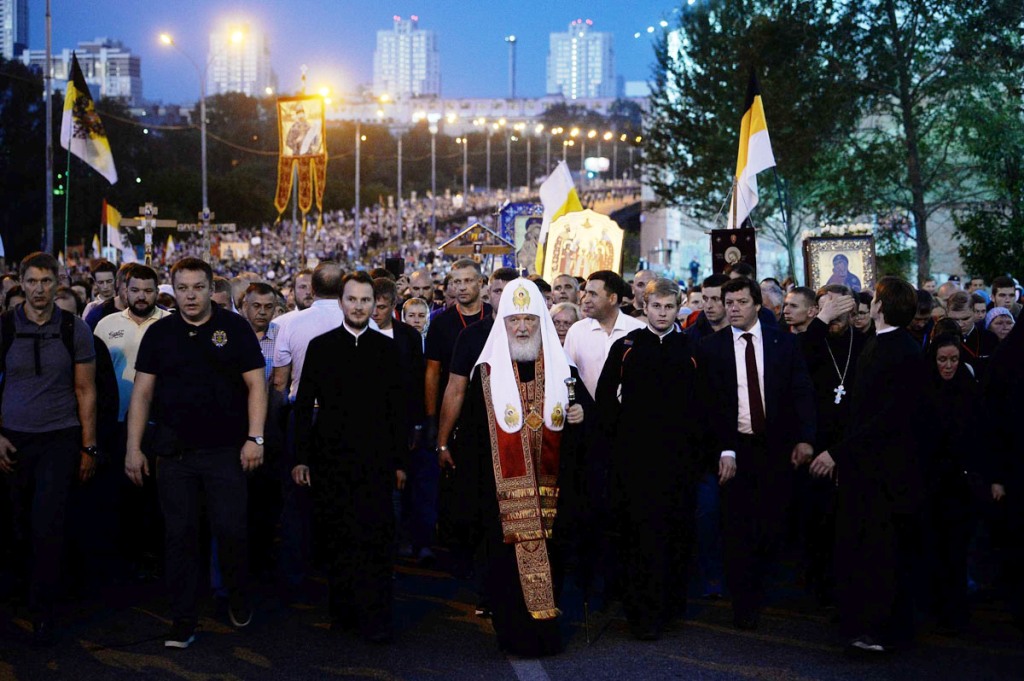
It was at this point, that the pilgrims assembled for the 21-km [13 miles] Cross Procession from the Church on the Blood to the Monastery of the Holy Royal Martyrs at Ganina Yama. The route of the this years procession remained unchanged from previous years, passing along the same route that the regicides transported the bodies of members of the Imperial family in 1918.

Foreign vistors from the USA, Germany, Serbia, Ukraine, Moldova, the Baltic countries, Uzbekistan and other countries also took part in this year’s Cross Procession. The column of pilgrims stretched along the road for kilometers. The procession was surrounded by police officers, 12 streets in the city center were closed. The pilgrims were accompanied by 10 mobile help groups of the Orthodox Mercy Service and volunteers of the Tsar’s Days.

PHOTO: pilgrims arriving at the Monastery of the Holy Royal Martyrs

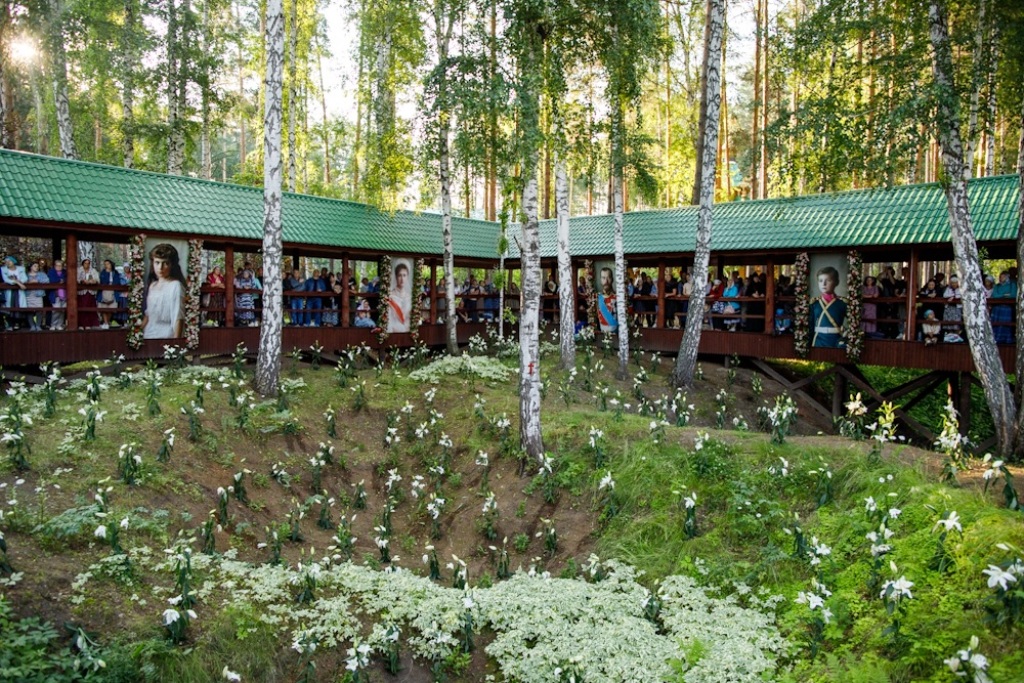
PHOTO: pilgrims line the the wooden causeway which surrounds the abandoned mine shaft at Ganina Yama, reflecting on the crime which took place here on 17th July 1918

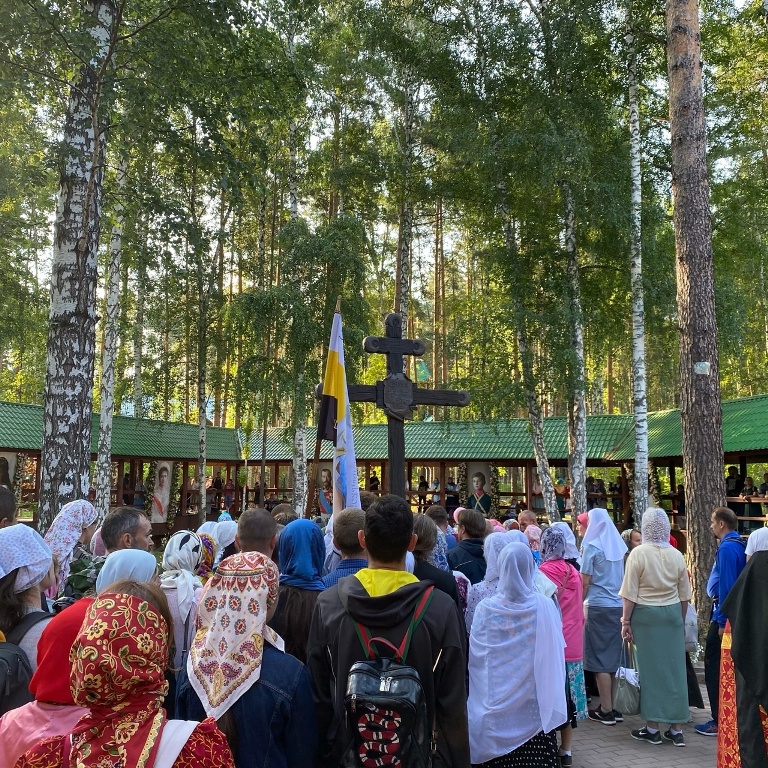
PHOTO: pilgrims pray at a tall Orthodox cross, which marks the edge of the mine shaft, where the regicides threw the remains of Tsar Nicholas II and his family

The first pilgrims of the Cross Procession began to arrive at the Monastery of the Holy Royal Martyrs at about 7:00 a.m. The brethren of the monastery greeted the pilgrims with the ringing of bells. Upon arrival at the monastery, a Divine Liturgy was performed at the tall Orthodox cross located on the edge of Mine No. 7, where the bodies of members of the Imperial family and their faithful servants were thrown by the regicides. The Divine Liturgy was led by Metropolitan Vikenty of Tashkent, Metropolitan Eugene of Yekaterinburg, Archbishop Nicholas of Salekhard, Bishop Theodosius of Isilkul, and Bishop Theodosius of Nizhny Tagil. At the end of the service, Bishop Vincent and Bishop Eugene heartily thanked all the participants in the procession for their spiritual achievement.

After the prayer service, all the pilgrims were offered a hearty meal of buckwheat porridge, bread and tea, prepared by volunteers in the field kitchen. Drinking water was freely available for everyone, and a first-aid post was available. Many pilgrims sought rest under the shade of trees. A fleet of 17 buses provided by the UMMC and the regional Ministry of Transport, offered FREE transport for pilgrims to Ekaterinburg and Sredneuralsk.

© 19 July 2022. Paul Gilbert

***

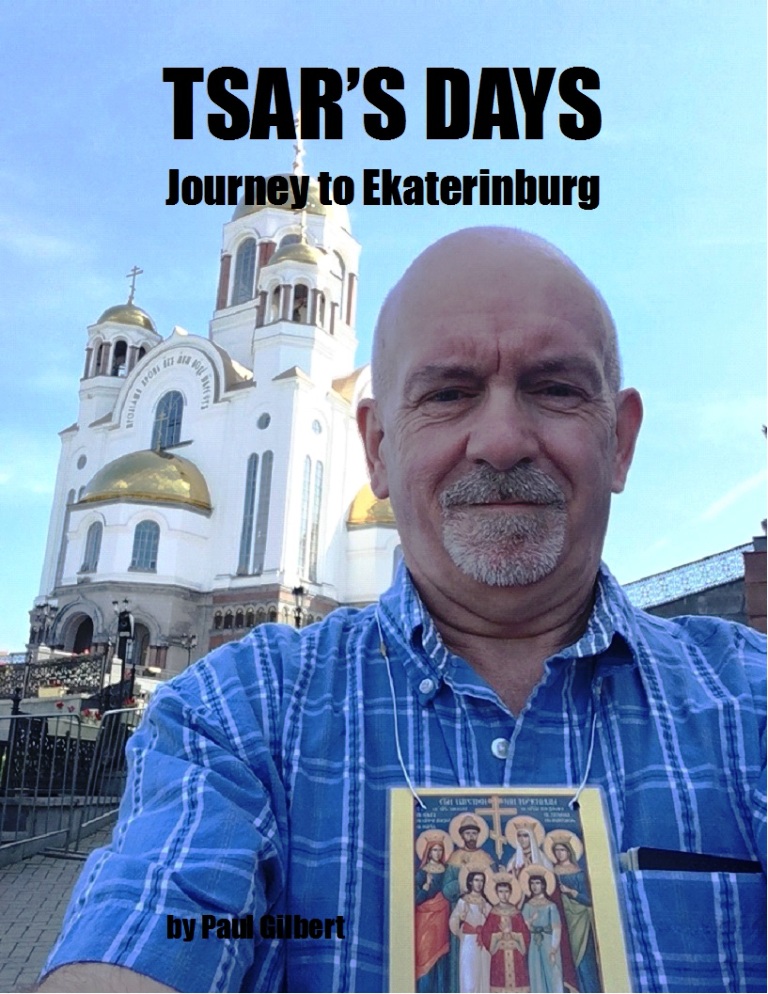
TSAR’S DAYS
Journey to Ekaterinburg
by Paul Gilbert

BOOK DESCRIPTION

Hardcover and Paperback editions. 152 pages + Richly illustrated with nearly 200 COLOUR PHOTOS, 65 of which were taken by the author

CLICK ON THE LINK BELOW TO ORDER FROM AMAZON

HARD COVER EDITION @ $40 USD

PAPERBACK EDITION @ $25 USD

Read all about my journey to Ekaterinburg – my 3rd visit to the Urals – in July 2018, to take part in the events marking the 100th anniversary of the deaths and martyrdom of Nicholas II and his family.

On 17th July 1998, independent researcher and writer Paul Gilbert travelled to St. Petersburg, for the interment of Emperor Nicholas II and his family. Twenty years later to the day, he journeyed to Ekaterinburg, to take part in the events marking the 100th anniversary of the Tsar’s death and martyrdom.

In his own words and photographs, the author shares his experiences and impressions of this historic event, which include visits to the Church on the Blood, Ganina Yama, Porosenkov Log, the Patriarchal Liturgy, exhibitions, and much more.

In addition are 24 illustrated news articles about events leading up to Tsar’s Days in the Urals, from 1st to 31st July 2018.

Gilbert’s solemn journey to the Urals allowed him to experience history in the making, and to honour the memory of the Holy Royal Martyrs, a century after their death and martyrdom.”

What is Tsar’s Days?

Tsar’s Days before the 1917 Revolution

This year marks the 30th anniversary of Tsar’s Days in Ekaterinburg. Tsar’s Days in Russia actually began during the Tsarist era, however, it was banned during the Soviet years. It was restored in Ekaterinburg in 2002, to mark the deaths and martyrdom of Nicholas II and his family on 17th July 1918.

The Tsar’s Days were divided into two groups – solemn and high solemn days.

The first group included the coronation, accession to the throne, birthdays, as well as the namesake [see below] of the emperor, empress-mother, empress-wife, and the heir to the throne. The second group included birthdays and namesakes of other members of the Imperial Family.

  • A namesake consists of celebrating a day of the year that is associated with one’s given name. The celebration is similar to a birthday. Russians celebrate name days [именины in Russian] separately from birthdays. Such a celebration begins with attendance at the divine services marking that day [in the Russian tradition, the All-Night Vigil and Divine Liturgy], and usually with a festive party thereafter. Before the October Revolution of 1917, Russians regarded name days as important as, or more important than, the celebration of birthdays, based on the rationale that one’s baptism is the event by which people become “born anew” in Christ. The Russian Imperial family followed a tradition of giving name-day gifts, such as a diamond or a pearl.

On high solemn days, special prayers were held in churches: on birthdays, a general thanksgiving service was performed, and on the day of the namesake, a prayer service to the saint of the same name [i.e. Nicholas II + Saint Nicholas of Myra]. On the day of the accession to the throne of the sovereign-emperor and his coronation, prayers were served for a special rite.

The solemn days, were postponed until the following Sunday. If the solemn day fell on the first week of Great Lent , it was postponed to the Feast of the Triumph of Orthodoxy. If it fell during Holy Week (the last week of Great Lent) or the first day of the celebration of Easter, the solemn day was postponed to Monday of Bright Week.

On 7th March 1917, the Holy Synod, in response to the February Revolution, began to call the “reigning” House of Romanov in the past tense and abolished “Tsar’s Days”. The corresponding decree of the Provisional Government appeared on 16th March of the same year.

Below, is a list of the four high solemn days celebrated for Nicholas II in 1913 [dates are noted in the Old Style Julian Calendar]:

May 6 – Birth of Sovereign Emperor Nicholas Alexandrovich ;
May 14 – Sacred Crowning of Their Imperial Majesties;
October 20 – Accession to the throne of Sovereign Emperor Nicholas Alexandrovich;
December 6 – Namesake of Sovereign Emperor Nicholas Alexandrovich.

Tsar’s Days in Post-Soviet Russia

In the 21st century, Tsar Days have taken on a whole new meaning. The annual holidays are held in mid-July in the Ekaterinburg diocese, during which divine services are held, a cross procession in memory of the death and martyrdom of Emperor Nicholas II and his family, as well as a festival of Orthodox culture, including exhibitions and other social events.

The name is taken from the pre-revolutionary Tsar’s Days, timed to coincide with the anniversaries of solemn events in the lives of members of the Romanov Dynasty. The dates of the modern Tsar’s Days are timed to the dates of 21st July 1613 – the day of the anointing of the first tsar of the Romanov dynasty, Mikhail Fedorovich, and 17th July 1918 – the day of the brutal murders of the last Emperor of Russia Nicholas II and his family, in the Ipatiev House in Ekaterinburg and 18th July – the day of the murders of Grand Duchess Elizabeth Feodorovna, Grand Duke Sergei Mikhailovich, Princes of the Imperial Blood Ioann, Konstantin and Igor Konstantinovich, Prince Vladimir Paley (son of Grand Duke Paul Alexandrovich) in Alapaevsk.

Events

As part of the Tsar’s Days, an all-night vigil is held in the Church on the Blood in Ekaterinburg, which includes a Divine Liturgy followed by a Cross Procession. The Tsar’s Days Festival celebrates Orthodox culture in the Ekaterinburg Diocese. Dozens of religious and secular public events dedicated to the tsarist theme are held, including exhibitions, concerts, conferences and other events.

Some of the city’s museums and churches become venues for exhibitions dedicated to Emperor Nicholas II, his family and other members of the Romanov dynasty, who were murdered in Ekaterinburg and Alapaevsk.

The main event, for which Orthodox pilgrims come to Ekaterinburg, is the solemn divine liturgy, which takes place on the night of the murder of the Holy Royal Murders – 16/17 July, in the Church on the Blood. At the end of the Liturgy, tens of thousands of pilgrims take part in the 21 km Cross procession from the Church on the Blood in Ekaterinburg to the Monastery of the Holy Royal Martyrs in Ganina Yama.

Pilgrims from other cities in Russia organize pilgrimages from their cities to Ekaterinburg to participate in the Tsar’s Days. A growing number of Russian cities [i.e. St. Petersburg, Kazan, etc.] are today organizing their own Tsar’s Days events, but on a much smaller scale than that of Ekaterinburg.

PHOTO: His Holiness Patriarch Kirill delivers a Divine Liturgy outside the Church on the Blood on the night of 16/17 July 2018 (above); His Holiness Patriarch Kirill leads the 21 km Cross Procession from the Church on the Blood in Ekaterinburg to the Monastery of the Holy Royal Martyrs in Ganina Yama (below)

100th anniversary of the death of members of the Romanov family

In 2018, the Tsar’s days in the Ekaterinburg Diocese were timed to coincide with the 100th anniversary of the deaths and martyrdom of members of the Romanov family in Ekaterinburg and Alapaevsk. The centenary celebrations also included the XVII Tsar’s Days Festival of Orthodox Culture, a five-day visit by the head of the Russian Orthodox Church and a meeting of the Holy Synod.

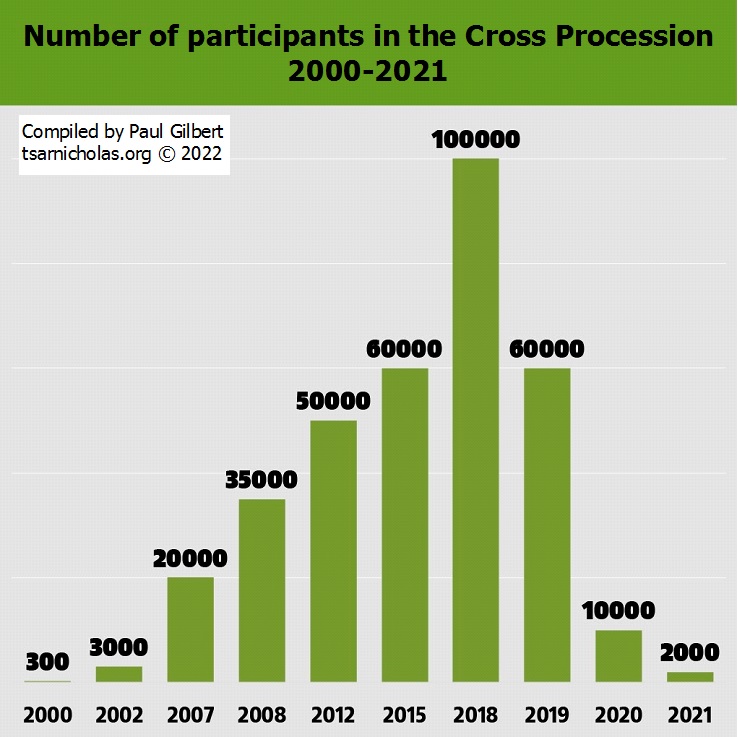
The first procession in memory of the Holy Royal Martyrs, headed by Metropolitan of Ekaterinburg and Verkhoturye Kirill, took place in 2002, in which more than 2 thousand pilgrims and about 100 clerics participated. In 2012, for the first time since the construction of the Church on the Blood in Ekaterinburg, an all-night vigil and Divine Liturgy were performed in the open air.

In 2017 they estimated crowds of up to 60,000 people. In 2019, 60 thousand participated, and in 2020, 10 thousand people [due to COVID]. In addition, up to 2 thousand people gathered an alternative religious procession of the schismatic and tsarist monk Sergius (Romanov) in the Sredneuralsky Nunnery.

In 2018, more than 100,000 Orthodox Christians, monarchists, among others from across Russia and around the world took part in the Patriarchal Liturgy and procession of the cross from the Church on the Blood to the Ganina Yama.

The events marking Tsar’s Days in 2018, fell on the tail end of the 2018 Football World Cup which was held in Ekaterinburg that year. It was estimated that as many as 200,000 people flocked to the city to commemorate the 100th anniversary of the regicide, undoubtedly the largest public demonstration yet of the growing significance of the Russia’s last emperor and tsar in the cultural, historical and spiritual life of modern-day Russia.

*NOTE: due to the fact the Moscow Patriachate does not yet recognize the Ekaterinburg remains as authentic, the Cross Procession does not stop at Porosenkov Log, where the remains of the Imperial family were unearthed in two separate graves in the late 1970s and 2007 – PG

*  *  *

On 17th July 2018, independent researcher and writer Paul Gilbert travelled to Ekaterinburg, to take part in the events marking the 100th anniversary of the Tsar’s death and martyrdom.

In his own words and photographs, the author shares his experiences and impressions of this historic event, which include visits to the Church on the Blood, Ganina Yama, Porosenkov Log, the Patriarchal Liturgy, exhibitions, and much more.

Tsar’s Days: Journey to Ekaterinburg is available in both hardcover and paperback editions. 152 pages. Nearly 200 COLOUR photos – many of them taken by me, during my visit to Ekaterinburg in July 2018. Click HERE to order your copy

© Paul Gilbert. 17 July 2022

The Fate of Nikolai Nikolaevich Ipatiev, 1869-1938

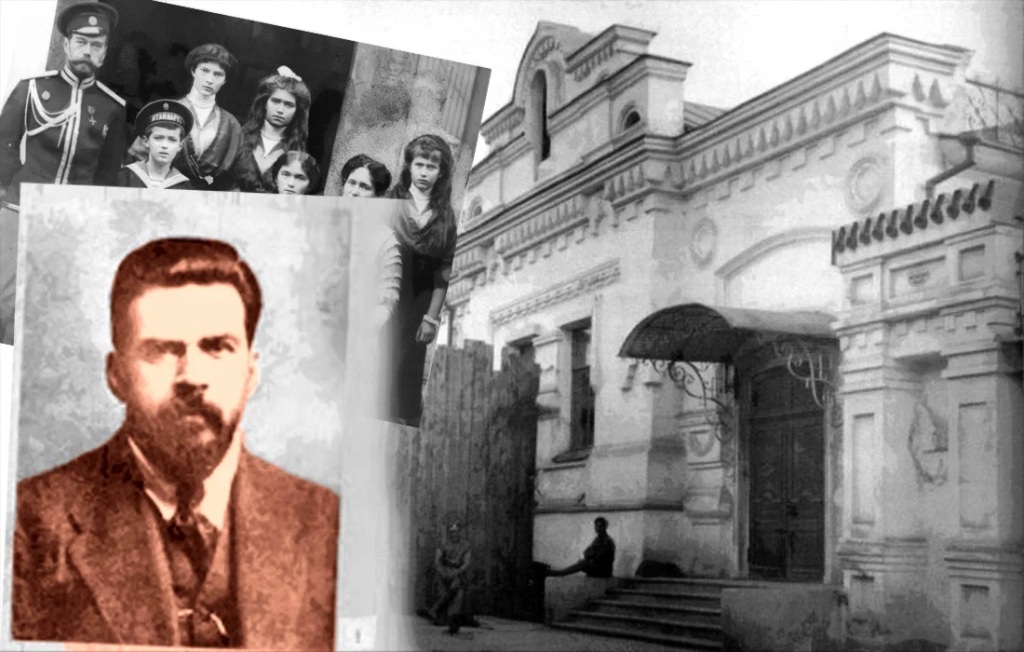
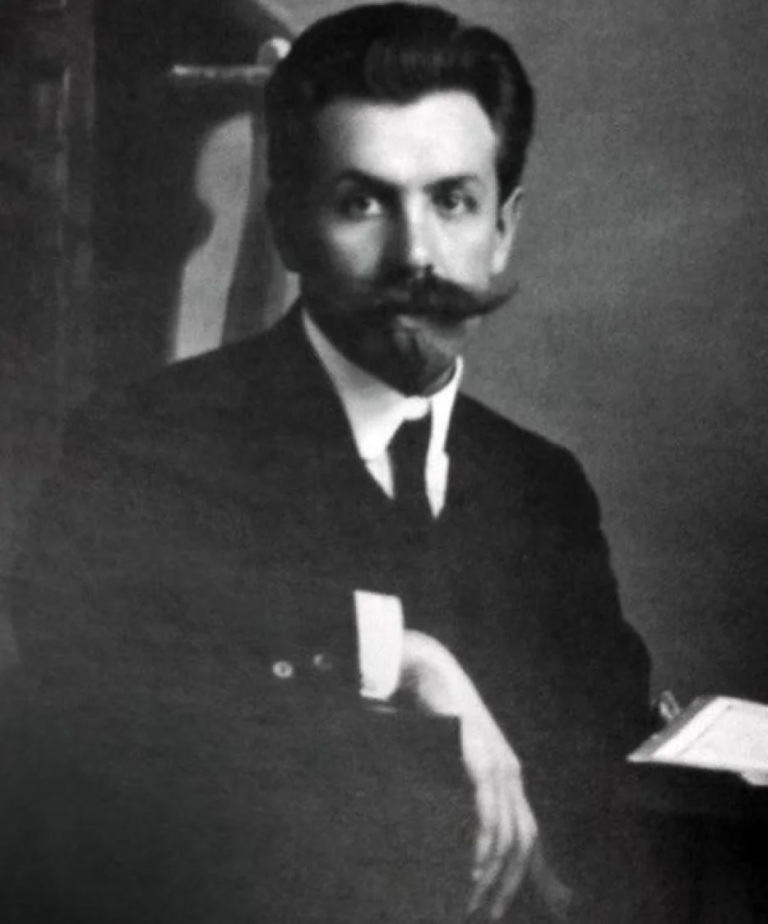
While the tragic fate of Russia’s last tsar, his family and their four faithful retainers is well known, the life and fate of the owner of the notorious house in Ekaterinburg, where they were brutally murdered on 17th July 1918 – Nikolai Nikolaevich Ipatiev (1869-1938), remains less familiar.

Nikolai was born on 18th February 1869 in Moscow, to Nikolai Alekseevich Ipatiev (1839-1890) a well-known architect in Moscow, who held a prominent and influential post – one of the three official architects of the first Russian Insurance Society – the most respected in the country. His wife Anna Dmitrievna Ipatieva (nee Glika) came from a family that gave Russia many remarkable intellectuals.

In addition to Nikolai, the couple had two other children, a daughter Vera and a brother Vladimir (1867-1952), who became a famous chemist, who is considered one of the founders of petrochemistry in the United States.

Nikolai was a graduate of the 3rd Moscow Cadet Corps, the Nikolaev Engineering School in St. Petersburg and the Military Engineering Academy. In 1906, after serving in the army, he retired with the rank of engineer captain and settled in Ekaterinburg, where he began working as a civil engineer. He later opened a very successful company engaged in the laying of railroad tracks.

At first, Nikolai lived in a rented apartment, but his business was so successful, that two years later in 1908, he was able to buy a two-storey stone mansion at Voznesenskaya Gorka, 49/9 paying the former owner 6 thousand rubles. He became the third owner of the house since it’s construction in the 1880s.

Nikolai and his wife lived on the upper floor of the house, while the main floor was used for his thriving business. The interiors were richly decorated with iron castings, stucco mouldings, and the ceilings were decorated with artistic painting. The house was equipped with all the modern amenities: electricity, sewerage, a bathroom with a water heater, a wine cellar, and even a telephone.

He took part in the construction of the Ekaterinburg-Perm railway. He was active in public and local history activities. He also participated in the development of the project for the construction of the building of the Ural Mining Institute. He also served as an engineer of the Railway Troops of the Russian Armed Forces, a unit in the engineering corps of the Imperial Russian Army.

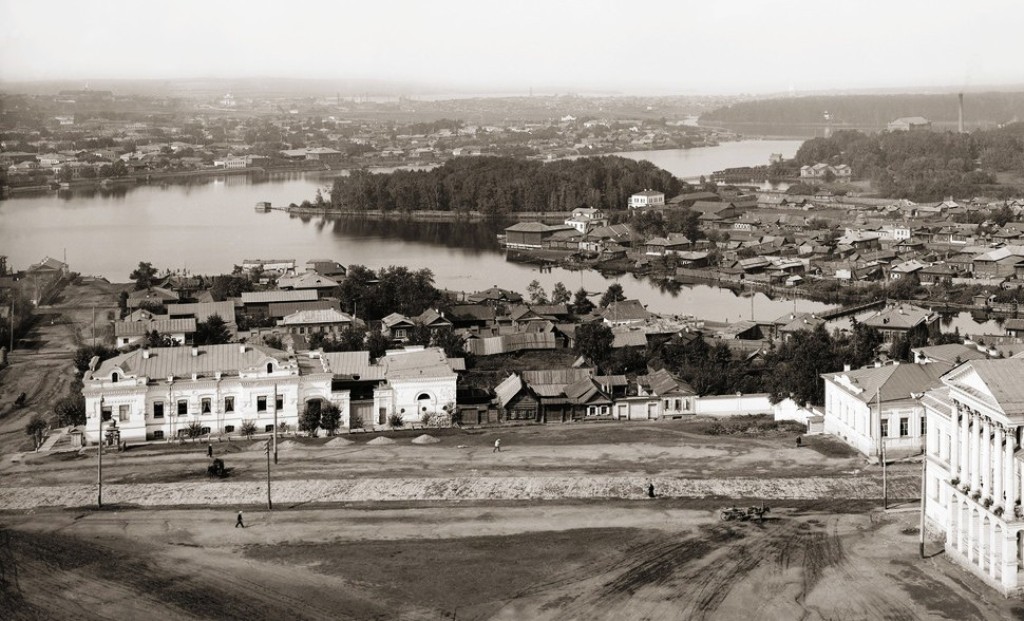
PHOTO: early 20th century view of the Ipatiev House (left) from the bell tower of the Ascension Church

THE BOLSHEVIKS EVICT THE IPATIEV’S

Nikolai Ipatiev and his wife Maria Feodorovna Ipatieva (1876-1953), led a quiet and peaceful life until April 1918, when the Bolsheviks suddenly knocked on the door of their house. Nikolai’s memories of that day are preserved in the State Archives of the Russian Federation (GARF).

“On 27th April, Commissar Zhilinsky [Alexander Nikolaevich Zhilinsky, 1884-1937] came to me and, announced that my house would be occupied for the needs of the council, and then ordered me to clean the entire house by 29th April,” writes Nikolai. “Having overheard the order, my wife asked Zhilinksy, among other things, whether the integrity of our belongings that we would leave in the house would be guaranteed to us; Zhilinsky replied to this that the people who would be living in the house would not damage anything.”

The choice and location of the Imperial family’s place of imprisonment is explained by Alexander Dmitrievich Avdeev (1887-1947), the first commandant of the Ipatiev House [renamed “House of Special Purpose” by the Bolsheviks] in his memoirs, that it was located “… almost in the very centre of the city, in such a place that its defence against an external attempt to free the former tsar was favourable in all respects … ”

Ipatiev was able to take only a small number of personal belongings from the house. He locked the cabinet with his valuable books in his office. His wife locked their dishes in the dining room. The rest of their belongings were locked in the basement pantry, a room adjacent to the one where the regicide was carried out, and then locked with a key.

“The keys to the locked rooms were left with me, while the members of the Commission sealed the rooms themselves with the Soviet seal,” said Ipatiev. “I had moved our folded kitchen and table utensils, chests with clothes and linen into the carriage house . After some time, the Chairman of the App. Committee Sergei Egorovich Chutskaev (1876-1944) demanded from me the keys to all the locked rooms in order to check what was in them and, after inspecting the rooms, he replaced seals on them.”

Until the very last moment, Ipatiev did not know who exactly the Bolsheviks were preparing his house for. Only after 29th April, when he had already moved out [Nikolai and his wife moved to the village of Kurinskoye], did his neighbour inform him that the ex-tsar Nicholas II, his wife and one of his daughters [Grand Duchess Maria] had been settled in the mansion. The rest of the family members were brought later.

A high double wooden fence exceeding the windows of the second floor in height, was built around the outer perimeter of the house, closing it off from the street. The fence had a single gate in front of which a sentry was constantly on duty, two guard posts were placed inside, eight outside. Machine guns were installed in the attics of neighbouring buildings.The Imperial family were held under house arrest in the Ipatiev House for 78 days, from 28th April to 17th July 1918.

PHOTO: Nikolai Nikolaevich Ipatiev (1869-1938)

“THE TENANT HAS LEFT”

Before leaving, Nikolai Ipatiev made an agreement with his cousin Yevgenia Poppel that she would send him a telegram with certain words if the Bolsheviks suddenly vacated his house. And such a telegram came to him on 22nd July – five days after the murder of the Imperial Family. It contained only four words: “The tenant has left,” whereupon Nikolai and his wife returned to Ekaterinburg.

An article appeared in the newspaper Ural Worker – stating that, “at the numerous requests of the workers, the blood-drinking tsar was shot.”

On the same day, Nikolai Nikolaevich was summoned to the local Cheka, who returned to him, the keys to his own house. By that time, all traces of blood had been washed away, the floors swept, the personal belongings of the dead packed and taken away. Nikolai and his wife never returned to the “bloody house” again, even leaving his belongings, which he had stored in the house.

Later, during an interview Ipatiev noted that “in all the years of the existence of the house, no one had died in it. And then, overnight, eleven people were all murdered at once … “

On 25th July, Ekaterinburg was occupied by the Czechoslovak Corps. Upon the arrival of the White Army, Admiral Alexander Vasilyevich Kolchak (1874-1920), ordered the Ipatiev House sealed, “the crime scene was to remain intact.” He ordered investigator Nikolai Alekseevich Sokolov (1882-1924), to launch an investigation into the fate of Nicholas II and his family, and the events which took place in the house of engineer Ipatiev, where bullet marks were discovered in the basement walls.

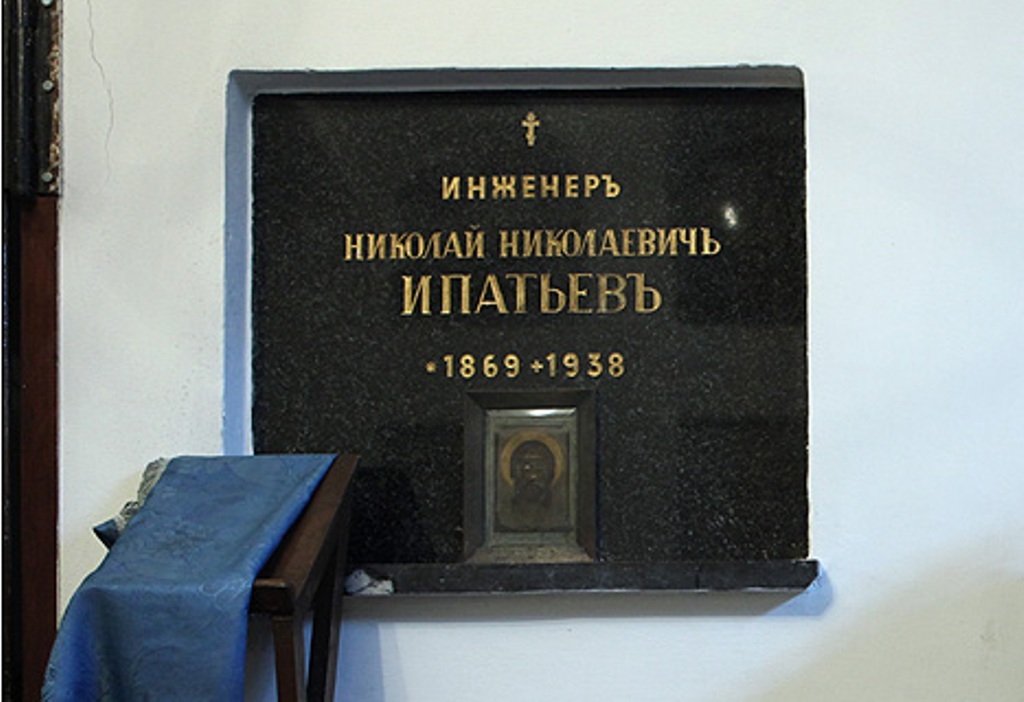
PHOTO: Nikolai Ipatiev’s grave at the Olshansky Cemetery in Prague

LIFE AND DEATH IN EXILE

On 28th July, 1919, Ekaterinburg was retaken by the Reds, Nikolai Ipatiev was now considered an “enemy of the Bolsheviks”, forcing him to flee the Urals.

Nikolai and his wife Maria evacuated from Ekaterinburg with the Whites. They travelled across Siberia to Japan, then moved to Turkey, but eventually ended up in Czechoslavakia in 1920, where they settled in Prague, teaching at the Civil Engineering Institute.

Nikolai died there on 20th April 1938, and buried in the crypt of the Assumption Church, at the Olshansky Cemetery in Prague. His burial niche is decorated with an orthodox icon of the Saviour Made Without Hands. On the church’s website, they note in one line: “N.I. Ipatiev, in whose house the last Russian Emperor and his august family were killed. Maria died in Prague in 1953, and is buried near her husband.

On 22-23 September 1977, the Ipatiev House in Ekaterinburg where Emperor Nicholas II and his family were held under house arrest for 78 days before being murdered, was razed to the ground. Click HERE to read my article How Yeltsin justified the demolition of the Ipatiev House, published on 25th February, 2020.

© Paul Gilbert. 14 July 2022
Program for the XXII Tsar’s Days in the Urals – 2022

From 12th to 20th July, the 22nd annual Tsar’s Days will be held in the Urals [Ekaterinburg and Alapaevsk], which includes a series of solemn events [16th to 18th July] dedicated to Emperor Nicholas II and his family, who met their death and martyrdom in Ekaterinburg 104 years ago, on 17th July 1918.

The main events are the night Divine Liturgy, which is performed on the square in front of the Church on the Blood, built on the site of the Ipatiev House, where members of the Imperial Family and their faithful subjects ended their earthly days, and the 21-km [13 miles] Cross Procession to the Monastery of the Holy Royal Martyrs at Ganina Yama, on the site of which the regicides first disposed of the Imperial family’s remains, before returning the following day to exum thre remains and bury them in two separate graves at *Porosenkov Log.

On 18th July, similar events will be held in Alapaevsk, where 8 additonal members of the Romanov dynasty and their faithful servants [see below] met their death and martydom.

The Ekaterinburg Martyrs – 11 victims

Emperor Nicholas II, Empress Alexandra Feodorovna, Grand Duchesses Olga, Tatiana, Maria, Anastasia, Tsesarevich Alexei Nikolaevich, and their four faithful retainers Dr. Eugene Botkin (court physician), Alexei Trupp (footman), Ivan Kharitonov (cook), and Anna Demidova (Alexandra’s maid).

The Alapaevsk Martyrs – 8 victims

Grand Duchess Elizabeth Feodorovna, Grand Duke Sergei Mikhailovich, Princes of the Imperial Blood Ioann, Konstantin and Igor Konstantinovich, Prince Vladimir Paley (son of Grand Duke Paul Alexandrovich), and two faithful servants: sister of the Marfo-Mariinsky Convent Varvara Alekseevna (Yakovleva), and Fyodor Semyonovich (Mikhailovich) Remez, secretary of the Grand Duke Sergei Mikhailovich.

In addition, the XXI International Festival of Orthodox Culture will be held in Ekaterinburg from 12th-20th July. The festival features many events in honour of the Holy Royal Martyrs, including divine services, religious processions, exhibitions, concerts, conferences and other events.

PHOTO: icon depicting the Ekaterinburg and Alapaevsk Martyrs

SERVICE CALENDAR

July 16, Saturday

09:00 – Divine Liturgy at the altar of the Holy Royal Martyrs, situated in the Lower Church of the Church on the Blood in Ekaterinburg.

13:00 — Cross procession along the route in which the Holy Royal Martyrs travelled upon arriving in Ekaterinburg [from Tobolsk] on 30th April 1918, from the Shartash Train Station [Kuibysheva street, 149-a] to the Church on the Blood. Route: [Tsarskaya street, 10] along the route: railway station Shartash – Kuibyshev street – Vostochnaya street – Chelyuskintsev street – Sverdlov street – K. Liebknecht street).

15:00 – Small Vespers with Akathist to the Holy Royal Martyrs. Confession. In the Lower Church of the Church on the Blood.

16:30-20:00 – All-night vigil, on the square in front of the Church on the Blood.

17:00-20:00 – All-night vigil, at the Monastery of the Holy Royal Martyrs at Ganina Yama.

23:30-02:00 – Divine Liturgy, on the square in front of the Church on the Blood.

July 17, Sunday

~ 02:30 – Traditional 21-km [13 miles] Cross Procession from the Church on the Blood to the Monastery of the Holy Royal Martyrs at Ganina Yama Route: Tsarskaya street, 10 – st. Tolmacheva – Lenin Ave. – V. Isetsky Boulevard – st. Kirov – st. Bebel – st. Technical – st. Reshetskaya – Railway forest park – pos. Shuvakish – Ganina Yama.

Upon the arrival of the procession, a Liturgy to the Holy Royal Martyrs will be performed at the Field kitchen.

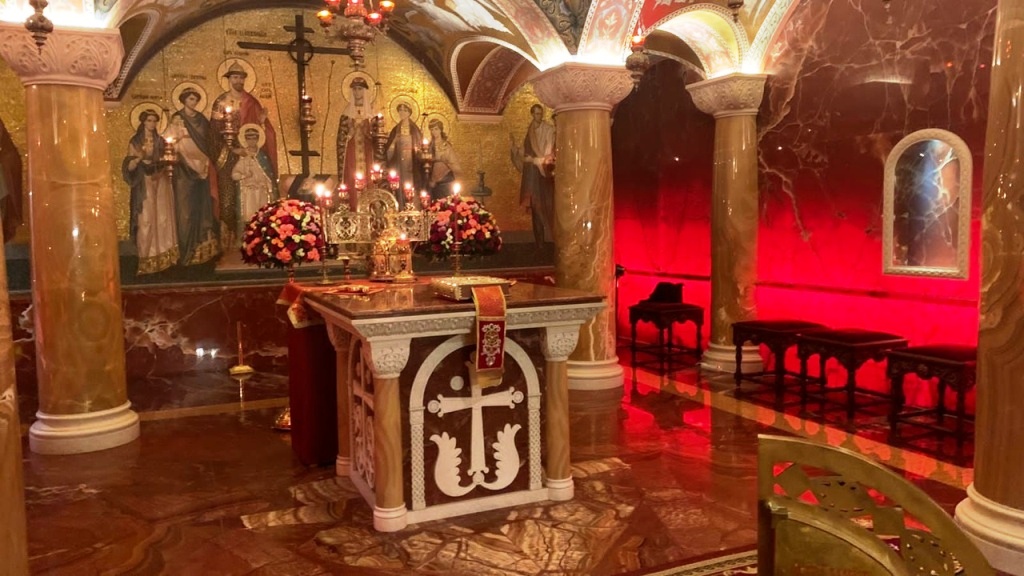
06:00 – Divine Liturgy (early). Church on the Blood. In the Lower Church, altar at the site of the martyrdom of the Holy Royal Martyrs aka the Imperial Room [built on the site of the murder room, located in the basement of the Ipatiev House].

09:00 – Divine Liturgy (late). Church on the Blood, Upper Church

09:00 – Divine Liturgy. Monastery of the Holy Royal Martyrs at Ganina Yama.

17.00 – All-night vigil. Church of St. Sergius of Radonezh, at Ganina Yama.

17.00 – All-night vigil. Monastery in the Name of the Holy New Martyrs and Confessors of the Russian Church, Alapaevsk.

July 18, Monday

00:00 – Divine Liturgy. Holy Trinity Archbishop’s Compound, Alapaevsk.

02:30 – Small Vespers with Akathist to the Holy Royal Martyrs Grand Duchess Elizabeth Feodorovna and nun Varvara. Holy Trinity Archbishop’s Compound, Alapaevsk.

03:30 – Procession from the Holy Trinity Bishops’ Metochion to the Napolnaya School [where Grand Duchess Elizabeth along with other members of the Imperial family and their servants were held under arrest] and further to the Monastery in the Name of the Holy New Martyrs and Confessors of the Russian Church, Alapaevsk.

05:30 – Divine Liturgy (early). Monastery in the Name of the Holy New Martyrs and Confessors of the Russian Church, Alapaevsk.

09:00 – Divine Liturgy (late). Monastery in the Name of the Holy New Martyrs and Confessors of the Russian Church, Alapaevsk.

Tsar’s Days in the 21st century

The first procession in memory of the Holy Royal Martyrs, headed by Metropolitan of Ekaterinburg and Verkhoturye Kirill, took place in 2002, in which more than 2 thousand pilgrims and about 100 clerics participated. In 2012, for the first time since the construction of the Church on the Blood in Ekaterinburg, an all-night vigil and Divine Liturgy were performed in the open air.

In 2017 an estimated 60,000 people took part; in 2019, 60 thousand participated; in 2020, 10 thousand people [due to COVID], and in 2021, 3 thousand people [once again, due to COVID]. In addition, up to 2 thousand people gathered an alternative religious procession of the schismatic and tsarist monk Sergius (Romanov) in the Sredneuralsk Convent in Honour of the Icon of the Blessed Virgin Mary.

In 2018, more than 100,000 Orthodox Christians, monarchists, among others from across Russia and around the world took part in the Patriarchal Liturgy and procession of the cross from the Church on the Blood to the Ganina Yama.

Click HERE to read my article What is Tsar’s Days? – published on 15th May 2021

*NOTE: due to the fact the Moscow Patriachate does not yet recognize the Ekaterinburg Remains as authentic, the Cross Procession does not stop at Porosenkov Log, where the remains of the Imperial family were unearthed in two separate graves in the late 1970s and 2007.

The Holy Synod of the Russian Orthodox Church (ROC) have confirmed that the Bishops’ Council, will meet in Moscow at the end of 2022, during which they will review the findings of the Investigative Commission and deliver their verdict on the authenticity of the Ekaterinburg Remains.

Summer 2022 Appeal

If you enjoy my articles, news stories and translations, then please help support my research by making a donation in US dollars to my project The Truth About Nicholas II – please note that donations can be made by PayPal or credit card. Thank you for your consideration – PG

© Paul Gilbert. 5 July 2022
Arson suspected near the Romanov Memorial

PHOTO: a large Orthodox cross marks the spot – covered with rail ties – where the remains of Nicholas II, his wife, three of their children, and four servants were exhumed in 1991

On the evening of Tuesday 3rd May, a fire broke out in the Porosenkov Log near Ekaterinburg, almost reaching the Romanov Memorial. According to Ilya Korovin, Director of the Romanov Memorial Charitable Foundation, the fire came within 50 to 70 meters of the main grave site, where the remains of Emperor Nicholas II, Empress Alexandra Feodorovna, three of their children and four servants were exhumed in 1991.

Two emergency vehicles were dispatched to the scene at around 6:30 in the evening. Firefighters were able to extinguish the fire before coming within 10 meters of a gas pipeline, which runs in behind the memorial site. Firefighters struggled with the fire for about two hours, bringing the fire under control shortly after eight in the evening. Had the fire not been contained, a massive explosion would most certainly have occurred if the flames had reached the pipeline. According to the emergency crews, “it was definitely arson”.

The area of the fire spread to about 4 thousand square meters, mostly forest. The fire did not cause any damage to the territory in or around the Romanov Memorial. “From the gas pipeline to the road, everything burned out—an area of about 100 square meters,” added Ilya Korovin – “Where there was once a swamp, is now nothing more than a large black sport, and an unpleasant smell.”

© Paul Gilbert. 4 May 2022
Pilgrimage to Ganina Yama – “for reflection and prayer”

PHOTO: the author [Paul Gilbert] of this article praying at Ganina Yama. A wooden causeway has been built around the edge of the mine shaft, a tall Orthodox cross marks the edge of the mine shaft – visible as a depression in the ground – where the remains of Nicholas II and his family were first discarded by the regicides.

In the pre-dawn hours of 17th July 1918, a crime of the most heinous kind was committed in the basement of the Ipatiev House in the Ural city of Ekaterinburg. It was here that members of the Ural Soviet [Bolsheviks] murdered Russia’s last Tsar, his wife and their five children, as well as the family’s four faithful retainers. The regicide remains one of the darkest pages in 20th Russian history.

Following the murders, the regicides secretly transported their bodies to the abandoned Isetsky mine, located near the Four Brothers tract, situated four kilometres southeast of the village of Koptyaki, and some 15 km (10 miles) north of the Ural city, where their remains were subsequently thrown into a 9 ft. deep pit. The site is today known as Ganina Yama.

Fearing that the burial site was no longer a secret, the regicides returned to the site the night after the first burial, retrieved the bodies from the mine and transported them to a second burial site known as Porosyenkov Log, situated 3.5 km from the original site.

On 20th August 2000, Emperor Nicholas II and his family were glorified as passion bearers[1] by the Council of Bishops of the Russian Orthodox Church[2]. On 23rd September 2000, during his visit to the Urals, Patriarch Alexei II (1929-2000) visited the Ganina Yama tract and, having blessed the establishment of the monastic monastery, put his signature on the master plan of the monastery[3]. The first stone of the monastery was laid on 1st October 2000. On 27th December, the Holy Synod officially “blessed the opening of a monastery in the name of the Holy Royal Martyrs in the Ganina Yama tract”. On 28th December, the all-male Monastery of the Holy Royal Martyrs was established here.

PHOTO: the author [Paul Gilbert] standing next to the monument to Emperor Nicholas II, installed on the grounds of Monastery of the Holy Royal Martyrs on 19th May 2008, the Sovereign’s birthday

Following their canonization, the Russian Orthodox Church declared the Ganina Yama site holy ground. The grounds were therefore dedicated to honour the family’s humility during their house arrest and their status as political martyrs. With financial assistance from the Ural Mining and Metallurgical Company, the Church constructed the Monastery of the Holy Royal Martyrs at the site in 2001. A tall cross marks the edge of the mine shaft, visible as a depression in the ground.[3]

Seven wooden chapels were later constructed at the site, one for each member of the Imperial Family. Each chapel is dedicated to a particular saint or relic. The katholikon [the main church of the monastery] is dedicated to the Theotokos Derzhavnaya [Reigning Icon of the Mother of God], an icon particularly revered by the monarchists.

Since the opening of the monastery, Ganina Yama has become not only a place of spiritual pilgrimage, but also a historical and educational center. Up to 10 thousand pilgrims visit Ganina Yama each month. They come mostly from the Ural region, however, increasing numbers from across Russia, and foreign countries as far away as the United States and Australia make the journey to honour the memory of the Holy Royal Martyrs. Most of the pilgrims are Orthodox Christians and monarchists, but Ganina Yama also welcomes the “curious” visitor, those who seek to learn about Russia’s last Tsar and his family. In July of each year, the number of pilgrims swells by the tens of thousands for the events marking Tsar’s Days.

A wooden causeway surrounds the abandoned mine shaft – visible as a depression in the ground – where the remains of Nicholas II and his family were first discarded after their brutal murder. The area is filled with fragrant white lilies[4]. In 2018, seven portraits [colourized by Olga Shirnina aka KLIMBIM] of Nicholas II and his family were installed around the causeway.

On the night of 16/17 July, a night-long service is held at the Church on the Blood in Ekaterinburg ]built on the site of the Ipatiev House]. At daybreak, tens of thousands of pilgrims take part in a 21 km [13 miles] Cross procession [a four hour journey on foot] from the Church on the Blood in Ekaterinburg to the Monastery of the Holy Royal Martyrs in Ganina Yama, where a Divine Liturgy is performed at the edge of the abandoned pit. In 2018, an estimated 100,000 people from across Russia and around the world took part.

Once a bastion of Bolshevism, Ekaterinburg has slowly shed its status as the “capital of atheism”. Since the fall of the Soviet Union in 1991, the Urals has experienced a revival of faith, with Ekaterinburg at the into the center of Orthodox Russia in the Urals. Ekaterinburg has done more to honour Nicholas II and his family than any other city in Russia.

For those who wish to honour the memory of Russia’s last Emperor and his family, a pilgrimage “for reflection and prayer” to the Urals is a once in a lifetime experience. If you are planning to visit Ekaterinburg during Tsar’s Days, I highly recommend visits to the places which memorialize the last days of Emperor Nicholas II and his family – in particular the Church on the Blood, Ganina Yama and Porosenkov Log.

Holy Royal Martyrs, pray to God for us! 
Святы Царственные мученики, молите Бога о нас! 

Visiting Information

The Monastery of the Holy Royal Martyrs at Ganina Yama is open daily from 09:00 to 18:00. Admission is FREE, although a donation box is located in the welcome center, near the entrance.

Visitors should allow approximately 3-4 hours for their visit. The monastery also has a museum and exhibition center – located on the ground floor of the Church of the Reigning Mother of God – which hosts numerous temporary exhibitions throughout the year.

In addition, the monastery offers a small cafe with refreshments and snacks; a gift shop, which offers books, icons and souvenirs, all the proceeds of which help with the maintenance and upkeep of the monastery.

On the weekends believers can attend the evening service on Saturdays, and the Divine Liturgy on Sundays. When visiting the monastery and churches, visitors are required to adhere to the Orthodox dress code: for instance, women must cover their heads – scarves and long aprons are available for tourists at the entrance to the monastery.

In addition, the monastery offers accomodation at the Diocesan Pilgrimage Center, providing pilgrims with a place to pray, rest and eat. The hotel has standard rooms, a conference room, a children’s room and a prayer room, Wi-Fi access and parking.

NOTES:

[1] Despite their official designation as “passion-bearers” in 2000, by the Council of Bishops of the Russian Orthodox Church, Emperor Nicholas II and his family are referred to as “martyrs” in Church publications, icons, and in popular veneration by the people.

[2] Emperor Nicholas II and his family were canonized as martyrs by the Russian Orthodox Church Outside of Russia (ROCOR) in 1981, however, it was not until 2000, that they were canonized by the Moscow Patriachate.

[3] It has come to this author’s attention, that the Monastery of the Holy Royal Martyrs at Ganina Yama is sometimes referred to by some Westerners as “Romanovland“, a disrespectful comparison to an amusement park.

[4] White lilies are considered to be a representation of Christ’s purity and divinity, also symbolizing resurrection.

© Paul Gilbert. 11 April 2022