An Atheist Among the Orthodox: Ural Correspondent Reflects on her Pilgrimage to Ganina Yama
“Nonbelievers have no place in the procession of the cross” – Olga Tatarnikova
On the morning of 17th July 2016, 66.ru special correspondent Olga Tatarnikova took part in the procession from the Church on the Blood in Ekaterinburg to the Monastery of the Holy Royal Martyrs at Ganina Yama. After she awoke the following morning, she described what she had to go through and why she was completely unprepared for this annual event.
After returning from my first religious procession, I collapsed on my bed and slept almost the entire day. Neither my body nor my head managed to recover from this strange night. It was only the next day, noting the calluses on my feet, that I was able to more soberly evaluate everything that had taken place and understand that nonbelievers have no place in the procession of the cross.
When the editorial board at 66.ru asked me to go along with the believers to Ganina Yama, I thought: “So what? It must be similar to the May Walk (a Russian physical culture event held in Ekaterinburg every 3rd Sunday of May), only the procession of the cross to Ganina Yama takes place in the early morning hours, among women in headscarves”. I could not even imagine that this would be the most difficult task in my entire career.
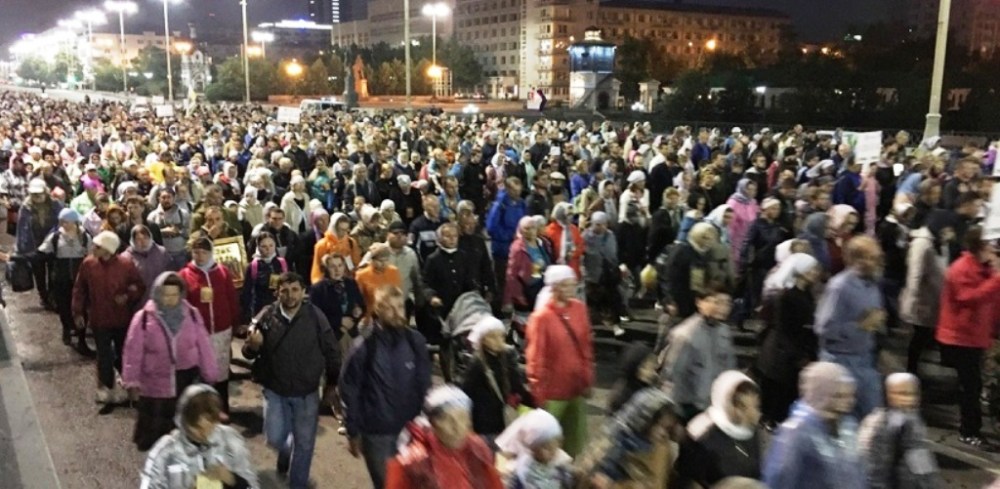
It all started at half past two on the morning of 17th July. At this time, a column of thousands of believers was gathering on the street below the Church on the Blood. The 20-kilometer journey, follows the route which almost a hundred years ago, the remains of members of the Imperial family were taken by their murderers to be disposed of in an abandoned mine. As the column began moving, I noticed heaps of rubbish, long lines for the toilets and crowds of people trampling down the lawn to join the procession.
Most of the pilgrims are women, wearing color scarves and skirts, carrying packs and mats on their back, many with raincoats. On their chest – icons bearing the image of Holy Royal Martyrs. Many went on their way in rubber slippers and socks, which by the end of the procession were covered in dirt and mud.
Overtaking the column was not an easy feat. Despite the fact that there were many women, pensioners and children in the procession, they walked so fast that I had to run to catch up with them. It was amazing to see young children who were led by their mothers, and I even came across people in wheelchairs.


Photos courtesy of 66.ru
And finally, I am among the believers. They hardly spoke amongst themselves. The bell ringing, and prayers gave the impression that they were in a state of trance. They repeat:
– Lord Jesus Christ, Son of God, have mercy on us.
Sometimes people took out their phones to take pictures of the crowd, themselves and the surrounding buildings. There are many visitors among the pilgrims, who at the same time take pictures of the city’s sights.
– Lord Jesus Christ, Son of God, have mercy on us.
As soon as I got inside the column, I felt scared and ill. Never at night in Ekaterinburg have I experienced such stuffiness. You take a breath of air – and it does not fill the lungs. You just can’t breathe. Gradually, my head began to spin, my forehead became heavy, and a strange sensation appeared in my eyes, as if someone was pressing on them. No matter how hard I tried to force myself to walk among the Orthodox, my legs carried me closer to the safety of the sidewalk.
– Lord Jesus Christ, Son of God, have mercy on us.
The temperature was already 18 degrees Celsius. After the first few kilometers, we turned onto Verkh-Isetsky Boulevard, it became hot, the humidity oppressive.
On the side of the lawn are the Cossacks – making sure that no one walks on the grass.
I stumble about wearing a long skirt, and disgruntled people rush at me from behind – the crowd does not stop.
– Alyosha! – shouts one woman. She lost her son in the crowd. Nobody responds to her calls, which are drowned in the prayers of human voices around her.
– Lord Jesus Christ, Son of God, have mercy on us.
We pass the Karnaval shopping complex, and fear that I will soon faint. I feel sweat trickling down my back and take off my jacket.
– Lord Jesus Christ, Son of God, have mercy on us.


Photos courtesy of 66.ru
As we approach the bridge, something starts to happen. I am sure that I will lose consciousness, from all the stuffiness, chants and oppression . The asphalt seemed to buckle under my feet. I am not imagining this in my head. You take a step, and it feels as if the earth is going up and down – I panic, and jump over the fence, running through the mud onto solid ground. But even then the buckling did not stop – it was as if I had been riding a boat for several hours.
– Lord Jesus Christ, Son of God, have mercy on us.
As we turn on Ulitsa Teknikalskaya, men run behind flower stalls and stand under the windows to relieve themselves. Women have nowhere to run, so they crouch under the trees, hiding behind flags bearing the image of the tsar. Someone went into the courtyard and upon, returning, said that the residents were swearing at the participants in the procession. Perhaps the organizers could remedy this problem by placing portable public toilets along the procession route.
– Lord Jesus Christ, Son of God, have mercy on us.
At the half way point the brain stops working. I carry on, trying not to step on my calluses, and listen to the conversations around me.
A bald man tells his neighbor that he had been sick with cancer. At first he lamented the injustices of his life, and then he accepted it. I decided to go to church, he added. And two weeks later, a doctor came to him with all the equipment, checked the man and said that he could find no trace of cancer. noting a miracle of God
– Lord Jesus Christ, Son of God, have mercy on us.
As we walk through the forest, every now and then people stop and shake the stones out of their shoes. On the side of the road stands a woman with a red cross on her head and with a spray gun in her hands:
– “Who wants to be sprinkled with Holy water?”
Six in the morning. Feet continue to slowly, painfully stride forward. I hear the conversation behind. A boy of five holds his mother by the hand and complains that he is very tired. Next to him is a man who advises him to thank God for his trials:
– Fatigue – it will pass. It will be hard for you – fold your hands like this and ask the saint for help. He sees every soul and immediately comes to the rescue. Only then do not forget to pray and say thanks to God for the difficulties he subjected you to. Work, pray and be patient.
– Lord Jesus Christ, Son of God, have mercy on us.


Photos courtesy of 66.ru
After an hour and a half we come to EKAD (Ekaterinburg Ring Road). The column blocks the road, and I can note the glare from angry drivers as we pass. Nearing Ganina Yama, we pass a growing number of beggars. And these are the same people who asked for alms at the Church on the Blood.
– Lord Jesus Christ, Son of God, have mercy on us.
As I approach Ganina Yama, I hear the ring of bells from the monastery’s churches. I am pleased with this sound. People collect their last remnants of strength, and seek out a spot to rest. I am short of being delirious, that we have reached the very end. My only desire is to finally stop and sit down.
When I come to the entrance, many people are already sleeping along the road. They have spread mats and rub their tired and sore feet. Some eat, while others sleep. I sit down near a large rock by a pine and have a blissful rest. Snoring resounds around me.
Buses were on hand to take people from the monastery back to Ekaterinburg. For the pilgrims, there was surprise that the buses would only go as far as the village of Shuvakish, to the town of Sredneuralsk and to the 9th hospital in Ekaterinburg. Traffic police officers try to reassure every one that there are enough places for everyone, but as soon as the bus approaches, the believers storm the bus fiercely, pushing, stepping on each other’s feet and cursing one another.
Those who do not want to suffocate, go on foot to Shuvakish and from there look for a way to get home. I am among them. Four kilometers more – and you can get in a taxi (cars are not allowed closer). Half past ten in the morning. “Thank God, take me home,” I say to the driver, and I immediately fall asleep in the backseat.
© Paul Gilbert. 10 March 2019




You must be logged in to post a comment.