Photo © Respublika / Oksana Kudryashova
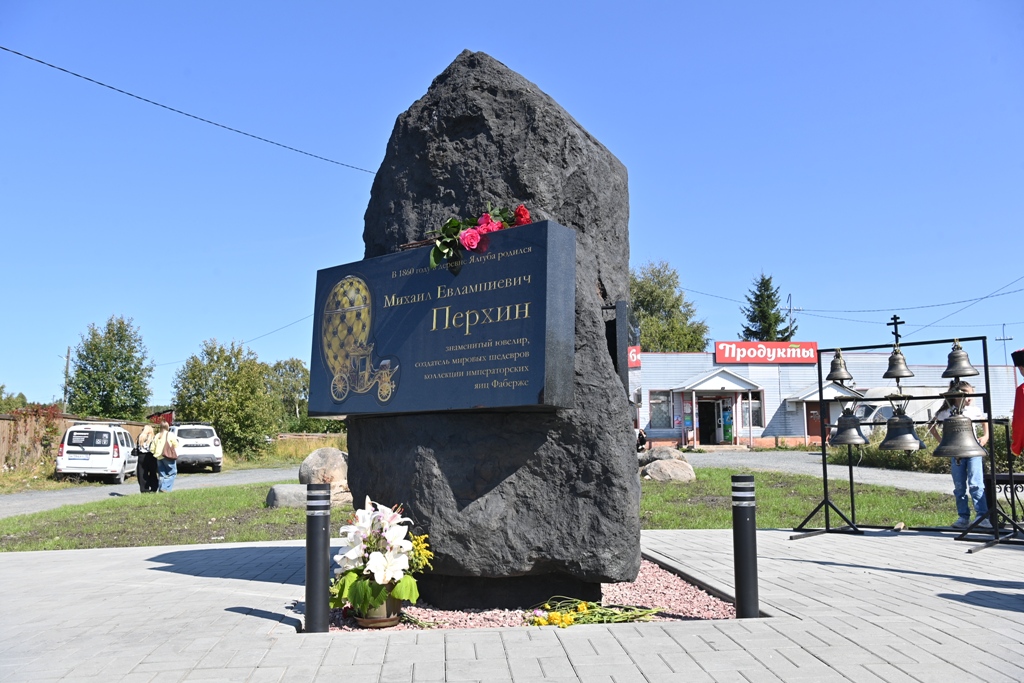
On 15th August 2026, a monument to Mikhail Evlampievich Perkhin (1860-1903), the outstanding master who created more than half of the famous Fabergé Imperial Easter Eggs was unveiled in the village of Yalguba.
The monument was installed on the village embankment, in front of No117 Tsentralnaya Street in the village of Yalguba, Prionezhsky District.
“Today we are opening a memorial to our famous countryman Mikhail Perkhin, a man who, as a jeweller of the House of Fabergé, glorified this world-famous jewelry house with his work. We also remember Mikhail Perkhin as a philanthropist and trustee who supported education here in Yalguba and invested a lot of time and money in supporting the local church,” said Olga Shmaenik, Vice-Speaker of the Parliament of Karelia.
“I am happy that today the successors of his work, patrons and philanthropists helped us create such an amazing art object. I thank the initiative group, historians, architects and designers. I am sure that this place will become a point of attraction not only for residents of the Karelian republic, but also for visitors to Yalguba,” she added.
The new monument was based on the famous Coronation Egg, created by Perkhin in 1897. Hidden inside the egg is a miniature gilded carriage, a tiny replica of the original from the Holy Coronation of Emperor Nicholas II in Moscow in May 1896. The plaque on the face of the monument is made of gold, depicted on a gabbro-diabase slab and attached to a shungite stone.
The project was brought to life by sculptor Alexander Laliashvili and landscape designer Evdokia Dembo. The financing of the manufacture and installation of the monument, as well as the surrounding landscaping, was undertaken by EFER LLC and the chairman of the board of directors of the Yuri Gorban firm.
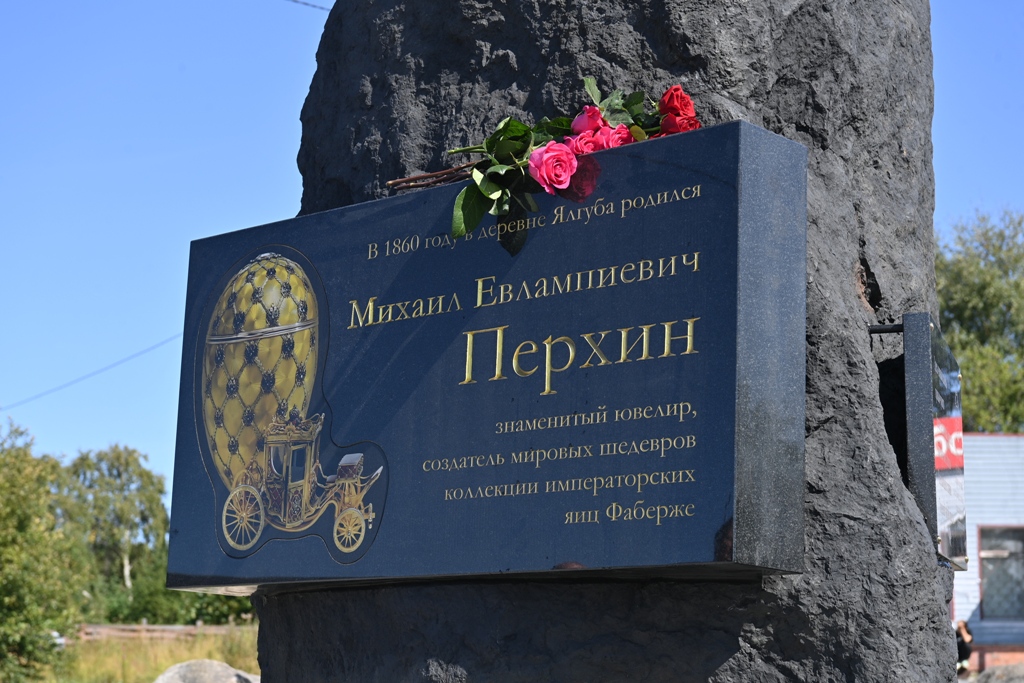
Photo © Respublika / Oksana Kudryashova
Mikhail Evlampievich Perkhin was born on 3rd June (O. S. 22nd May) 1860, in the village of Okulovskaya [renamed Yalguba] into a peasant family with Russian and Karelian roots. Mikhail was the fifth of seven children born to Evlampy Arsenyevich (1825-1877) and Anna Trefilovna (1821-1899).
In his youth, Mikhail went to St. Petersburg, where he worked his way up from an ordinary student to the owner of his own workshop under the auspices of the House of Fabergé with the right to put his personal hallmark on the items he produced. Mikhail Perkhin made 28 of the 50 Imperial Easter Eggs for Emperors Alexander III and Nicholas II. The eggs he was responsible for were marked with his initials.
About 20 thousand pieces of jewellry were made in Perkhin’s workshop. The workshop produced chased and engraving works on gold and silver, stone frames, exquisite pieces of jewellry and gifts: rings, earrings, snuffboxes, hairpins, caskets, cigarette cases and much more.
From 1896-1903, Perkhin served as a trustee of the Yalguba Zemstvo School. In 1899-1900, he donated expensive gilded silver liturgical vessels and a gold plaque with chased patterns with the names of his parents and relatives to the local church in the name of St. Nicholas the Wonderworker. The church was built in 1809, and demolished by the local Soviet in November 1930.
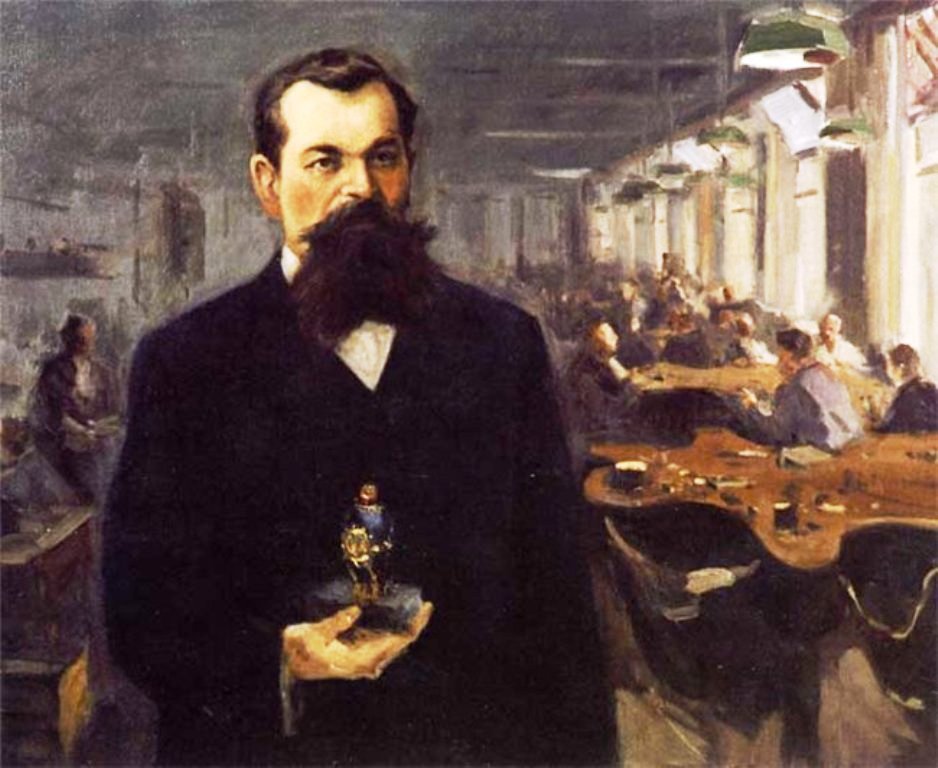
Portrait of Mikhail Evlampievich Perkhin (2011).
Artist: Anatoly Perevyshko (b. 1952).
In 1884, he married 16-year-old Tatyana Vladimirovna Finnikova, the daughter of his teacher. The couple had five children: four daughters and one son.
In 1886, Mikhail received the title of master, the right to a personal brand “M. P.” (Mikhail Perkhin) and was invited by Carl Fabergé to work in the jewellry workshop of the Fabergé firm
In 1895, Perkhin was awarded the title of personal honorary citizen as a reward for the execution of imperial orders. In the same year, the family moved to Tsarskoye Selo, where Mikhail bought a wooden house for permanent residence.
Mikhail Evlampievich Perkhin died on 10th September (O. S. 28th August) 1903 – aged 43 – from “spinal cord dryness” [aka Disc desiccation] in a hospital for the mentally ill. He was buried at the Novodevichy Cemetery in St. Petersburg. His wife died in 1907 in Tsarskoye Selo and was buried at the Novodevichy Cemetery in St. Petersburg near her husband’s grave.
Mikhail Evlampievich bequeathed his workshop and all the tools to his first assistant Henrik Immanuel Wigström (1862-1923). He left 25 thousand rubles to his wife and five children, and 500 rubles to his sister Maria. He left 100 rubles to each of his Godchildren, apprentices, and employees.
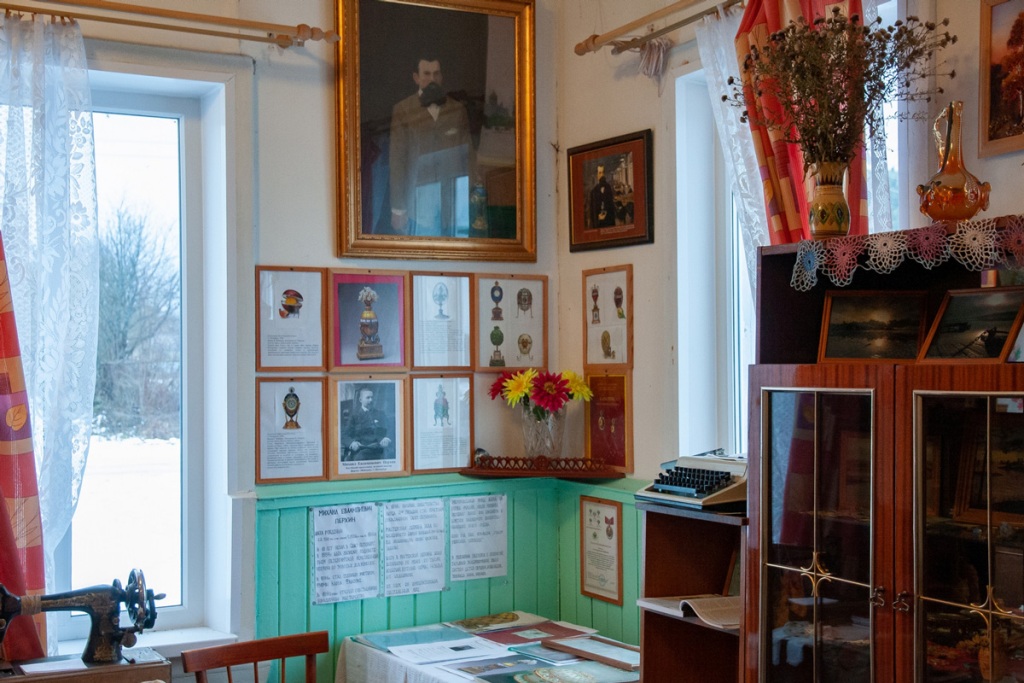
A corner of the local history museum in Yalguba is dedicated to Mikhail Perkhin
At the end of the 20th century, the grave of Mikhail Perkhin was first discovered and the lost tombstone was restored by the scientific secretary of the Carl Fabergé Memorial Foundation, andjewellry historian Valentin Vasilyevich Skurlov [b. 1947] and the chairman of the Union of Jewelers of the North-West Alexander Sergeevich Gorynya.
In the local history museum, in his native Yalguba, there is a small permanent exhibition dedicated to Mikhail Perkhin. Among the exhibits are a portrait of the jeweller made by the artist Anatoly Perevyshko (seen above) and donated to the museum, several coloir photocopies of his works, a photocopy of his birth record from the local parish book, a photo album, a book about the master, and the genealogy of Mikhail Evlampievich.
© Paul Gilbert. 15 August 2026


You must be logged in to post a comment.