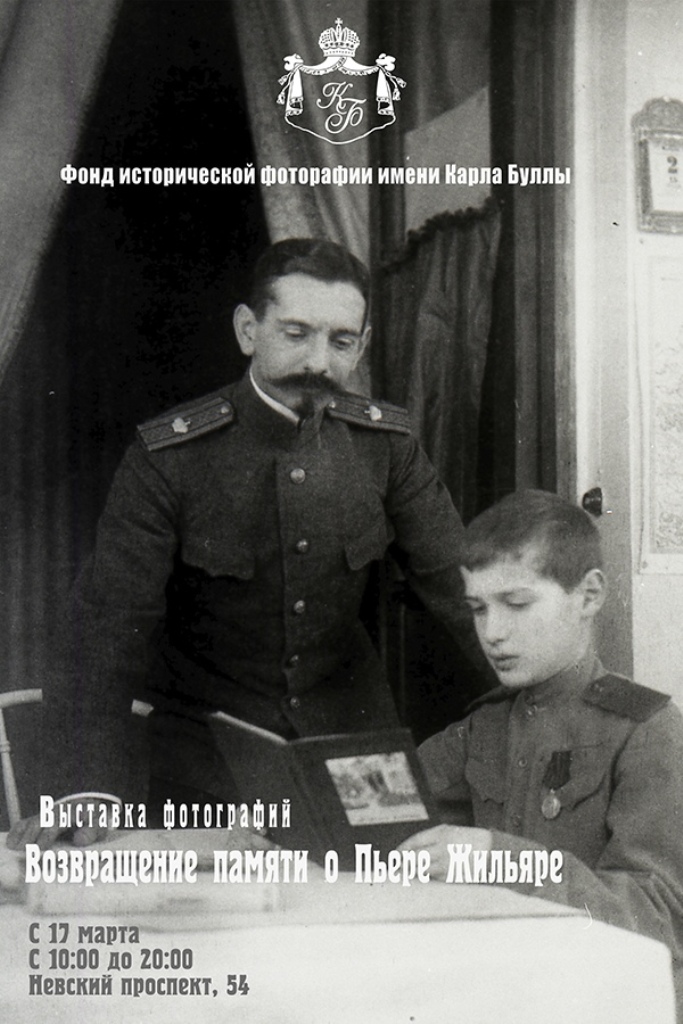
An exhibition of photographs depicting the life of Emperor Nicholas II and his family, from the collection of Pierre Gilliard, opened 17th March at the Karl Bulla Fund for Historical Photography, situated at No. 54 Nevsky Prospekt in St. Petersburg.
The one day exposition was timed to coincide with the release of the Russian translation of Gilliard’s book Трагическая судьба Николая II и его семьи (The Tragic Fate of Nicholas II and His Family), published in 1929 in Paris by Payot.
From 1905 Swiss citizen Pierre Gilliard (1879-1962) taught the French language to the children of Nicholas II. From 1913 he was appointed tutor to the Heir Tsesarevich Alexei Nikolaevich. Gilliard accompanied the Imperial Family into exile to Tobolsk, but upon arrival in Ekaterinburg he was separated from the family. Gilliard was a keen photographer, and returned to Switzerland with a large number of photographs. In exile he wrote his memoirs of his life in Russia and his impressions of the daily life of Nicholas II and his family.
Today, Gilliard’s archives are stored in the Lausanne Museum of Photography, including 384 black and white photos. More than 70 photos from Pierre Gilliard’s archive, most of which never been exhibited in Russia are presented in the exhibition.
“In essence, this is the return of the memory of Pierre Gilliard, who, by the will of fate, witnessed one of the most tragic events in the history of Russia,” said the President of the Karla Bulla Foundation for Historical Photography Valentine Elbek.
He added that the photo exhibition will open at Livadia Palace in Yalta in May 2020, to coincide with the international scientific conference Russia. The Romanovs. More than a dozen photographs brought from Gilliard’s collection depict the Imperial Family during their visits to Livadia.
It is interesting to note that the idea of publishing a photo album based on Pierre Gilliard’s collection is being worked out. “Our partners in Lausanne expressed a desire to host our exhibition, which will probably be shown in various European capitals,” added Valentin Elbek.
The St. Petersburg exhibition was implemented in partnership with the Ludwig Nobel Foundation. The Tsarskoye Selo Museum Reserve has shown interest in this initiative, where Gilliard’s working room is being restored in the Alexander Palace, and his heirs donated part of his belongings to the museum as a gift.
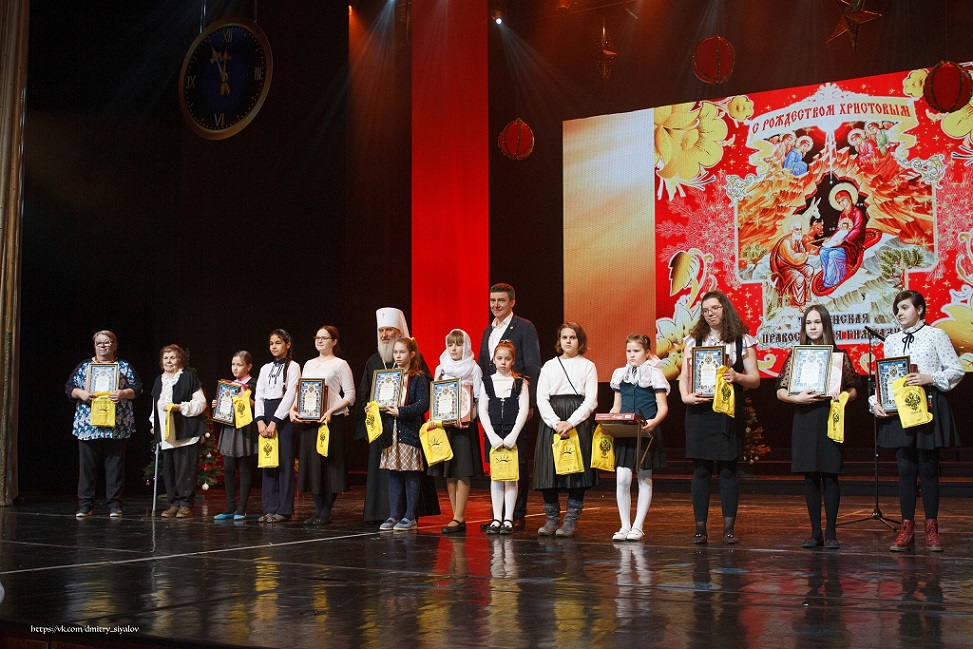
Metropolitan Demetrius of Tobolsk and Tyumen with the winners of the competition
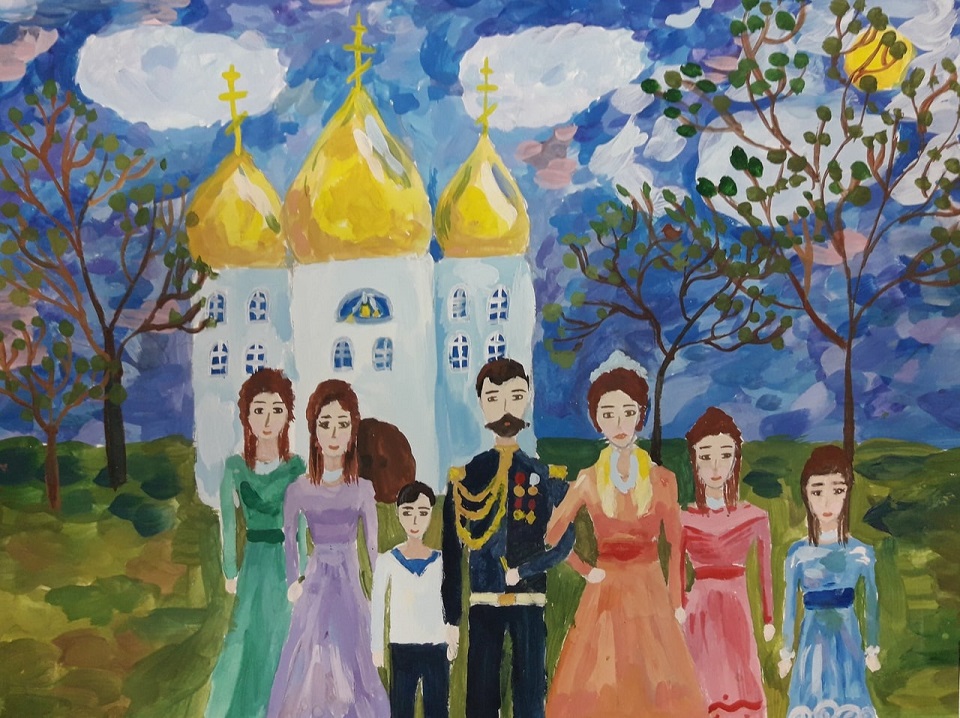
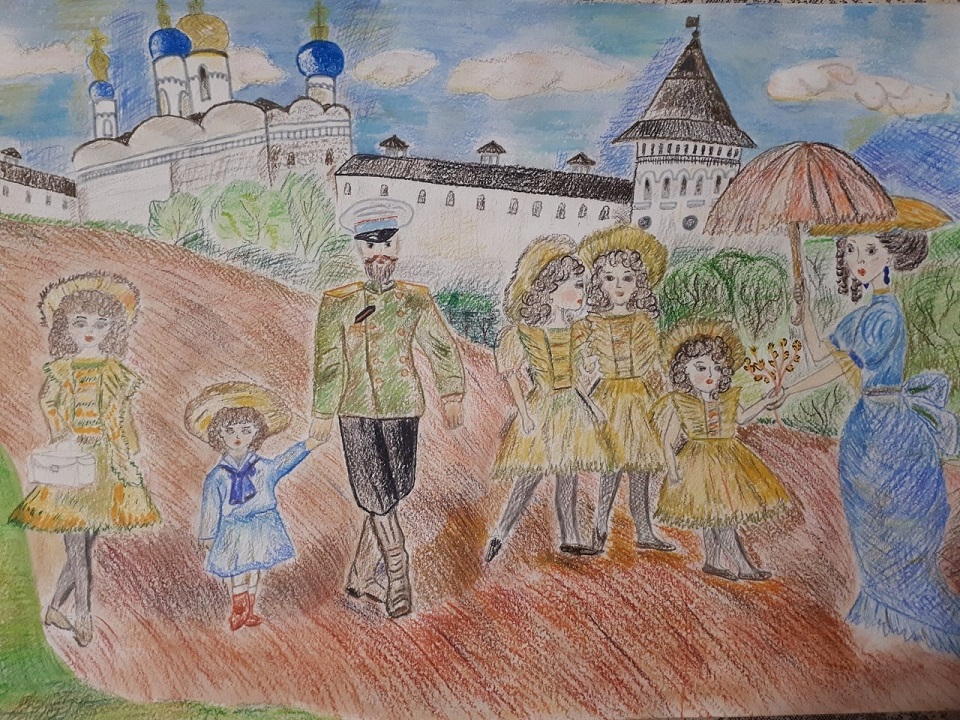
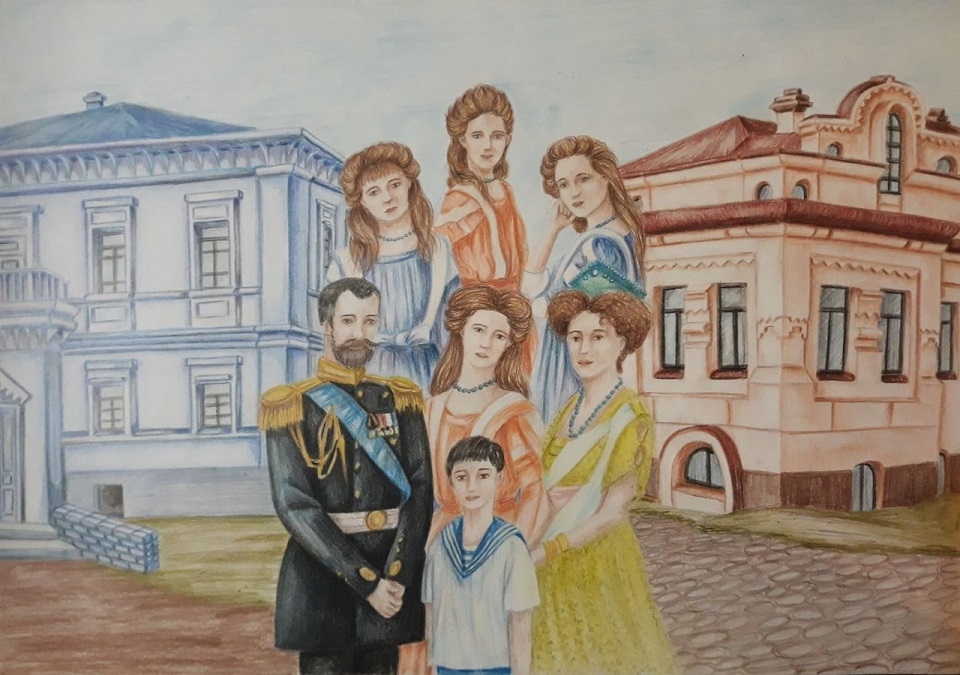
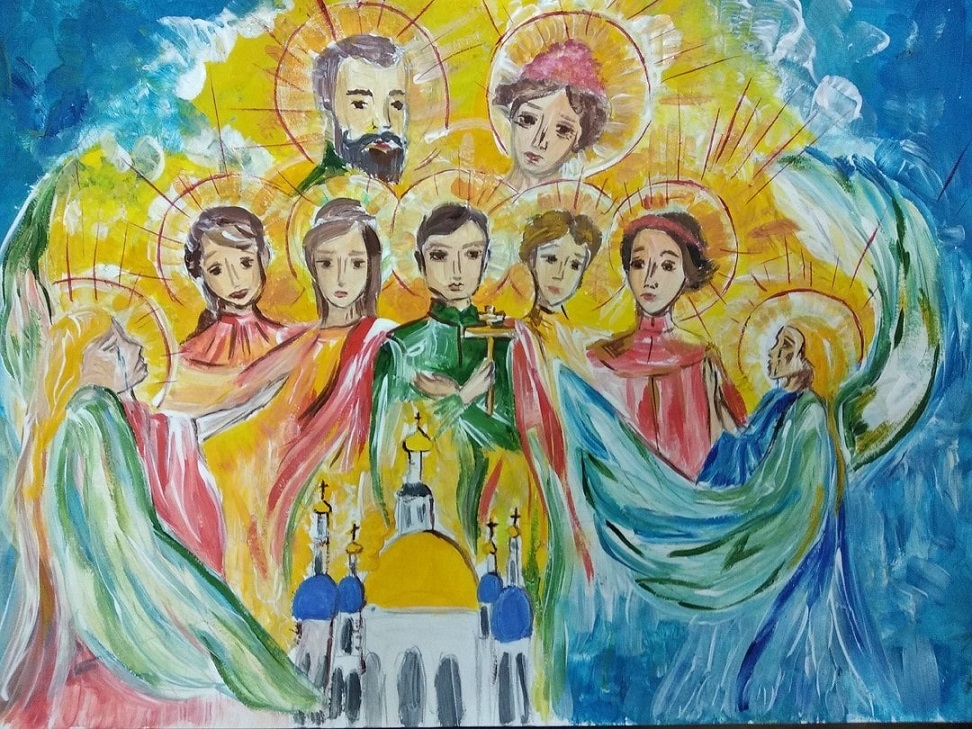
In December 2019, The Holy Royal Martyrs in the History of Siberia was held in Tyumen, as part of the celebration of the 400th anniversary of the Tobolsk Metropolis. The events included a competition of paintings by children depicting Emperor Nicholas II and his family.
More than 40 children participated in the competition. The ceremonial awarding of the finalists took place on 10th December as part of the Christmas holiday for students of the Tyumen Orthodox Gymnasium. Organizers noted that the children submitted “colourful, creative work”, distinguished by each child’s skill and dedication.
“The Imperial family out for a walk”
“The Imperial family out for a walk in Tobolsk”
“From Tobolsk to Yekaterinburg”
“In One Prayer”
Diplomas and gifts were presented to the best 10 colorful works, in addition to several other participants. The names of the paintings speak of the children’s involvement in the contest theme: “The Imperial family out for a walk”, “The Imperial family out for a walk in Tobolsk”, “From Tobolsk to Yekaterinburg”, “In One Prayer”.
Metropolitan Demetrius of Tobolsk and Tyumen took part in the award ceremony and thanked the young people of Tyumen for their participation in the competition.
“It is gratifying that many participants reflected the most important essence, which is inherent in the title of the contest: the family of the last Emperor Nicholas II, the Royal Martyrs in the history of Siberia. Children approached the task responsibly, invested their souls, reflected the high moral and spiritual values inherent in Nicholas II and his family,” noted Vladyka Dimitri.
NOTE: All of the articles pertaining to Nicholas II and his family which were originally published in my Royal Russia News blog, have been moved to this Nicholas II blog. This article was originally posted on 15 February 2018 in my Royal Russia News blog – PG
The following exhibition ran from 26 January to 4 April 2018
The exhibition Imperial Yacht Standart and the Family of the Last Russian Emperor, opened on 26 January at the Central House of Artists in Moscow. The exhibition is based on memories and original photographs from the personal archive of Captain 2nd Rank Nikolai Pavlovich Sablin (1880-1937), who served on the Imperial yacht Standart from 1906 to 1914.
A significant part of these historic images were photographed by the co-owner of the photographic studio “K. E. von Gan and Co., the famous Russian photographer AK Yagelsky, who had the title of Court photographer of His Imperial Majesty. Yagelsky also owned the right to conduct filming of the imperial family. The exposition includes photographs of the photographic studio K. E. Von Gan and Co., as well as unique newsreel footage taken on board the imperial yacht. In addition to the photographs, original letters of Emperor Nicholas II written on board the ship, watercolours and a collection of postcards dedicated to the Imperial yacht, a yacht logbook and a number of other unique documents will be on display.
The photos taken on board the yacht Standart are not widely known to the general public and are associated with the inner life of the royal family, moments not intended for an outsider’s eye and therefore very sincere and direct.
***
The exhibition was first shown at the State Museum and Exhibition Center ROSPHOTO in St. Petersburg, from 2 August to 24 September 2017 and in Smolensk from 18 October to 15 December 2017. Click on the VIDEO above to view highlights from the St. Petersburg venue.
The exhibition Imperial Yacht Standart and the Family of the Last Russian Emperor, runs until 4th April 2018, at the Central House of Artists in Moscow.
Click HERE to visit the ROSPHOTO site for more information and photographs of the Imperial Yacht Standart – in Russian only.
NOTE: All of the articles pertaining to Nicholas II and his family which were originally published in my Royal Russia News blog, have been moved to this Nicholas II blog. This article was originally posted on 17 March 2018 in my Royal Russia News blog – PG
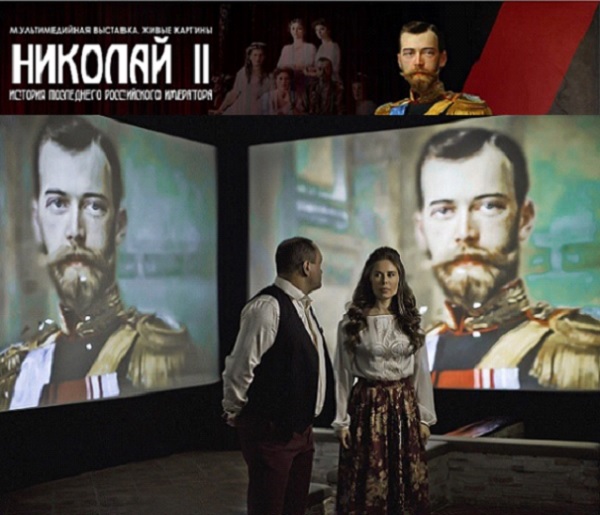
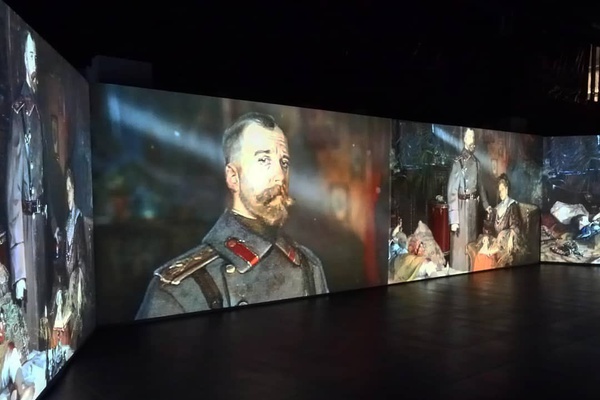
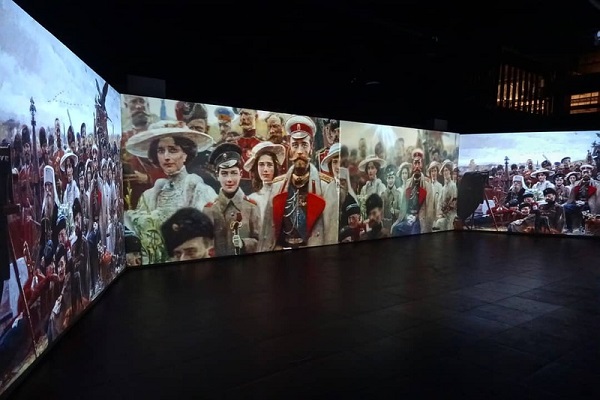
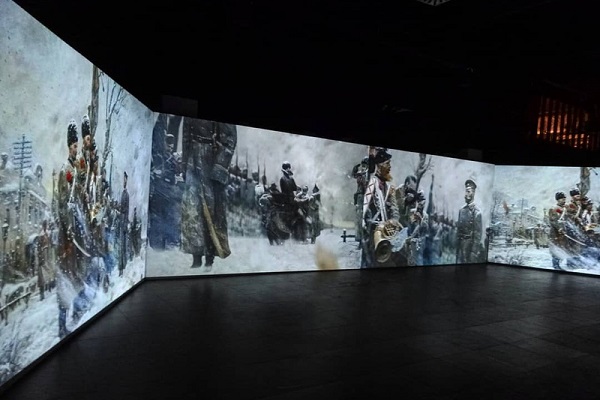
An exhibition dedicated to Russia’s last emperor and tsar has opened Kvadrats Gallery, situated in Sokolniki Park in Moscow.
Sokolniki Park is situated not far from the center of the city, near Sokolnicheskaya Gate. The park gained its name from the Sokolnichya Quarter, the 17th-century home of the tsar’s falconers (sokol is the Russian word for falcon). It was created by Tsar Alexei Mikhailovich (father of Peter the Great), a keen hunter who loved to go falconing in the area.
The multi-media exposition is timed to the tragic date in Russia’s history – the 100th anniversary of the death of Nicholas II, his wife Alexandra Feodorovna and their five children in Ekaterinburg on the night of 16/17 July 1918.
After their murders, Bolshevik and Soviet authorities did everything in their power to blacken the name of Nicholas II and forever erase the memory of his life, his reign and his service to Russia. During the past century, historians and biographers have shamefully been content to carry this negative image of Nicholas II in their books and documentaries. This is why the period of Nicholas II’s 22-year reign remains enveloped in all sorts of lies and myths, despite the release of new documents in Russian archives which challenge their often biased assessments of him.
The organizers of the multi-media exhibition project share facts about the life of Russia’s last emperor and tsar, with the hope of restoring the historical truth, and reminding the public that during the reign of Nicholas II the Russian Empire was one of the strongest, most powerful and prosperous countries in the world.
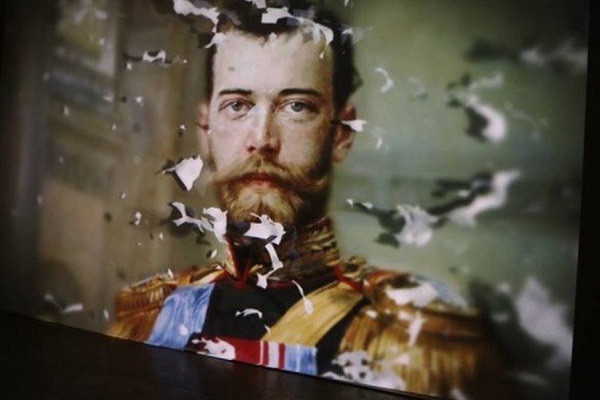
The exhibition includes a collection of “revived” paintings created by famous Russian masters of fine art from the late 19th and early 20th centuries. These are complimented with contemporary works, which include paintings by Orthodox artist Pavel Ryzhenko (1970-2014).
NOTE: All of the articles pertaining to Nicholas II and his family which were originally published in my Royal Russia News blog, have been moved to this Nicholas II blog. This article was originally posted on 14 April 2018 in my Royal Russia News blog – PG
On 10th April 2018, the Museum of Holy Royal Martyrs opened in the Museum of Russian Art in Moscow. The permanent exhibit Family of the Emperor includes personal items, historical relics, photographs and other exhibits which reflect the life of the last Russian Emperor Nicholas II and his family. Many exhibits are presented to visitors for the very first time.
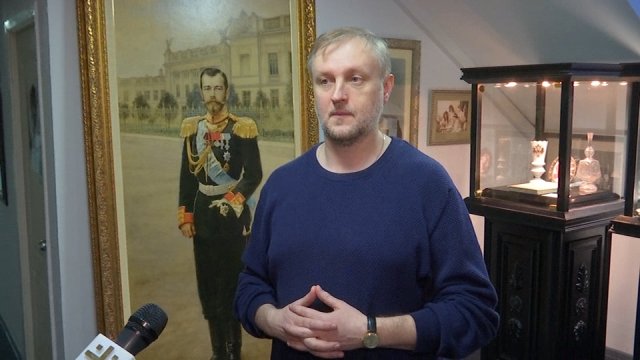
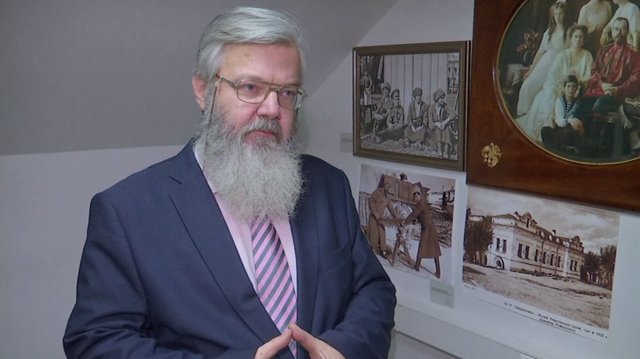
“There are a lot of personal items here of the Emperor Nicholas II and his family, including an icon, a napkin, photographs, and more. Not only are they historical artifacts, they have a cardinal value for Orthodox people, like any object of a loved one who has left us” – said Konstantin Kapkov.
Konstantin Kapkov. Photo: TV channel “Tsargrad”
The exposition features items from the private collection of the famous Moscow artist-restorer Alexander Vasilyevich Renzhin, who over the past few decades has reverently collected everything connected with the memory of Nicholas II, his family and his ancestors. Renzhin is a collector, artist, icon painter, art historian, researcher, restorer, and an expert of the Ministry of Culture of the Russian Federation in the field of paintings and church art. He is the Founder and head of the icon painting workshops Kupina (1987) and Kanon (since 1995).
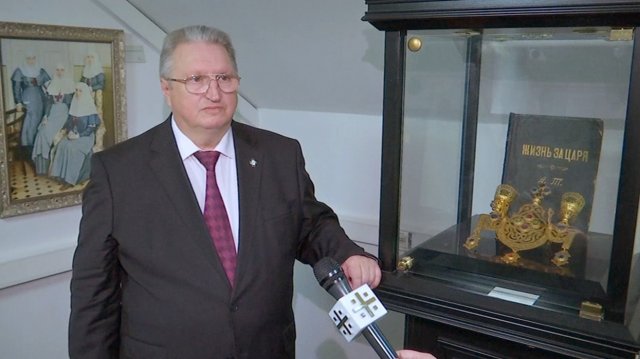
Vladimir Lavrov. Photo: TV channel “Tsargrad”
Doctor of Historical Sciences, and member of the Council of the Double-Headed Eagle Society Vladimir Lavrov notes:
“The year marking the 100th anniversary of the murder of the last Tsar and his family should be a year of historical memory. We must live it with honour, and it is very important that a center, a museum of spiritual and moral education, centered on the fate and reign of Nicholas II, be created. It is of great importance that the museum be Russian, Orthodox, and in Moscow … “
As a convinced monarchist, the creator of the exposition is convinced that this year will be the beginning of the revival of the historical form of government in Russia. Just as it happened in 1613 after the feat of the national hero Ivan Susanin. The feat, glorified in Mikhail Glinka’s opera Life for the Tsar, which sounded, including, at the last coronation in 1896.
Alexander Renzhin. Photo: TV channel “Tsargrad”
Alexander Renzhin shared with his aspirations about Russia’s future with Russian television network Tsargrad:
“We placed Glinka’s score with in our exposition, and in front of it sits a double-lamp, which was specially made for the coronation of the Emperor Nicholas II and the Empress Alexandra Feodorovna, held in Moscow in May 1896. But now the lamp lies unlit. But it is my hope, that in Russian patriotic circles, we will find opportunities to revive not only Orthodoxy in it’s highest form during the era of Nicholas II, but we will revive autocracy and relight this lamp!”
The permanent exhibition Family of the Emperor is open daily, except Monday, in the Museum of Russian Art in Moscow.
Konstantin Malofeev (second from left), chairman of the Double-headed Eagle Society
NOTE: All of the articles pertaining to Nicholas II and his family which were originally published in my Royal Russia News blog, have been moved to this Nicholas II blog. This article was originally posted on 17 April 2018 in my Royal Russia News blog – PG
“The context of the important dates of the country’s history, related to the last Russian Sovereign Nicholas II, can not but influence the development of the country.”
That is why a fair interpretation of the events connected with the downfall of the Russian Empire and its last sovereign contributes to a more intensive spiritual and political development of the country.
In 2018, Russia marks the 150th anniversary of the birth of Russia’s last emperor and tsar Nicholas II, and the 100th anniversary of the massacre of members of the Imperial family.
The act of villainous execution, of course, requires additional comprehension and discussion by historians, politicians, journalists and public figures.
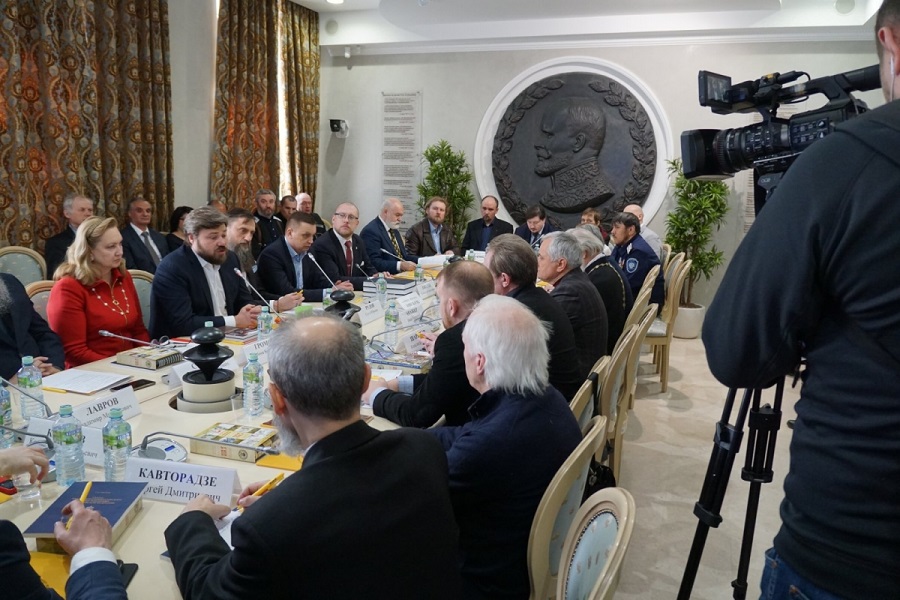
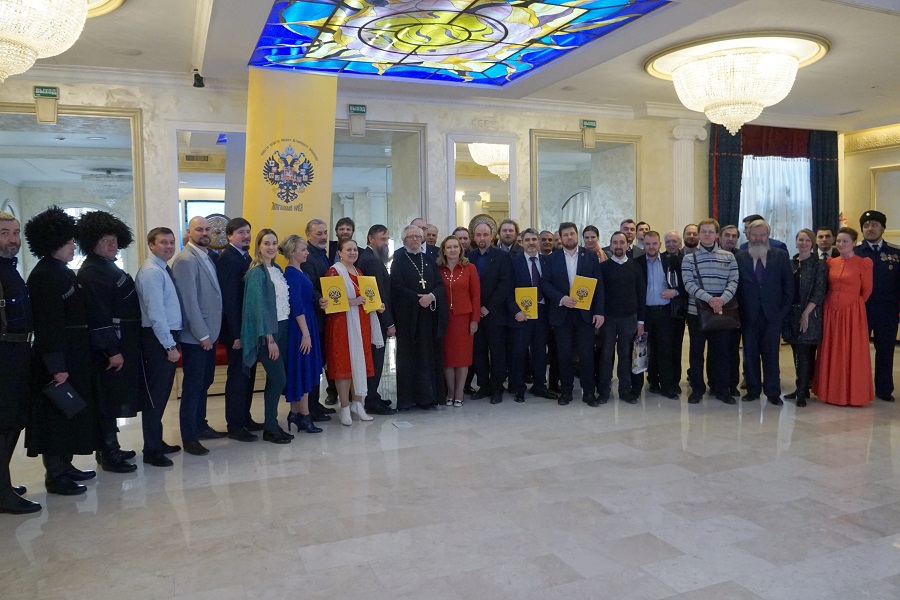
This was guided by the Double-Headed Eagle Society and the Public Chamber of the Russian Federation, who held a joint round table forum in Moscow on 11th April 2018: “Nicholas II: to the 150th Anniversary of his Birth and the 100th Anniversary of the Massacre.”
The event, organized by the Double-Headed Eagle Society, with the assistance of the Public Chamber, included representatives from Moscow, Tula, Nizhny Novgorod, and Stavropol.
The Terek Cossack Host was represented at the forum, as well as the Union of Cossacks of the Warriors of Russia and Abroad (SKVRZ). The round table was moderated by Konstantin Malofeev, chairman of the Double-Headed Eagle Society.
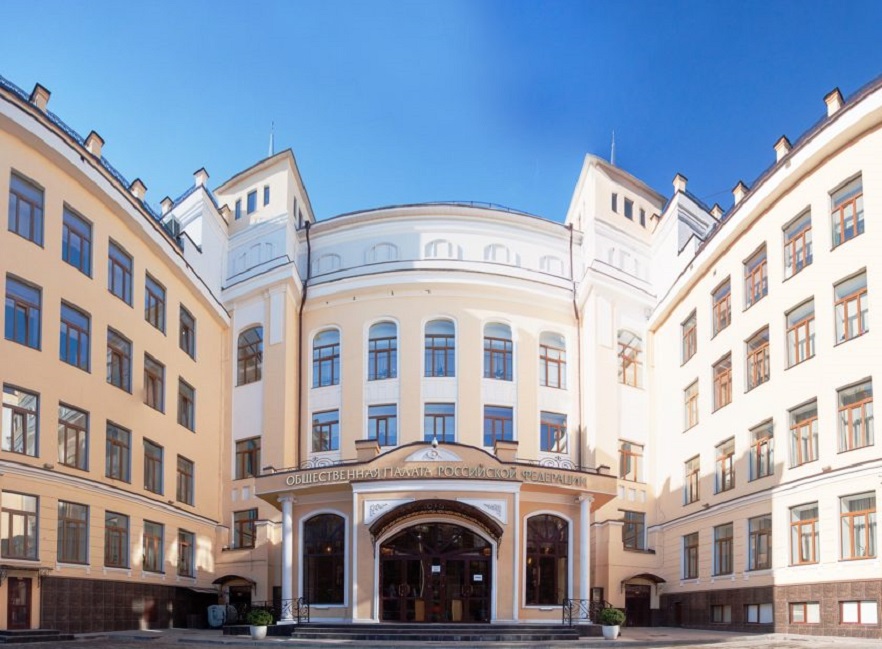
Public Chamber of the Russian Federation in Moscow
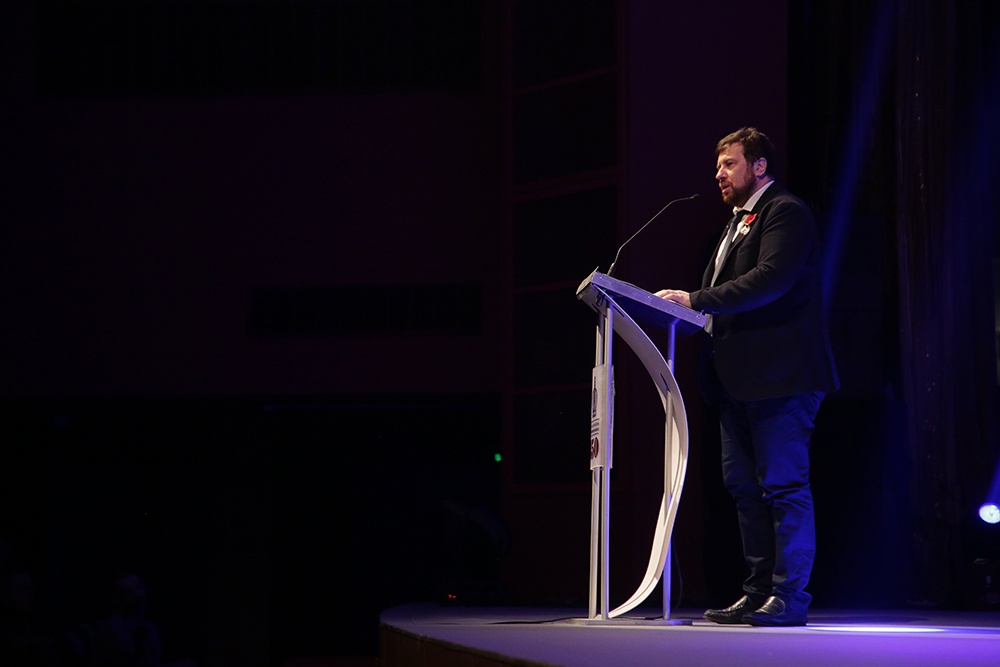
The round table was opened by the welcoming speech of Alexander Tkachenko, Chairman of the Commission on Philanthropy, Civic Education and Social Responsibility of the Public Chamber of the Russian Federation.
This was followed by the welcome speech of the member of the Commission on charity, civic education and social responsibility of the Society S. Rudov.
The first report “Emperor Nicholas II and his influence on the historical and political processes in the world” was made by the chairman of the Double-Headed Eagle Society Konstantin Malofeev.
This was followed by “Preserving the historical memory of the Imperial family: the experience of cooperation of state, church and social organizations”, presented by Anna Gromova, candidate of historical sciences, the chairman of the supervisory board of the Elisavetinsky-Sergievsky Educational Society.
Then the floor was given to Alexander Zakatov, the director of the office of the Head of the Russian Imperial House. He made a presentation on the topic “Orthodox veneration of St. Emperor Nicholas II and his family and the legal protection of their memory in modern conditions.”
Deputy editor-in-chief of the Tsargrad television channel, Mikhail Smolin, Ph.D. in History, gave a detailed account of the influence of monarchical consciousness on Russian statehood. In his report, attention was focused on the advantages of a monarchic system of government.
Doctor of Historical Sciences, Chief Researcher of the Institute of Russian History of the Russian Academy of Sciences Vladimir Lavrov made a presentation on “The reign of Nicholas II and the present: what remains relevant?”
Delegates at the round-table forum on Nicholas II held on 11th April in Moscow
And the next Russian historian and writer Konstantin Kapkov spoke about the spiritual world of Emperor Nicholas II and his family, while candidate of historical sciences, presenter of the television channel “Tsargrad” Pyotr Multatuli spoke on “Emperor Nicholas II. Tragedy of the Unaccounted Autocrat.”
The final report at the round table was made by Alexander Muzafarov, director of information and analytical programs of the Fund for Historical Perspective. He drew the attention of the forum participants to the nature of the last emperor and spoke about the need to further study the personality of Nicholas II .
The free discussion was attended by Evgeny Tsybizov , the head of the Novosibirsk regional branch of the Double-headed Eagle Society, Filip Mosvitin, Honored Artist of Russia , the co-chairman of the International Ilyinsky Committee, the writer A. Sharipov and several other participants.
In the near future, the Double-Headed Eagle Society will present the public with a resolution of the round table forum, for the preparation of which a special editorial group will be created.
The following exhibition ran from 18th July to 9th September 2018
On 18th July 2018, in the year marking the 100th anniversary of the martyrdom of Emperor Nicholas II and his family, an exhibition will open in the Andrei Rublev Museum of Ancient Russian Art in Moscow, presenting a look at the development of the Russian icon during the more than 22-year reign of the last Russian emperor.
Russian icon painting developed in a single cultural space along with literature, music and theatrical art, experiencing an extraordinary rise during the reign of Nicholas II (1894-1917). This flourishing activity was achieved through a number of icon painting and jewelry workshops, which received the title “Supplier of the Imperial Court”. The Imperial manifesto of 1905 on the toleration and the opening of the Old Believers altars attracted wide acceptance of church art by the Old Believers’ and the creation of new works oriented to the art of pre-Petrine time.
The exhibition will feature a wide range of icons from museum and private collections, including items with memorial inscriptions, from the time of Emperor Alexander III’s death in 1894 to the fall of the Russian monarchy in 1917.
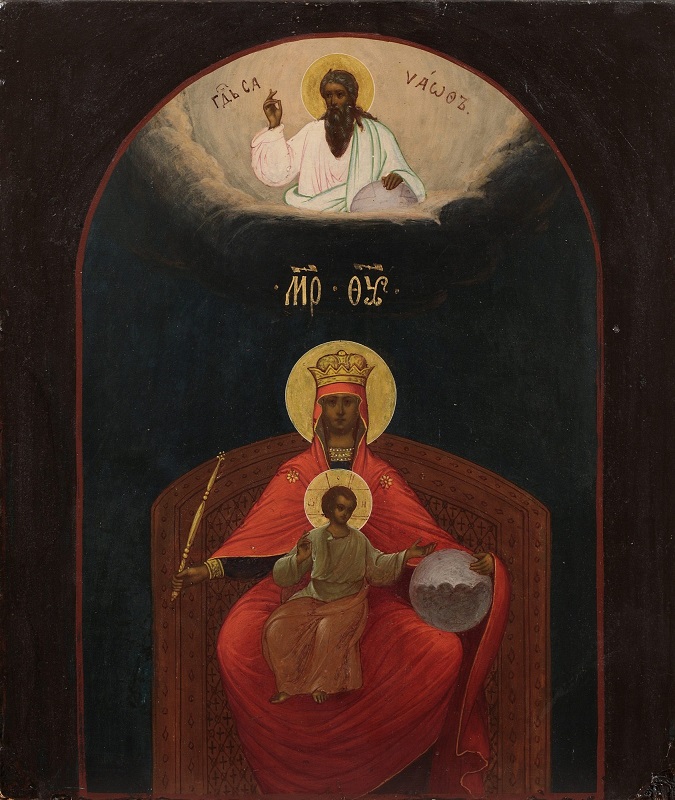
The Icon of the Mother of God “the Sovereign” – pictured above – has a unique place in Russian history. It appeared in the Kolomenskoye village near Moscow on 2 March 1917, the very day that Emperor Nicholas II abdicated the throne. Until 1812 the icon belonged to a convent in Moscow, but in the year of Napoleon’s invasion of Moscow it was hidden in the Kolomenskoye village and forgotten there for 105 years, until the time came for the icon to be revealed in accordance with God’s will. The icon was found among other old icons in the cellar of the Church of Ascension, after the peasant woman Yevdokiya Adrianova was twice instructed in a dream to go to the Kolomenskoye village and search there for a special icon of the Mother of God. After being cleaned of centuries-old dust and grime, the icon revealed an image of the Theotokos sitting on a throne, with the Infant Christ on Her knees, extending His hand in blessing. The Holy Virgin held a scepter in one hand and an orb in the other, and had a crown on Her head. With Her regal air and unusually stern visage, Her appearance was divine.
Significantly, the icon revealed itself at a time when the Russian Empire embarked on its apocalyptic course of destruction, while out of its depths came Holy Russia to gain the crown of martyrdom. The Theotokos’ red robe reflected the color of blood, while the icon’s appearance on the day of the abdication of the last Tsar, and the Theotokos’ regal air with all the attributes of royal power signified that the Mother of God Herself took sovereigny over the Russian people who had just lost their monarch.
The exhibitions Icons from the Era of Nicholas II runs from 18 July 9 September 2018 at the Andrei Rublev Museum of Ancient Russian Art in Moscow
VIDEO of the entire Forum (in Russian only) – duration 2 hours, 20 minutes
NOTE: All of the articles pertaining to Nicholas II and his family which were originally published in my Royal Russia News blog, have been moved to this Nicholas II blog. This article was originally posted on 20 May 2018 in my Royal Russia News blog – PG
On 18th May 2018, on the eve of the 150th anniversary of the birth of the last Russian emperor, a public forum was held in Ekaterinburg to preserve the heritage of Tsar Nicholas II.
Scientists, historians and authors, along with representatives of the public, gathered to discuss the urgent issues of preserving the historical memory of the sovereign, including recognizing the merit of Nicholas II for the development of the Russian state and an assessment of the murder of the Tsar’s family committed a hundred years ago.
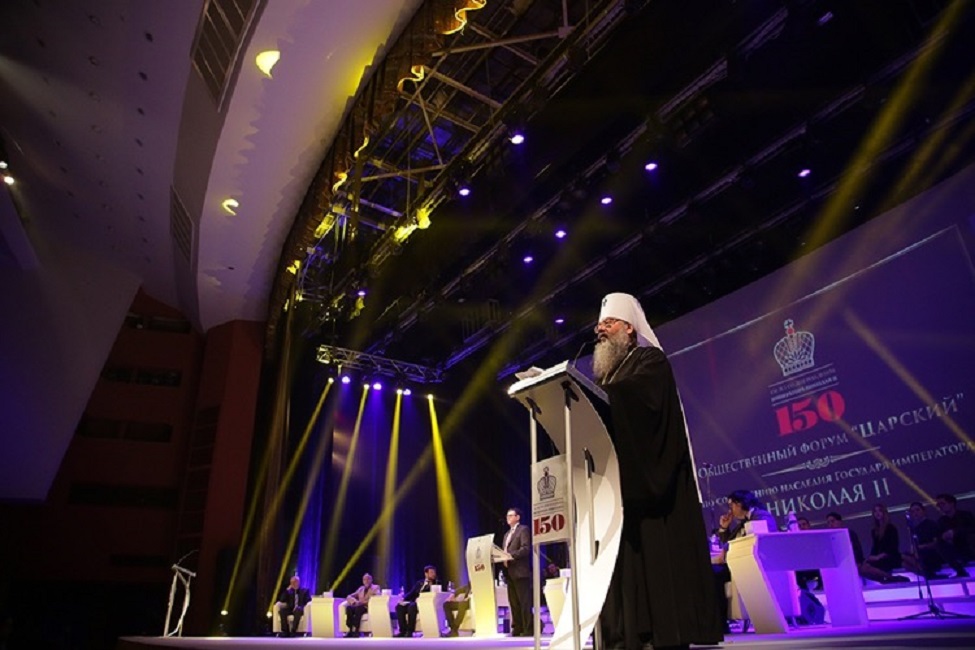
Metropolitan Kirill of Ekaterinburg and Verkhoturye
Opening the forum was Metropolitan Kirill of Ekaterinburg and Verkhoturye, who noted that Ekaterinburg “has become a symbol of the tragedy of the Tsar’s family and, together with her, our Motherland.”
“Since these tragic events, which took place 100 years ago, tragedy befell Russia and it’s people. It is here, on the 150th anniversary of the birth of Emperor Nicholas Alexandrovich, that our holy cause is to gather and reflect on what the Russian Empire was during his reign, what was good about our great country, and what should we take from the past, what lessons, what edifications should we learn for our own lives” – said His Eminence.
The special guest of the forum – the Chairman of the Double-Headed Eagle Society the media group Tsargrad Konstantin Valerievich Malofeev, noted “the triumph of the reign of Emperor Nicholas II, is unparalleled in the thousand-year history of Russia.
“During the history of the Russian Empire, it was the most powerful, the largest, the happiest during the reign of Nicholas II. We should not forget this, and our forum is dedicated to this, which we, the society of historical enlightenment Double-Headed Eagle Society, proudly hold together with the Ekaterinburg Metropolis where our local branch is working under the guidance of Metropolitan Kirill.”
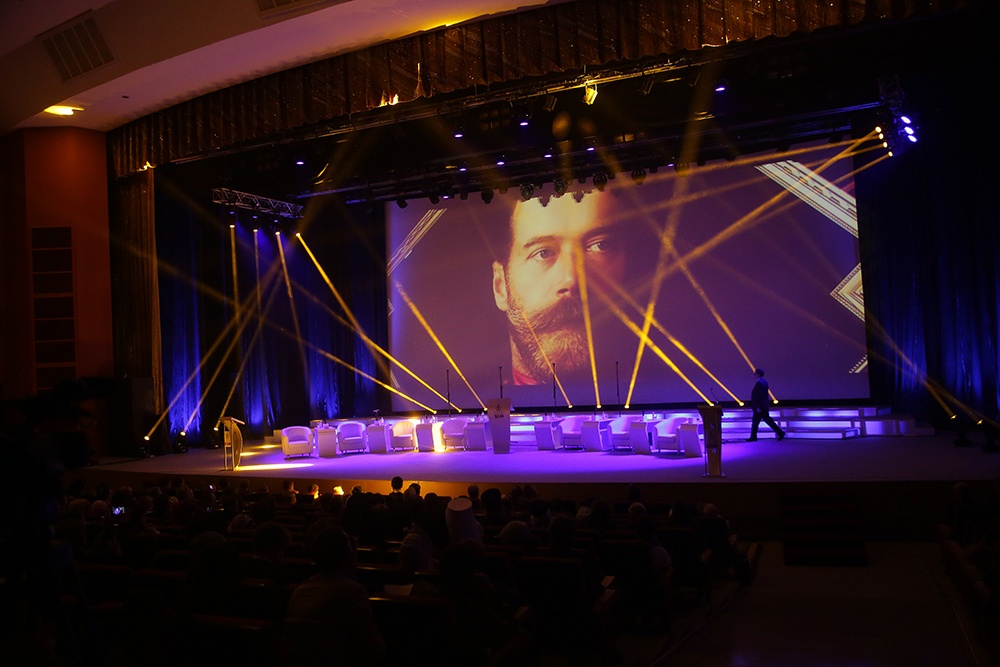
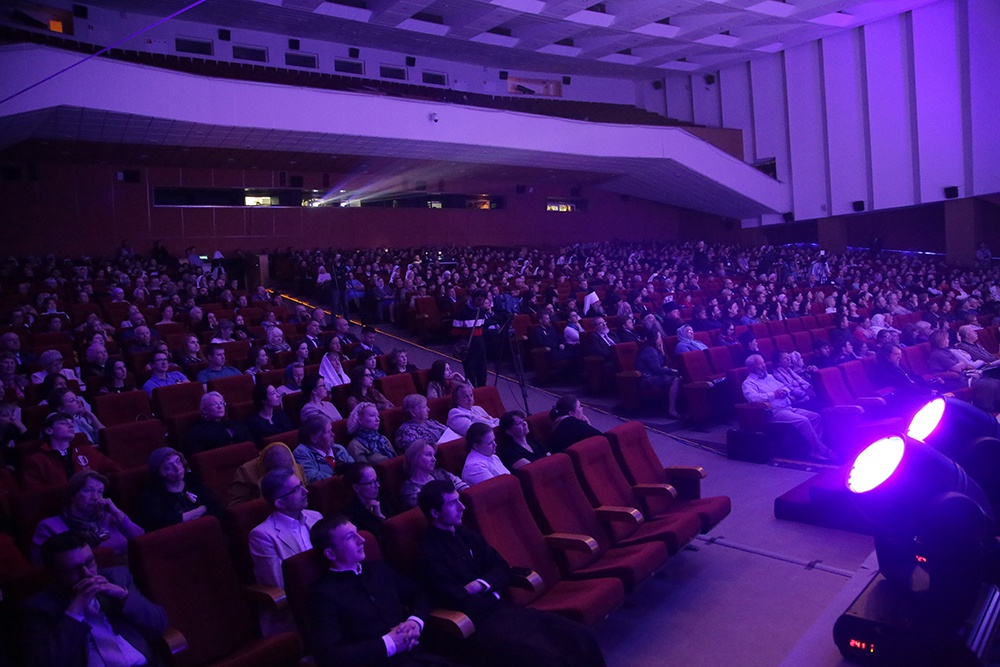
The stage is set for the Nicholas II Forum, held at the Cosmos Theater, Ekaterinburg
The forum was also attended by Bishop Evgeny of Nizhny Tagil and Nevyansky, Bishop of Serov and Krasnoturinsky Alexy, Minister of Education of the Sverdlovsk Region Yury Biktuganov, First Deputy Minister of Culture of the Sverdlovsk Region Vladimir Manturov, as well as representatives of the Double-Headed Eagle Society, the World Russian People’s Council, the Imperial Palestinian Orthodox Society, arriving from various regions of Russia.
Historians, philosophers, theologians, public figures from Russia (among them also experts from Moscow and St. Petersburg), Serbia and Bulgaria discussed issues related to the restoration and preservation of the historical memory of Nicholas II.
Within the framework of the forum, experts assessed the era of the reign of the last Russian emperor as a time, providing great breakthroughs in the development of the state and creating the foundations of socio-economic, including technological development for decades to come. Experts came to the conclusion that Nicholas II was one of the most effective Russian rulers and issued a number of initiatives to perpetuate the memory of Emperor Nikolai Aleksandrovich as an outstanding statesman.
More than 2,000 people attended the Nicholas II Forum on 18th May
Among the proposals included in the final document of the forum is the need for a large-scale federal information and enlightenment campaign on Russia’s achievements in the era of Nicholas II, the development of textbooks and other scientific and educational literature on the basis of reliable scientific information on era, the state order for quality works of art in various fields of culture and art; importance of historical archival research and public dialogue among the scientific community and citizens interested in history; installation in the cities and towns of Russia monuments to the sovereign – an initiative put forward by a member of the Regional Public Chamber, chairman of the Ural branch of the Union of Russian Paratroopers Yevgeny Teterin.
An important topic of the forum was the discussion of the need for public evaluation of the murder of the Imperial Family and their faithful servants, which occurred a century ago in the Ipatiev House in Ekaterinburg. The tragedy of 1918, crowned with the feat of the Holy Royal Passion-Bearers, has not yet been properly evaluated at the state level.
The experts of the forum supported the initiative of Moscow colleagues – participants of a recent round-table hosted by the Parliamentary Newspaper (Парламентская газета) where representatives of the Russian Orthodox Church, State Duma deputies, jurists and political scientists condemned the murder of the Tsar’s family as an unacceptable and unjustifiable crime.
Russia’s leading expert on Nicholas II, historian and author Pyotr Valentinovich Multatuli
During the forum on May 18, in Ekaterinburg, experts presented their views on the sovereign and the era at the forum by:
– Pyotr Valentinovich Multatuli, Russia’s leading expert on the life and reign of Nicholas II, candidate of historical sciences, member of the Council of the Society for the Development of Russian Historical Education of the Double-Headed Eagle Society, and regular commentator of the television channel “Tsargrad”;
– Vladimir Mikhailovich Lavrov, Doctor of Historical Sciences, Member of the Council of the Russian Historical Education Development Society of the Double-Headed Eagle Society, Academician of the Russian Academy of Natural Sciences, Chief Researcher of the Institute of Russian History of the Russian Academy of Sciences;
– Konstantin Valerievich Malofeev, chairman of the Society for the Development of Russian Historical Education of the Double-Headed Eagle Society.
– Yegor Stanislavovich Kholmogorov, publicist, blogger, editor-in-chief of the Russian Observer and New Chronicles sites, author and presenter of the 100 books website;
– Nikola Tanasich, teacher of the Faculty of Philosophy, Belgrade State University;
– Georgi Dimov, Doctor of Science, Senior Researcher of the Bulgarian Academy of Sciences;
– Dmitry Borisovich Grishin, chairman of the Sergievsky Memorial Society (Moscow).
Other participants of the forum were Vladislav Nikolayevich Mayorov, military journalist, expert on the history of Nicholas II and author of the “Royal Calendar”; Vladimir Ilyich Bolshakov, Doctor of Philosophy, Vice-Rector for Research of the Russian Academy of Painting, Sculpture and Architecture Ilya Glazunov (Moscow), as well as members of the Urals Association in Moscow and other experts.
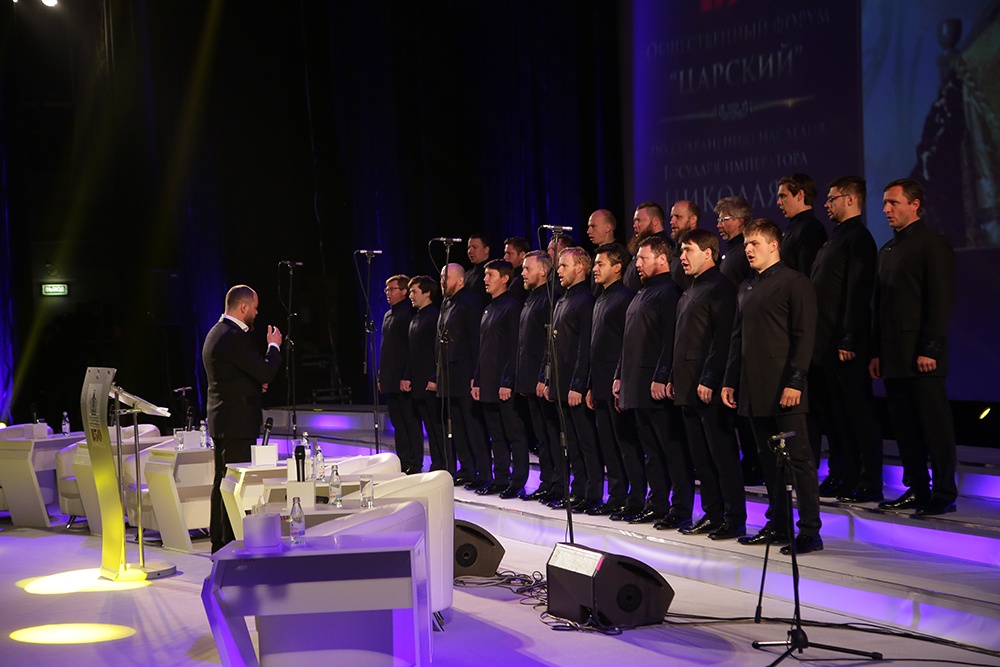
The Sretensky Monastery Choir
The Forum came to close with the singing of God, Save the Tsar and Glory! and A Life for the Tsar, performed by the Sretensky Monastery Choir – please take a moment to watch/listen at the end of the video posted at the top of this post – PG.
The Forum on the preservation of the historical heritage of the Emperor Nicholas II was held in the Kosmos Theater in Ekaterinburg. More than 2,000 people participated in the historic Forum. The event, which became a significant public event, was covered by the leading federal and regional media and was broadcast by the Orthodox television channel Soyuz to 82 countries with a multi-million audience.
NOTE: All of the articles pertaining to Nicholas II and his family which were originally published in my Royal Russia News blog, have been moved to this Nicholas II blog. This article was originally posted on 5 June 2018 in my Royal Russia News blog – PG
The following exhibition ran from 24th May to 30th December 2018
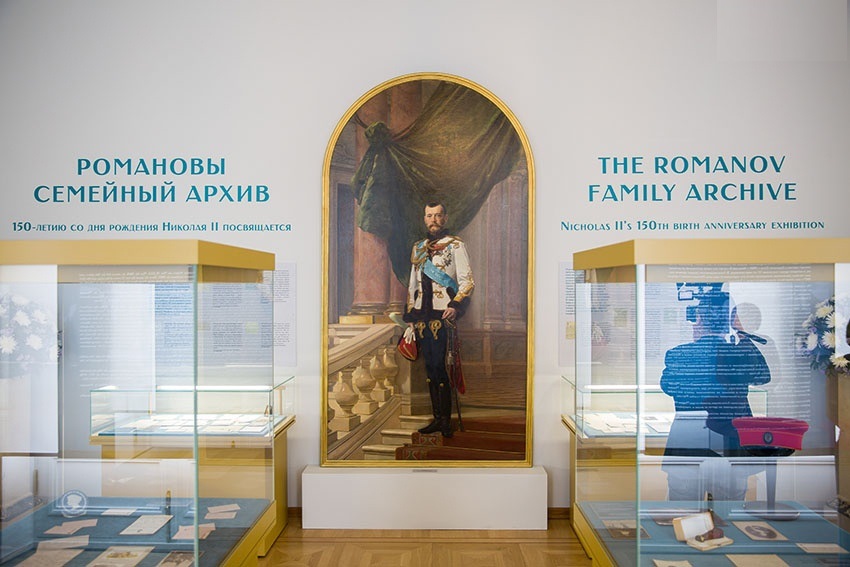
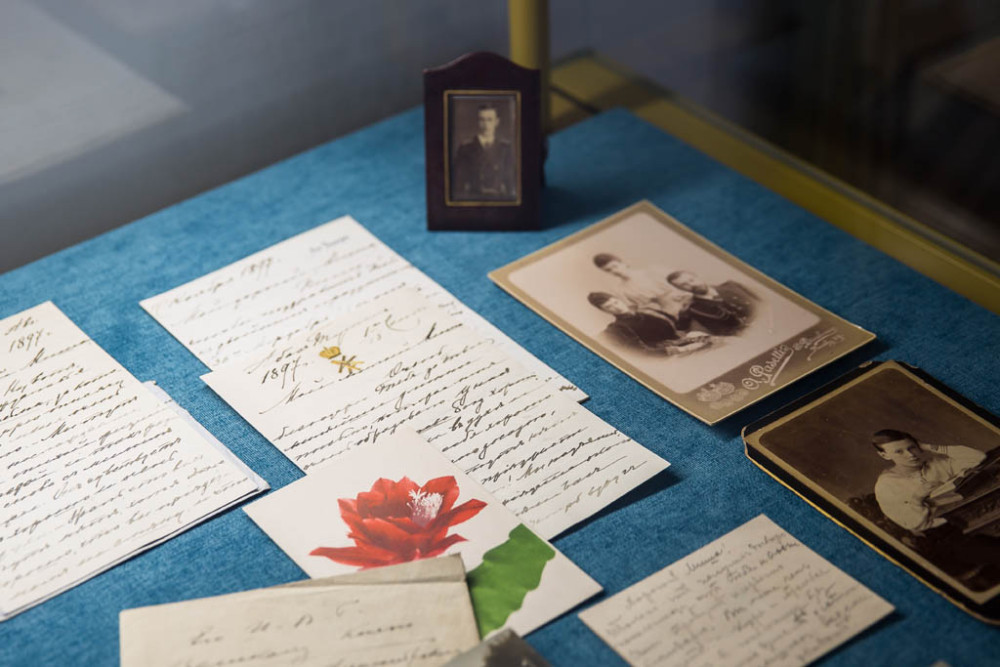
On 24th May 2018, the exhibition The Romanovs. Family Archive, opened in the Catherine Palace at Tsarskoye Selo. The exhibit presents the largest collection of documents and photographs associated with the Imperial family, acquired in the hundred-year history of the museum. The collection of personal documents and photos of the families of Emperors Alexander III and Nicholas II, was acquired at an auction in London in 2017 thanks to the financial support of Sberbank of Russia.
The exhibit is dedicated to the 150th anniversary of the birth of Nicholas II, whose life was closely connected with Tsarskoye Selo: on 18 May (O.S. 6 May) 1868, Nicholas Alexandrovich was born in the Alexander Palace. From his birth, Russia’s last tsar held Tsarskoye Selo close to his heart, and from 1905, made the Alexander Palace his permanent residence, in which he spent the last 12 years of his reign. It was in the Alexander Palace, in which the Emperor was held under house arrest during the first months of his abdication on 15 March (O.S. 2 March) 1917. It was from here on 14 August (O.S. 1 August) 1917, that he and his family were sent into exile to Tobolsk in Siberia.
The archive which spans from 1866 to the 1920s, includes 200 items from the museum collection. Among them – telegrams with warm messages to their children from Emperor Alexander III and his wife Maria Feodorovna. These laconic, but warm parental messages testify to how the August couple cherished family values. In separation, the loving father always found the time to write letters to his children, sharing with them his successes in hunting, fishing, his health, and about how he misses them when they are apart.
The exhibition also presents the letters of Grand Duchess Xenia Alexandrovna to her younger brother Mikhail, with whom she was in correspondence from a young age. Hardly having learned to write, the little brother and sister shared impressions of new discoveries, and humourous anecdotes from their still carefree life. Later, after marrying the Grand Duke Alexander Mikhailovich, Xenia never forgot her “dear Mishkin.” The young couple often wrote to the Grand Duke from their estates “Ai-Todor” in Crimea, and “Abas-Tuman” in the Caucasus. In letters from the French city of Biarritz, Alexander Mikhailovich also shared his interest and passion of motor-driving, his hobbies, hunting, fishing, archaeological excavations, playing tennis, golf and maps.
Of particular importance for the museum was the acquisition of several autographs of Emperor Nicholas II and his wife Alexandra Feodorovna. A letter written by the empress at Easter to her sister-in-law Xenia, included one of her handmade watercolour drawings with a congratulatory signature.
The tragic events of 1917-1918 are described in the letters of Grand Duke Nikolai Mikhailovich to Prince Georgi Shervashidze – the Ober-Hofmeister, who served the Dowager Empress Maria Feodorovna. The grand duke’s letters, which reflect his diary entries record his vision and understanding of the fate which awaits Russia in the future.
From revolutionary Petrograd, Nikolai Mikhailovich writes to his friend in the Crimea: “It’s hard to tell what’s going on here, not only here, but all over Russia. If the Bolshevik regime comes to an end, then little good can be expected from their successors – socialist-revolutionaries or anarchists. . . ”
With the growing nationalization of property, which took place in Russia, the Grand Duke noted in February 1918: “Yesterday I was forced to leave my palace, to leave my rooms and personal things to the mercy of fate and move to another house, an apartment of one of the employees … I now live in one room on the 4th floor … My palace is now the headquarters of the new Red Army … “. As if in anticipation of his tragic fate, the Grand Duke finishes the letter with a hopeless line: “I do not know if we are destined to meet again on this earth, but in the next world my feelings for you will remain invariably friendly. All your NM. ”
The meeting was not destined to take place. Georgi Dmitrievich Shervashidze died in the Crimea on 26 March 1918, and Grand Duke Nikolai Mikhailovich was shot the following year on 9 January 1919 in the Peter and Paul Fortress in St Petersburg.
The collection also includes several letters from the widowed British Queen Alexandra, the sister of Empress Maria Feodorovna, to Grand Duchess Xenia Alexandrovna during her life in exile.
The exhibition The Romanovs. Family Archive runs until 30 December 2018 in the Catherine Palace at Tsarskoye Selo.
NOTE: All of the articles pertaining to Nicholas II and his family which were originally published in my Royal Russia News blog, have been moved to this Nicholas II blog. This article was originally posted on 6 June 2018 in my Royal Russia News blog – PG
The following exhibition ran from 5th June to 23rd September 2018
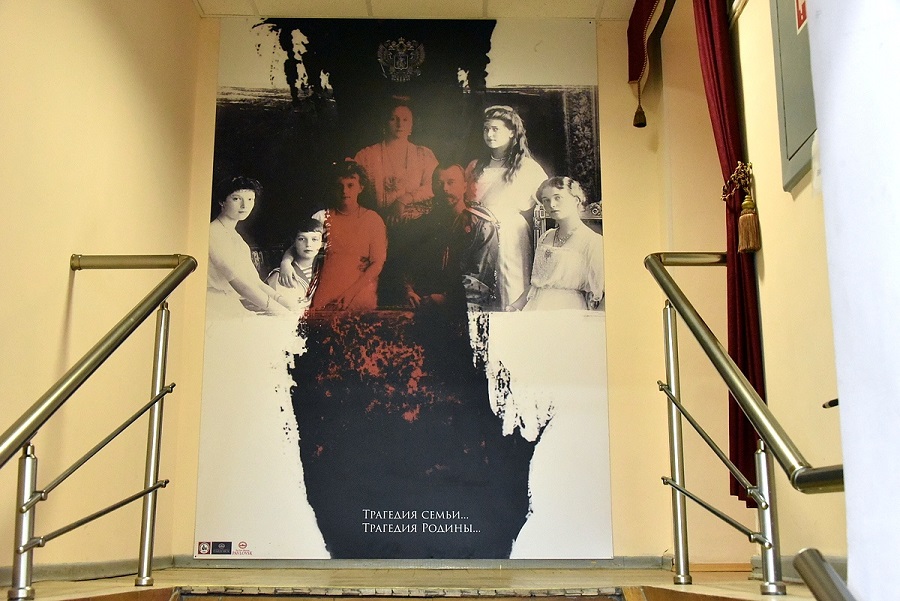
The exhibition project The Tragedy of the Family … The Tragedy of the Motherland, dedicated to the Romanov family, opened on 5th June 2018 in the Ural city of Ekaterinburg.
The venue for the exhibition is the Poklevsky-Kozell House – a branch of the Sverdlovsk Regional Museum. The exhibit is a joint historical and art project with the Pavlovsk State Museum-Reserve, and the Elisavetinsky-Sergievskoe Enlightenment Society.
Visitors to the exhibition can acquaint themselves with the private life of members of the Imperial family in the palaces of St. Petersburg, Tsarskoye Selo, Peterhof and Pavlovsk. The exhibition presents more than 150 unique items, including examples of fine and applied art, watercolours and amateur photographs, lovely trinkets from private collections and priceless gifts to the emperor, the Empress and their children.
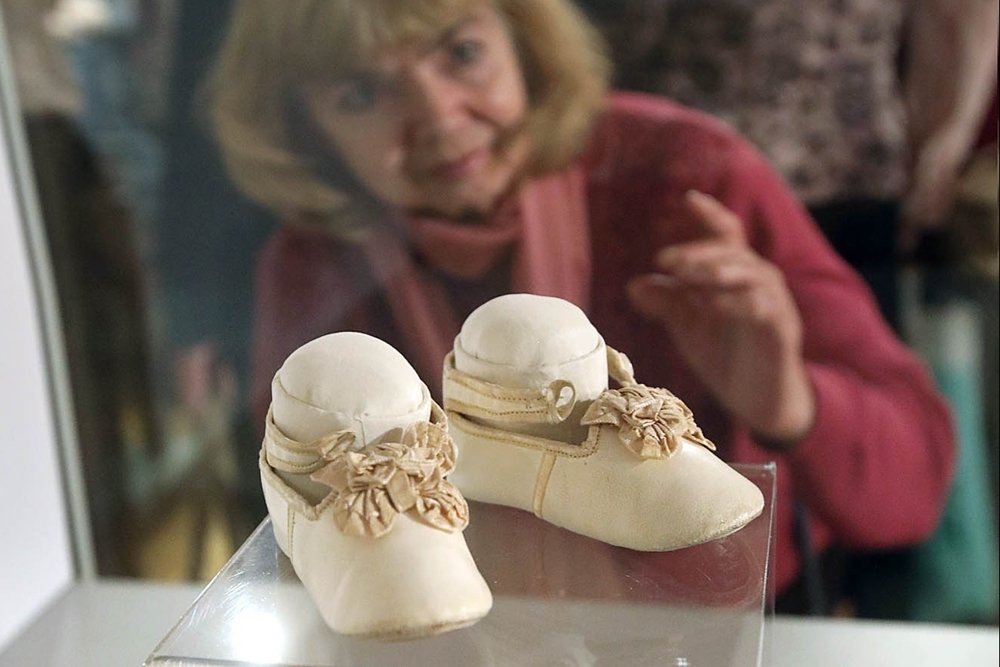
For the first time in the Urals, numerous well-executed original photographs taken by court photographers are exhibited: a portrait of a young Tsesarevich Alexei, ordered by the Empress herself. The photograph in an elegant frame, accompanied Alexandra Feodorovna from Tsarskoye Selo first to Tobolsk, then to Ekaterinburg, and now stored in the collection of the Pavlovsk State Museum-Reserve. Also among the exhibits are the beautifully preserved children’s shoes of Grand Duchess Olga Nikolaevna and a house dress of the last empress, in which only the closest people saw her; two silver cigarette case of Nicholas II, one of which he had with him during his internment in the Ipatiev House. Also on display – for the first time – is a unique, rare banner with the Romanov emblem, made for the 200 year anniversary celebrations of 1913.
The exhibition The Tragedy of the Family … The Tragedy of the Motherland ran from 5th June to 23rd September 2018, in the Poklevsky-Kozell House in Ekaterinburg.












You must be logged in to post a comment.